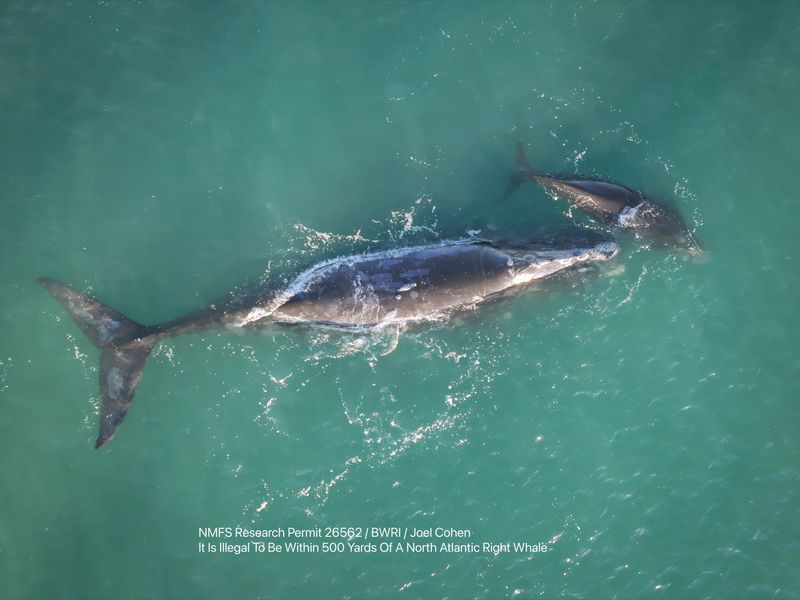
One of Florida’s largest snowbirds is experiencing a banner year. The number of North Atlantic right whale calves born this season is the highest in 17 years.
On March 14, an aerial survey team from the Florida Fish and Wildlife Conservation Commission spotted a right whale and her new calf about a quarter mile off Crescent Beach, marking 23 calves so far this calving season. The mother is 10 years old and this is her first known calf. She was last seen on Feb. 12, without a calf, making this baby a month old or less. In 2009, there were 39 calves born, according to NOAA Fisheries.

The right whale calving season begins in mid-November and runs through mid-April. The whales migrate to Florida, Georgia and South Carolina coastal waters from winter through spring to give birth, making the territory the only known calving ground for the species.
Right whales migrate to Florida, Georgia and South Carolina
North Atlantic right whales are among the most endangered whales in the world, and deaths are outpacing births. Of the 370 whales left, there are only 70 reproductive females, and a below-average number of calves being born in recent years, according to NOAA.
Every single female North Atlantic right whale and calf is vital to this endangered species’ recovery. Since 2017, the whales have been experiencing an “Unusual Mortality Event,” which has resulted in more than 20 percent of the population being sick, injured or killed. The primary causes of the mortality event are entanglements in fishing gear and collisions with boats and ships.
Fewer calves impacts the ability of the species to recover. Female right whales become sexually mature at about age 10. They give birth to a single calf after a pregnancy lasting over a year. Three to four years is considered a normal or healthy interval between right whale births. But now, on average, they are having calves every seven to 10 years. Biologists believe the additional stress from entanglements, vessel strike injuries and changes in prey availability due to climate change all likely contribute to fewer births.
With the current number of females and the necessary resting time between births, 20 newborns in a calving season would be considered a relatively productive year. However, given the estimated rate of human-caused mortality and serious injury, about 50 or more calves are needed per year for many years to stop the decline and allow for recovery, according to NOAA Fisheries. The only solution is to significantly reduce human-caused mortality and injuries, as well as stressors on reproduction.
North Atlantic right whales have calves off Florida
Every identified North Atlantic right whale has an assigned four-digit number in the Right Whale Catalog. Researchers assign names to whales that have a unique physical feature or a strong story in connection to a community or habitat where they were seen.
You can view mother-calf photos and stories from previous right whale calving seasons on the NOAA Fisheries archive page.
Mothers nurse their calves for about a year because it takes that long for them to learn to forage for food on their own, said Julie Albert, director of right whale sightings for the Blue World Research Institute. Being baleen whales, they are filter feeders that eat zooplankton.
This is an important time for conservation, with efforts focused on reducing vessel strikes and entanglements, as the species is critically endangered, Albert said. Sightings are most common along Florida’s northeastern coast.
Increasing levels of ocean noise is another concern because it may interfere with their communications and increase their stress levels, according to NOAA. Federal fishery agencies notify the military and shipping industry about traveling right whales’ locations, and there is technology to prevent entanglements, but it’s not mandatory for commercial fishers to use, Albert said.
Right whales hunted to the brink
By the early 1890s, commercial whalers had hunted the whales to the brink of extinction for their oil and baleen. They called them the “right” whales to hunt because they were slow and floated when they were killed.
With hunting banned in 1935, whaling is no longer a threat, but they have not recovered to pre-whaling numbers.
People are encouraged to report right whale sightings to the Blue World Research Institute’s hotline at 888-979-4253. People can also report right whales via a free interactive app called Whale Alert App. The app gives real-time alerts about whale locations and provides maps and whale identification guides.
Boat strikes have killed four calves, one juvenile and a mother in the past six seasons, said Joel Cohen, a videographer and photographer with Blue World Research Institute.
Tim O’Hara is TCPalm’s environment reporter. Contact him at tim.ohara@tcpalm.com.
This article originally appeared on Treasure Coast Newspapers: Florida sees record birthing season of North Atlantic right whales
Reporting by Timothy O’Hara, Treasure Coast Newspapers / Treasure Coast Newspapers
USA TODAY Network via Reuters Connect