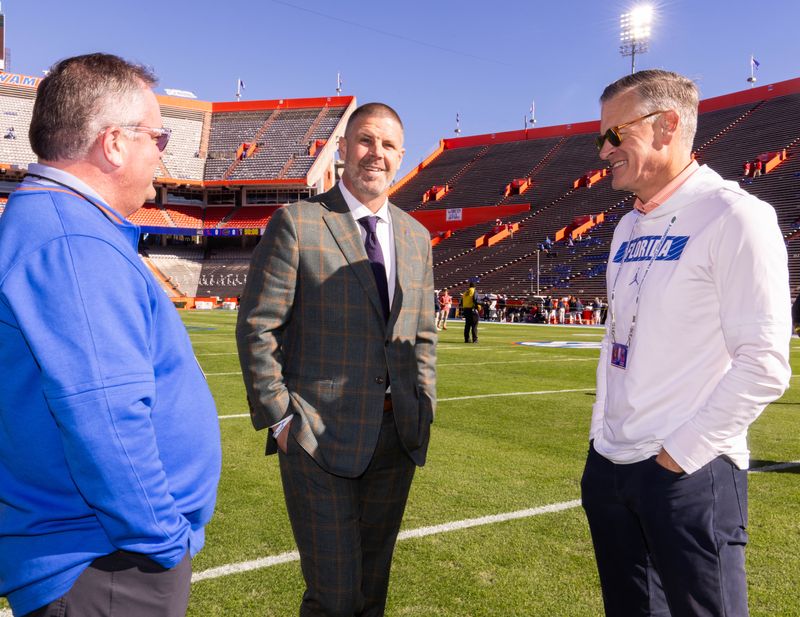
Florida athletic director Scott Stricklin remains committed to renovating The Swamp.
Speaking on the Gator Nation Football Podcast on June 25, Stricklin updated the status of the project and explained why seating capacity will need to be reduced at the home of Florida football, which currently seats 88,548.

“People ask, ‘Why do we need to do anything?,” Stricklin said on the podcast. “There’s about $500 million in deferred maintenance alone in this stadium. So, if you want to have that go to a safe environment that makes us all proud, we need to invest in it. And that’s all we’re doing; we’re re-investing in something that I think every Gator fan really holds dear ….
“And the minute we start addressing deferred maintenance, we’re going to trigger federal code related to the Americans with Disabilities Act and that right there reduces the seat capacity by thousands. Adding ADA seats, widening aisles—and so that’s if we add no chair backs anywhere in the stadium. That’s just a reality that we’re dealing with. That’s not something I dreamed up. We can sit there and just not touch it and let it fall into disrepair, or we can finally address it and try to do something in a thoughtful manner that makes The Swamp stay The Swamp and try to minimize that impact as much as possible.”
Reducing capacity at the iconic home of the Florida Gators has been a hot-button topic among fans who believe the atmosphere and crowd noise contribute heavily to UF’s home field advantage. Florida has gone 14-6 in three seasons at The Swamp under head coach Billy Napier, which has included upsets over ranked teams Utah, Tennessee, LSU and Ole Miss. EA Sports recently rated The Swamp as the seventh-toughest venue to play in college football entering the 2025 season.
Stricklin said the goal in the renovation is to minimize the loss of capacity, which early estimates have at 83,000 post-renovations.
“From a fan standpoint you’re going to have the same experience in the bowl,” Stricklin said “The stadium is going to be louder, the concourses are going to be wider, they’ll have more and better concessions, more and better restrooms, the outside’s going to look a lot more unified, the video boards will be bigger, they’ll be wider, you’ll have more square footage, you’ll have more ribbon boards, you’ll have better audio and sound,” Stricklin said. “Everything that touches a fan they’ll be able to enjoy. There will be a new structure built to accommodate some of the seat loss that the ADA code will impact.
“But it’s going to be the most ambitious project in the history of college athletics. And I think it’s going to be a model — once we accomplish it — that all these schools that have 100-year-old stadiums are going to come look at and try to figure out how we did it, because I think it’s going to be really impactful and it’s something Gators are going to feel really good about for a long time.”
What’s the timeline on The Swamp renovation?
Stricklin said the project is currently in design development phase, which will wrap up in the fall.
“At that point, we will have a really good sense on a budget, on what we’re going to actually do,” Stricklin said.
A planned budget of $400 million was proposed on June 5 at a University of Florida Board of Trustees meeting, with phased completion from 2026-28. Costs, though, could run higher depending on the extent of the project. Florida State recently spent $450 million for a renovation on the west side of Doak Campbell Stadium that will be unveiled this fall.
Last week, Stricklin was asked the challenge of fundraising for The Swamp renovation while dealing with the House vs. NCAA Settlement in which Florida will provide $20.5 million in direct financial compensation to athletes annually starting on July 1.
“That’s part of the trick,” Stricklin said. “There’s no easy solutions. There is demand for what’s provided when people come to a football game at Ben Hill Griffin Stadium and that demand seemingly continues to grow. I think there can be a multiplier off that because I think our program now is in position where it’s going to be a lot of fun, even more fun, coming to The Swamp than it has been. So we’ve got to be really creative and aggressive and come up with a really good plan.”
Stricklin pointed to the construction and amenities of Condon Family Ballpark as an example of how a new, modern facility can generate both excitement and revenue.
“Our game day revenue from the last year at McKethan Stadium to the first year at Condon Ballpark was 7X (times),” Stricklin said. “So, a lot more people are coming out but they are willing to pay more, it just drives revenue. That’s why it’s really important that you don’t just spot paint on this thing and you really have a plan that keeps what is special about The Swamp but extends the useful livelihood of the facility for 50 years.”
Kevin Brockway is The Gainesville Sun’s Florida beat writer. Contact him at kbrockway@gannett.com. Follow him on X @KevinBrockwayG1. Read his coverage of the Gators’ national championship basketball season in “CHOMP-IONS!” — a hardcover coffee-table collector’s book from The Sun. Details at Florida.ChampsBook.com
This article originally appeared on The Gainesville Sun: Florida AD Scott Stricklin explains why Swamp renovation will result in reduced seating capacity
Reporting by Kevin Brockway, Gainesville Sun / The Gainesville Sun
USA TODAY Network via Reuters Connect