Are you familiar with the expression “once in a blue moon”?
If there’s a second full moon in a month, it’s known as a blue moon. It’s a rare occurrence.

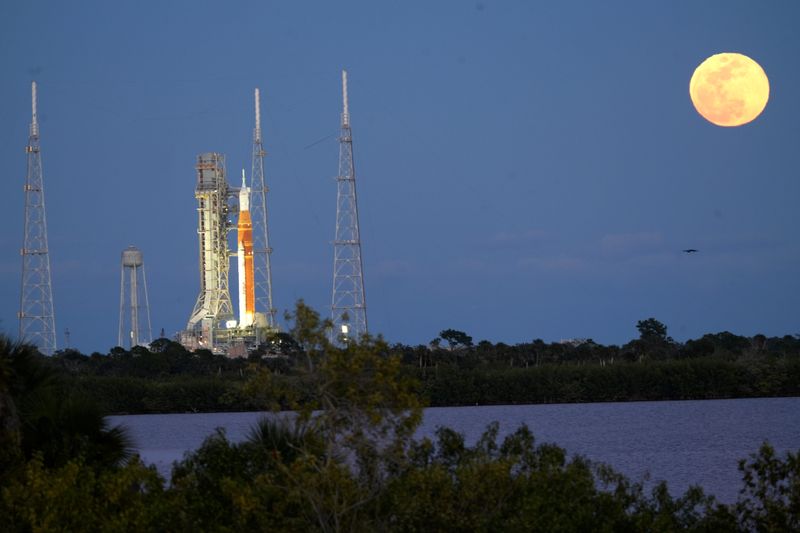
This month, not only will we have a blue moon, but it’ll be a micromoon.
➤ Here’s how to spot the International Space Station from Florida
The first full moon of May, the flower moon, occurred May 1. The blue moon is coming May 31.
When should you head outside to see it, and will we be able to see it in Florida?
When will be May’s blue moon?
The next full moon will peak at 4:45 a.m. ET May 31.
Because it’s the second full moon to occur in May — the first was on May 1 — it’s known as a blue moon.
As if that weren’t enough, it’ll also be a micromoon.
How rare is a blue moon?
According to NASA, a blue moon happens every two to three years.
It will be awhile before we see the next blue moon but it will be remarkable, if nothing else for its timing.
The next blue moon will occur on New Year’s Eve, Dec. 31, 2028.
What is a micromoon?
Because the moon follows an elliptical path — not a perfect circle — around the Earth, there are times when it’s very close to Earth and times when it’s much farther away.
At its closest approach — known as perigee — it’s called a supermoon.
When the moon is at its farthest distance from Earth — known as apogee — it’s called a micromoon.
How far from Earth will be May’s micromoon?
On May 31, the moon will be be 252,360 miles away from Earth, compared to the average distance of 238,900 miles, according to earthsky.org.
Just as a supermoon makes the moon look much brighter and bigger, a micromoon appears smaller and dimmer, according to Old Farmer’s Almanac.
A full micromoon appears about 12% to14% smaller than a full supermoon, or about 7% dimmer than an average full moon, according to earthsky.org.
Will blue moon be visible in Florida?
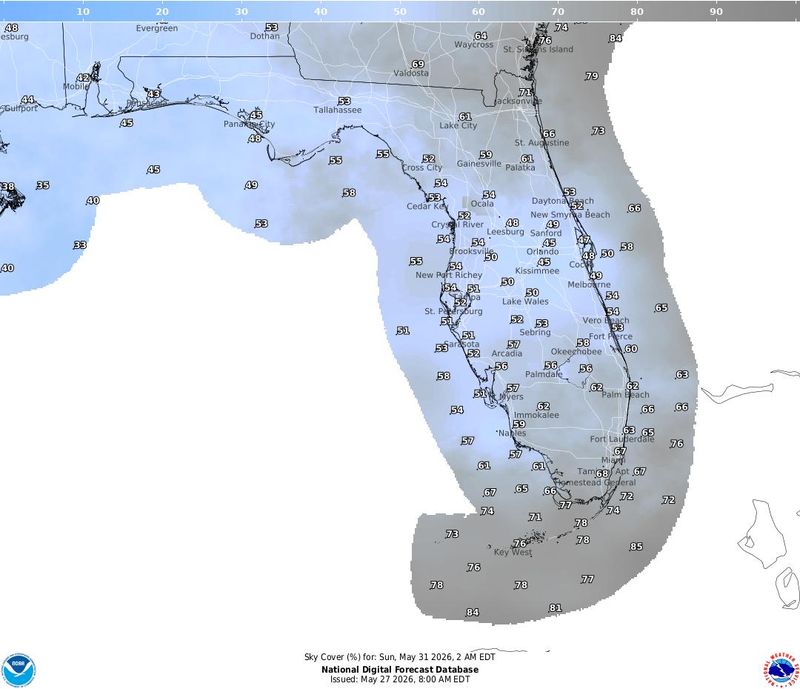
Rain is predicted across much of Florida for the last week of May and into the first part of June.
➤ Who’s ready for some rain, but will Florida soon see flooding?
The long-range forecast for May 31 shows clouds may obscure your view of the blue moon, especially in North and South Florida.
Slightly fewer clouds are predicted in the Panhandle and Central Florida so residents may be able to spot the moon if there are any breaks.
While the peak will occur at 4:45 a.m. ET May 31, to the naked eye, the moon will still appear full for a day before and day after its peak, according to timeanddate.com.
When are full moons in 2026?
Here’s when to expect each full moon this year:
Total solar eclipse coming in August 2026
A total solar eclipse will occur Aug. 12, 2026.
➤ Fun fact: A solar eclipse always occurs about two weeks before or after a lunar eclipse.
A partial lunar eclipse will occur Aug. 27, 2026.
Where is path of totality for 2026 total solar eclipse?
The path of totality for the total solar eclipse will be across Greenland, western Iceland and northern Spain, according to space.com.
Will the total solar eclipse be visible in Florida, US?
Sorry, but seeing even a partial solar eclipse won’t be possible in Florida.
Visibility in the U.S. will be limited to the Northeast and Alaska, according to timeanddate.com.
➤ See cities, states with view of a partial solar eclipse
Partial lunar eclipse coming in August 2026
A partial lunar eclipse will occur Aug. 27-28, 2026, and this will be visible across North America.
Will partial lunar eclipse be visible in Florida?
The partial lunar eclipse will begin at 9:23 p.m. ET Aug. 27 and ends at 3:01 a.m. Aug. 28.
It will be visible in Florida, although residents along the east coast may miss some of it since the moon may be low on the horizon during the peak portion of the eclipse.
Florida residents can expect to see about 93% of the moon to be in the Earth’s shadow, according to timeanddate.com.
➤ See view and timing from where you live
What is a lunar eclipse?
A lunar eclipse happens when the Earth passes between the sun and the moon, creating a shadow across the lunar surface.
Cheryl McCloud is a journalist for the USA TODAY Network-Florida’s service journalism Connect team. You can get all of Florida’s best content directly in your inbox each weekday day by signing up for the free newsletter, Florida TODAY, at https://floridatoday.com/newsletters.
This article originally appeared on Florida Today: Don’t miss this rare lunar event. Here’s when to look up in Florida
Reporting by Cheryl McCloud, USA TODAY NETWORK – Florida / Florida Today
USA TODAY Network via Reuters Connect