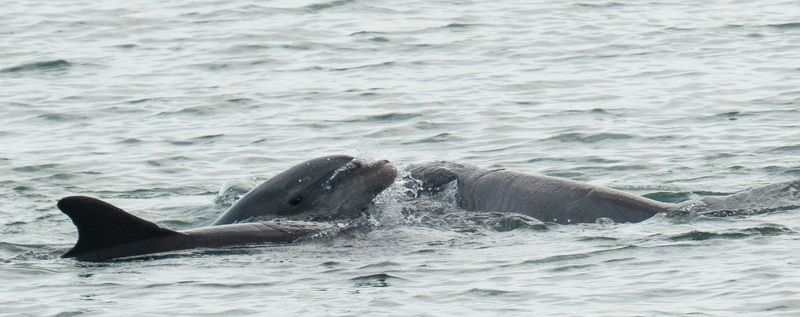
Why dolphins sometimes strand themselves on shore, often to die, has long troubled scientists and beachgoers alike.
A recently published article explores whether their brains may warn that Florida’s algae blooms pose not just ecological risks, but neurological ones as well. Researchers posit the doomed marine mammals might have dementia caused by toxins produced by cyanobacteria, commonly called blue-green algae.

On Saturday, one of the paper’s authors, University of Miami researcher David Davis, will speak about the research at Calusa Waterkeeper’s quarterly “State of our Water” event.
For the study, scientists examined 20 bottlenose dolphins stranded in the east coast’s Indian River Lagoon. They found their brains contained a toxin produced by cyanobacteria. The toxic amino acid, beta-N-methylamino-L-alanine, and related molecules, can damage neurons and are linked to such neurodegenerative diseases as Parkinson’s, Alzheimer’s and ALS.
Florida dolphins with ‘similar markers to humans that have Alzheimer’s’
In experimental animals, BMAA has been shown to trigger “Alzheimer’s-like neuropathology and cognitive loss,” according to Brain Chemistry Labs, a nonprofit involved in the paper’s research. In the ocean system, the toxins can become biomagnified – increasingly concentrated – in animals higher up the food chain. As top predators, dolphins would be getting higher doses from their prey.
The researchers found that the brains of dolphins stranded during the summer blue-green algae bloom season had 2,900 times the concentration of one of the toxins compared with those from non-bloom seasons.
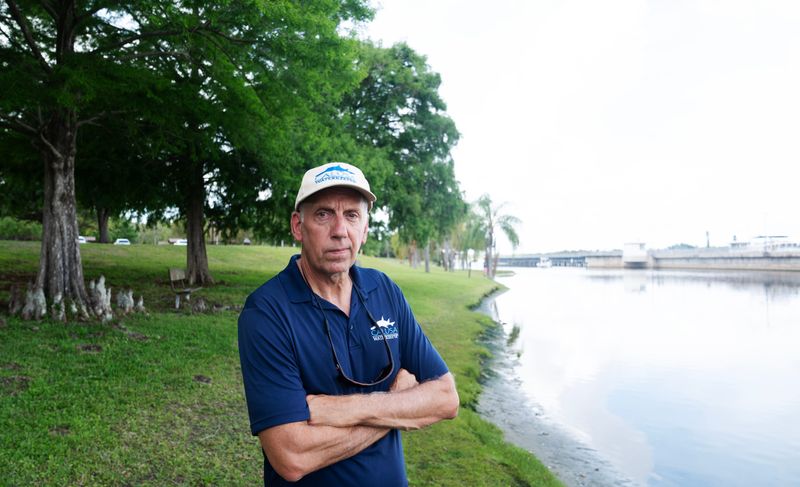
What might be the implication for humans? “So far, I think (Davis and colleagues) has found a causal link between blue-green algae blooms and dolphins in the area that have similar markers to humans that have Alzheimer’s,” said Calusa Waterkeeper Joe Cavanaugh, “and those markers have been found in the necropsies (post-mortem exams) of brains of dolphins that were in the Indian River Lagoon at the same time there was a very healthy blue-green algae bloom.”
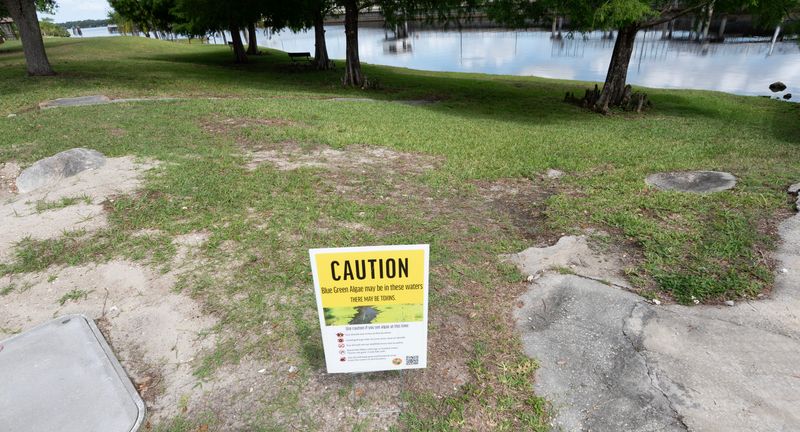
Davis’ talk will highlight the “potential health implications for us – for people living on the canals,” Cavanaugh said – even for people living not so close to canals. “Aerosolized toxins we know can travel up to four miles from the source, … so even if you’re inland, say in Fort Myers or Alva, you could have impacts from short-term exposure. (With) the respiratory system, exposure is much quicker and more impactful in a negative way to human health,” he said. “People should know, especially visitors, snowbirds and people who live here.”
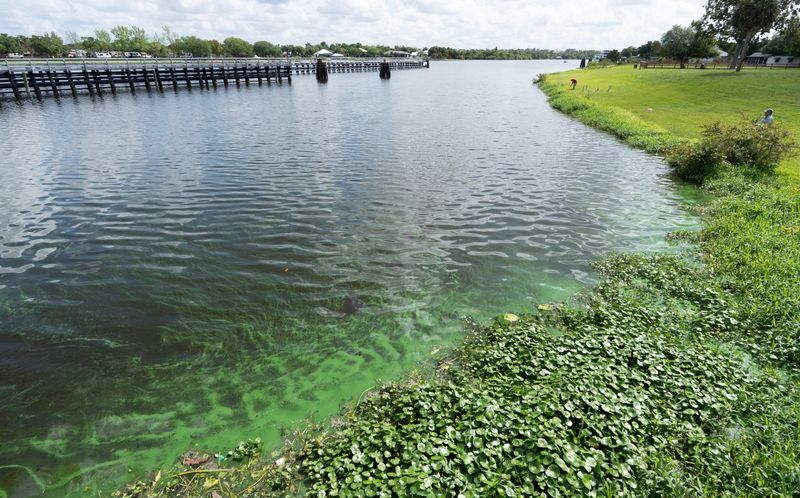
He points out that there was a blue-green algae bloom in the Caloosahatchee this year that started earlier and was more widespread than many in the past. “Lots of people were here and for the first time, lots of snowbirds were exposed,” he said. “I think it’s really important that people are aware of what the potential health impacts could be.”
How comparable are the two waterbodies? Cavanaugh says they both have nutrient pollution – “heavy loads of phosphorous and nitrogen that then feeds algal blooms (which) proliferate very quickly because they’re saturated with these nutrients” – and many of the same species of blue-green algae … we have the same bottlenose dolphins they have in the Indian River Lagoon.”
As for people, “There is a human health concern based on what Dr. Davis is seeing with dolphins in terms of ingesting fish. Obviously if you’re fishing and you’re eating fish … that’s a direct source.”
But it’s not the only source, Cavanaugh says, and this is where Calusa Waterkeeper’s research intersects with Davis’.
“The other source of contamination is aerosolized toxins, and that’s something we’re looking at,” Cavanaugh said.
How much algae toxin is in the air? Florida agencies don’t test that
So far, there have been fewer studies of the potential effects of airborne algal toxins, “but that research is catching up quickly,” Cavanaugh said. “So now Dr. Davis is taking it the next step of what could those potential impacts be to humans.”
Besides the known hazards of swallowing algae or its toxins, the risks of breathing them are much less clear, and many questions remain – questions that universities like FGCU are working to answer.
What we do know: Algae toxins can become airborne when tiny droplets or particles from bloom-affected water are lofted into the air by wind, wave action, spray or bursting bubbles. People and animals can then inhale them.
But just how much winds up in the air? How dangerous is that?
State agencies don’t know.
“DOH-Lee does not conduct testing for aerosolized cyanotoxins,” the Florida Department of Health’s Lee County office wrote in an email. And though Florida’s Department of Environmental Protection hadn’t answered calls and emails by publication, it hadn’t done so in the past either.
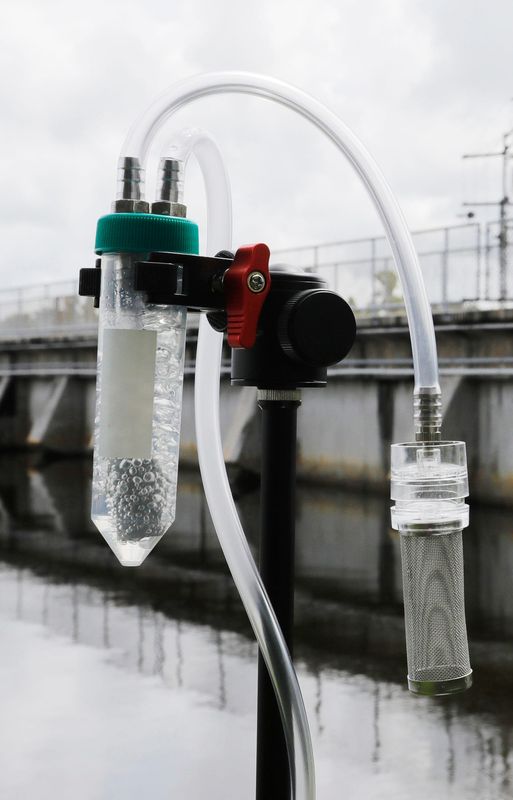
Enter Calusa Waterkeeper. It’s working to do what the state doesn’t: test the air for toxins produced by cyanobacteria.
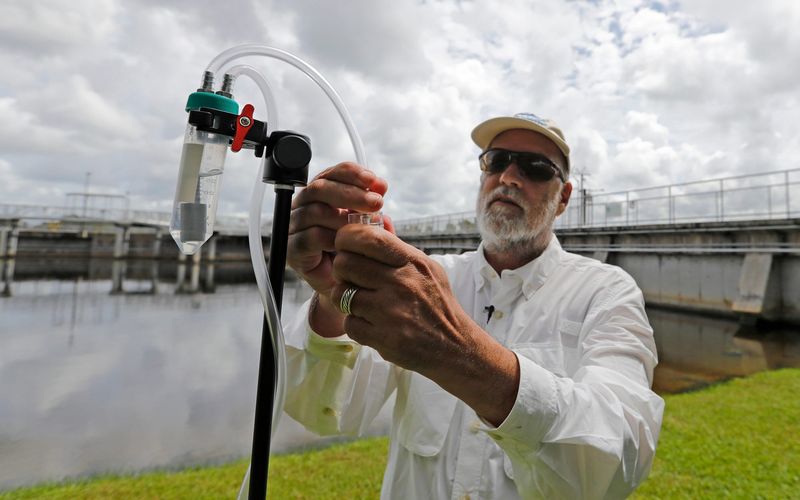
Five years ago, the group designed and created a first-of-its kind sniffing device to test the air around blooms for toxins, engineering and building a portable toxin sensor, dubbed ADAM for Aerosol Detector for (Harmful) Algae Monitoring.
That do-it-yourself ethic has come to characterize the nonprofit, which operates on a slim budget, but packs a punch of scientific firepower.
A big limitation so far has been the budget: ADAM produces samples that are pricey to test, so its use has been limited. But Cavanaugh is working on grant funding and is rebooting the ADAM task force along with a strategic plan for its use.
“We really want to get it out there,” he said.
Five questions for University of Miami researcher David A. Davis
Q: Your dolphin work is rooted in the Indian River Lagoon, which has its own hydrology, bloom history, salinity swings and residence times. When you think about Southwest Florida’s Caloosahatchee estuary, with freshwater pulses from Lake O, different cyanobacteria dynamics, and bloom transport into the lower estuary, how comparable do you believe the exposure risk is? Are these systems biologically similar enough that your findings should raise concern on the Gulf coast?
A: Our study focused on a toxin call 2,4-DAB, a structural isomer to a neurotoxin commonly known as BMAA. 2,4-DAB is produced by cyanobacteria, diatoms as well as dinoflagellates, which have been identified in blooms on the Gulf coast. Although our study focused on the Indian River Lagoon, we can predict 2,4-DAB would also be produced during bloom seasons on the Gulf coast. However, more research is needed to understand the relative amounts of 2,4-DAB and potential for exposure compared to the Indian River Lagoon.
Q: One of the questions my readers here will immediately ask is whether shorter-term residents – our snowbirds who spend three to six months a year in Southwest Florida during bloom-prone seasons – face any meaningful neurological risk, or whether the concern is more about lifelong cumulative exposure. Based on what’s known so far, how should we think about duration, frequency, and timing of exposure?
A: Our study was designed to understand how chronic seasonal exposure to a harmful algal bloom toxin may impact the brain health of dolphins. It is difficult to relate this finding to shorter-term health risks in human.
Q: In dolphins, you’re looking at animals immersed in bloom-affected water consuming prey from the same food web, so exposure is chronic and multi-route. Humans on the Southwest coast may instead be inhaling aerosolized cyanotoxins near shorelines, canals, or estuaries. How different do you think those exposure pathways are biologically, and what do we still not know about the neurological implications of inhalation alone? I.e.: Is inhalation exposure enough, by itself, to plausibly produce the kind of Alzheimer’s-like signatures you saw in dolphins, or do you suspect the food-web accumulation route is doing most of the damage?
A: Exposure to cyanotoxins can be multifactorial combining different routes of entry to the brain. Magnification of cyanotoxins in the food-web is a major concern because of the potential of eating a large amount of toxin at once. However, inhalation exposure is also possible during harmful algal blooms, well-documented, and provides a higher rate of bioavailability for the toxin. Both routes of exposure are central to investigations on how cyanotoxins cause harm. In principle, once the toxin reaches the target organ it will have the same biological effect on gene expression.
Q: I’m particularly interested in how this might be tied to what Calusa Waterkeeper’s ADAM device is showing. It’s now measuring airborne cyanotoxins around blooms in the Caloosahatchee, its tributaries and canals. If you were designing the ideal follow-up study for Southwest Florida, what would you most want to measure: toxin species, aerosol concentration, repeated human exposure, biomarkers, sentinel species, medical outcomes, something else?
A: All of these topics are very important for understanding the risk of cyanotoxins on human health. I would also add that more research is needed to understand the impact of exposures to multiple cyanotoxins.
Q: At this stage, is there any evidence for neuroprotective strategies against cyanotoxin exposure – whether behavioral, like avoiding bloom aerosols, or biological, such as compounds that help with oxidative stress or blood-brain barrier injury? Or supplements like L-serine? Or is the science simply not there yet?
A: Neuroprotective strategies to cyanotoxins are an emerging field of research. There is evidence suggesting that the effects of cyanotoxins can be mitigated. However, more data is needed to understand how these toxins effect the brain and which populations are more susceptible to them. Currently, the best strategy is to reduce one’s exposure.
If you go
Register to hear Dr. David A. Davis at Calusa Waterkeeper’s State of Our Water meeting, 9:30 a.m.-noon, Sat., April 11 in room U-102, Florida SouthWestern State College, 8099 College Parkway, Fort Myers. Call 239-899-1440 or email info@calusawaterkeeper.org
Amy Bennett Williams is a senior reporter. Reach her at at awilliams@news-press.com.Do you have an opinion about this topic? Write a letter to the editor and send it to letters@naplesnews.com and/or mailbag@news-press.com. Keep it to 250 words or fewer and include your contact info. Have more to say: Send a guest column of no more than 600 words.
This article originally appeared on Fort Myers News-Press: Dolphin dementia: Florida scientist to share research, talk about algae
Reporting by Amy Bennett Williams, Fort Myers News-Press & Naples Daily News / Fort Myers News-Press
USA TODAY Network via Reuters Connect