Jacksonville City Council President Kevin Carrico exchanged text messages with two City Council members about legislation during a council committee meeting, even though long-standing guidance from city lawyers has been for council members to never use text messages for official business.
In addition to the advice by the city’s Office of General Counsel, the state’s Government in the Sunshine Manual says a government board should not “take part or engage in private discussions of board business” by using text messages.

Carrico said the text messages sent during the Aug. 4 meeting of the council’s Neighborhoods Committee were about the legislative process rather than the substance of the legislation.
“As council members, we take Florida’s Sunshine Law seriously and are all trained on its requirements,” he said in a statement. “The brief, transitory exchange in question was procedural in nature and did not involve policy deliberations. Out of an abundance of caution, these messages have been provided to council staff for inclusion in the official record to ensure full transparency.”
An October 2015 memo by the city’s Office of General Counsel to City Council members said it is “never permissible” for council members to text each other about official business.
“Texting between Council Members carries with it an extraordinarily high risk that such messages would be considered unlawful,” wrote Jason Gabriel, who was the city’s general counsel at the time.
Gabriel sent that 10-page memo after a series of stories by the Florida Times-Union found the then-president of the firefighters union used text messages to relay communications between council members during a meeting when they voted on legislation regarding the rank of 17 recently promoted fire chiefs.
What did council members say from dais during meeting?
In the recent case of texting, the exchange of short messages happened while the Neighborhoods Committee discussed legislation sponsored by Carrico for changes in the Public Nuisance Abatement Board’s operations.
That legislation (2025-435) previously had been set for a vote by the full City Council on July 22 when Carrico sent it back to committees so City Council member Jimmy Peluso, the bill’s co-sponsor, could revisit it and propose amendments to the bill.
When the Neighborhoods Committee took up Peluso’s amendments at the Aug. 4 meeting, several council members wanted to know how Carrico, who was not in attendance, stood on the proposed amendments.
“It’s my understanding that President Carrico is OK with this bill and the amendments since he’s the bill sponsor,” City Council member Ron Salem said.
“I believe so, yes,” said Assistant General Counsel Laura Hartung, who worked with Peluso on drafting the language for the amendments.
“OK, just want to make sure that’s the case before I vote ‘yes,'” Salem said.
City Council member Randy White followed up by saying he wanted to know more about Carrico’s position.
“The ‘I believe so’ comment does not have me real comfortable until I hear from Carrico,” White said.
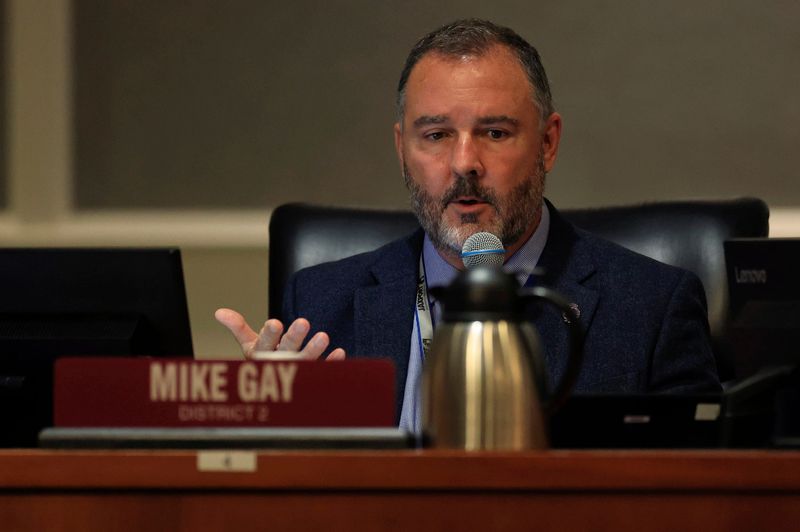
City Council member Mike Gay, who is chairman of the Neighborhoods Committee, then told the committee, “I did receive a text from President Carrico saying he’s good with that.” The committee subsequently voted unanimously for the amended version of the bill.
What were council members writing in text messages?
In response to a Florida Times-Union public records request, City Council members provided copies of the text messages sent during the committee’s discussion of the bill.
“Are you okay with Peluso’s amendment on 2025-0435,” Gay texted to Carrico in reference to the bill’s identification number.
“Yup, he worked with Josh and OGC kept me in the loop,” Carrico texted to Gay.
OGC is the abbreviation for Office of General Counsel. Peluso worked with Josh Cockrel, the chairman of the Public Nuisance Abatement Board, on the amendments.
Carrico sent a second text to Gay that said, “For the record my ok was speaking in a procedural manner since I did send the bill back to committee. I assumed you were asking if I was ok with moving forward and accepting amendments.”
Salem also reached out to Carrico via text.
“Are you ok with 435 at this point? In neighborhood,” Salem texted.
“Yes all good,” Carrico replied.
Council members say texts were about procedural matters
In statements about the texts, Gay and Carrico made a distinction between communications about council procedures versus the substance of a bill.
“I fully understand the requirements of the Sunshine Law,” Gay said. “My inquiry was procedural as President Carrico was the bill introducer.”
Salem said he reached out to Carrico because a council member who does not sit on the Neighborhoods Committee was seeking to offer an amendment.
“Because this action falls outside the standard Rules of Council, I was conferring with the council president to confirm whether he approved the procedure and whether the amendment could be properly offered,” Salem said.
“This was a procedural discussion with council President Carrico — similar to others I’ve had in the past while serving as council president myself,” Salem said. “It is my understanding that procedural discussions of this nature may be conducted outside of the Sunshine Law.”
General Counsel Michael Fackler said it’s not the role of his office to determine whether the Sunshine Law prohibits or allows the text messages sent during the Neighborhoods Committee. He said those determinations on Sunshine Law come from the State Attorney’s Office.
He said the guidance spelled out in Gabriel’s memo in 2015 is still what the Office of General Counsel recommends.
“Jason’s memo is pretty thorough,” Fackler said. “I don’t think there’s anything wrong with that memo. I will say that. The Sunshine Law is what it is.”
This article originally appeared on Florida Times-Union: City Council president and two council members texted about bill as committee discussed it
Reporting by David Bauerlein, Jacksonville Florida Times-Union / Florida Times-Union
USA TODAY Network via Reuters Connect