

There’s a lot University of Florida researchers know about spectacled caimans.
But there’s a lot they don’t know.

Yet.
So they can use your help.
➤ Alligators, crocodiles beware. Spectacled caimans moving into Florida
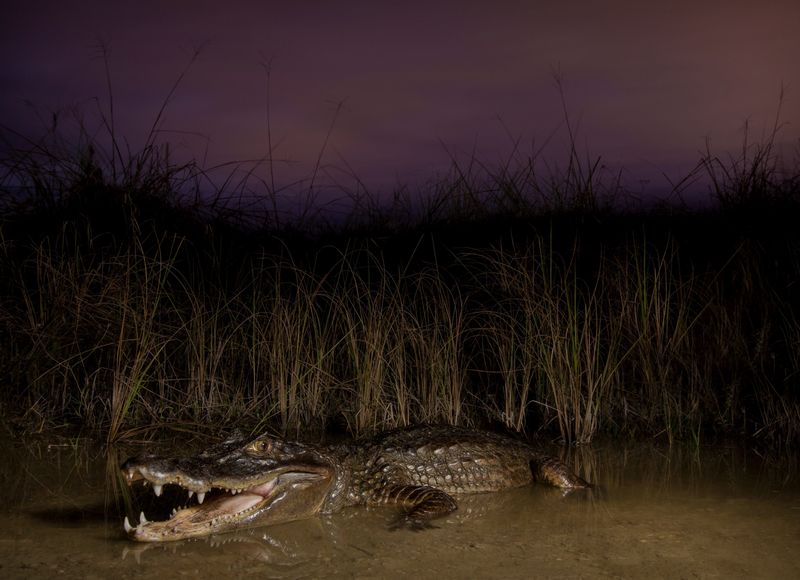
Spectacled caimans aren’t new to the Sunshine State, but this invasive species related to Florida’s alligators and crocodiles, has established breeding populations in South Florida and may pose new challenges for Everglades restoration.
What is a spectacled caiman?
Originally from Central and South America, the spectacled caiman is another crocodylian — a smaller relative of the American alligator — that has been in the pet trade since the 1950s, with established populations in Florida documented since the 1970s, according to the report.
It has one of the widest ranges of all crocodylians in the Americas, spanning 17 countries from Mexico to Brazil.
Spectacled caimans firmly established in Florida Everglades
“In the canals, wetlands and marshes of the Florida Everglades, the spectacled caiman has quietly expanded its foothold threatening an already-vulnerable ecosystem,” according to UF researchers.
A University of Florida study synthesizes more than 70 years of research on the invasive species native to Central and South America that has firmly established itself across the most vulnerable part of the Sunshine State — the Florida Everglades.
“Researchers at UF’s Institute of Food and Agricultural Sciences in Fort Lauderdale say the reptile may further complicate the Comprehensive Everglades Restoration Plan (CERP) — the largest wetland project in the history of the United States.”
What is the Everglades Restoration Plan?
“In 2000, Congress approved the Comprehensive Everglades Restoration Plan to restore, preserve, and protect the South Florida Ecosystem, while providing for other water-related needs of the region,” according to evergladesrestoration.gov.
Researchers get some answers but have lots of questions about Florida’s spectacled caimans
“We now know the spectacled caiman is established in more areas than we previously thought,” said Sergio Balaguera-Reina, lead author of the study, a co-lead of The Croc Docs and research assistant scientist at the UF/IFAS Fort Lauderdale Research and Education Center.
“We also know that spectacled caimans are more adaptable than we previously understood.
“We still lack basic information about how this species may affect Everglades ecosystems. That is one of the most striking findings from this work.”
Researchers also know little about where spectacled caimans nest, how far they travel during seasonal periods or whether restored waterways could accelerate their spread into protected natural areas.
How could Everglades restoration affect spectacled caimans?
Researchers said they don’t know whether Everglades restoration efforts might create more or less suitable habitat for caimans.
“More study is needed to see how spectacled caimans will respond to restoration and affect native alligators, crocodiles and wildlife.
“We think caimans in Florida may move more than populations in their native range because of dry-down conditions in the Everglades,” Balaguera-Reina said. “This could potentially mean that they can disperse faster than we expect.”
Why do UF researchers say spectacled caimans may be ‘difficult to control’?
Researchers findings from the recent study “underscore the need for continued management and expanded scientific research before the species becomes even more difficult to control.”
Spectacled caimans in Florida originally were thought to come from Colombia. Researchers have since found genetic evidence showing origins from Brazil and Guayana. That’s not a good thing.
“These mixed origins may boost their adaptability, making it tougher to control,” Balaguera-Reina said.
Researchers plan to continue to track, tag spectacled caimans in Florida
Researchers plan to continue tracking spectacled caimans “to better understand their movements and how they use habitats.
Future projects include:
“These efforts are critical as wildlife managers try to reduce the spread, while protecting the Everglades restoration,” UF said.
How can public help researchers studying spectacled caimans?
“We want people to be aware that this species is present in the Everglades,” Balaguera-Reina said.
“Reporting sightings can help agencies and researchers respond quickly and better understand where populations are expanding.”
Report spectacled caiman sightings through the IVEGOT1 app or calling 1-888-IVEGOT1 (483-4681) or reporting on the EDDMaps website.
Cheryl McCloud is a journalist for the USA TODAY Network-Florida’s service journalism Connect team. You can get all of Florida’s best content directly in your inbox each weekday day by signing up for the free newsletter, Florida TODAY, at https://palmbeachpost.com/newsletters.
This article originally appeared on Palm Beach Post: Caimans may pose challenge in Everglades restoration. You can help
Reporting by Cheryl McCloud, USA TODAY NETWORK – Florida / Palm Beach Post
USA TODAY Network via Reuters Connect
By Cheryl McCloud, USA TODAY NETWORK – Florida | USA TODAY Network
