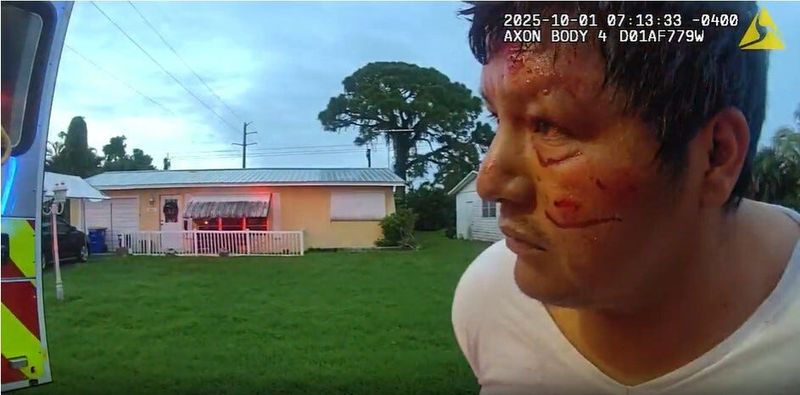
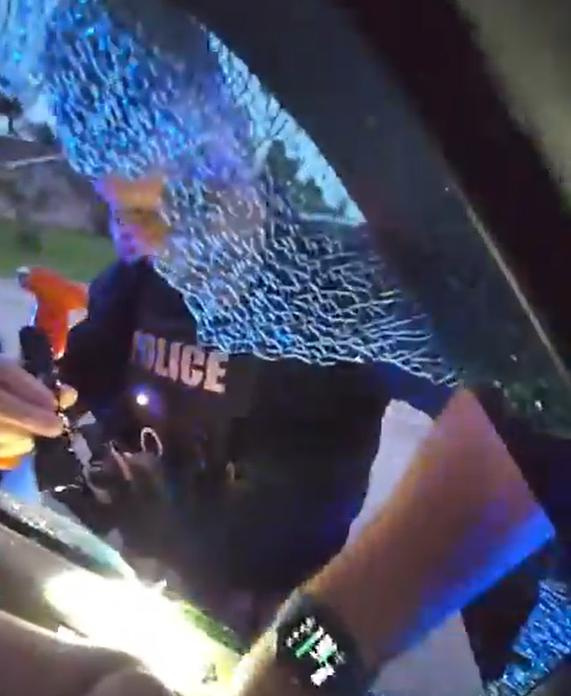
A Florida Department of Law Enforcement agent smashed a legal resident’s van window, dragged him through broken glass and pinned him face down on the ground as he wailed and bled from gashes, video shows.
FDLE records show the agent suspected Ernesto Puac Son, 33, of Stuart, was living in the country illegally, but court records show he has a work permit and a pending asylum case.

As officers sat Puac up on the ground, he said he’d never done anything wrong and that he’d worked 20 years as a roofer and 10 years to pay off his house, video shows.
Now the Martin County Jail will be his home for a year. He was convicted of resisting arrest with violence on Jan. 7.
“This is where we’re at,” a Martin County sheriff’s deputy who was assisting FDLE remarked.
‘You have no sheriff now,’ FDLE agent tells legal resident
The Oct. 1 arrest that left Puac’s face, back and arms gashed and his “blood everywhere” began when he didn’t come to a complete stop at a sign near his house on his way to work about 6:20 a.m., FDLE reports show.
He showed an FDLE agent a valid Florida driver’s license, but he refused to roll down his window or get out of his van, the report says. He began recording his own video on his phone and laid on his horn for 1½ minutes until an agent dragged him out, video shows. He was scared and signaling for help, he later told TCPalm.
“I thought they were going to send me to Guatemala and I would lose everything,” he said in Spanish from jail on May 29. “My business, all my customers, everything.”
He said he was confused when two sheriff’s deputies arrived to assist what he thought was an Immigration and Customs Enforcement agent.
“Sheriff, why are you working with him? Why?” video shows him saying.
“You have no sheriff now,” video shows FDLE Special Agent John Soltys responding.
Convicted of resisting arrest with violence
Puac locked his arms in the steering wheel as Soltys wrestled him, video shows.
“Let go or you’re going to break your arm,” Soltys said.
Puac bit Soltys’ arm and hit his face, and Soltys cut his forearms on the glass, FDLE reports say.
Those actions are not visible in Puac’s video nor the body-cam video released to TCPalm by the Sheriff’s Office, which redacted much of the audio and video, citing medical privacy and the protection of undercover agents.
FDLE did not respond to TCPalm’s questions, including why agents ordered Puac out of the van after a “rolling stop,” why they forcibly removed him, whether that aligns with agency policy, and whether there were alternatives.
“This just goes to show you how racial profiling works,” said Thomas Kennedy, a researcher with the immigrant-rights nonprofit Florida Immigrant Coalition. “Officers are like, ‘Well, he looks Hispanic, so we can take him to jail, put him on a detainer and violate his Fourth Amendment rights.’ ”
The Fourth Amendment protects everyone — regardless of legal status — from unreasonable government search and seizure.
FDLE surveilled house for 9 days for immigration arrest
For nine days before Puac’s arrest, FDLE surveilled his house to find his brother, Felipe.
Felipe had a deportation order, but no criminal history, court records show. Agents waited in unmarked cars outside Puac’s house and arrested Felipe when he left for work — at the same time as Puac.
“I saw everything,” Felipe told TCPalm in January from Guatemala, where he’d been deported. “It was an abuse of power. They broke his window and pulled him out on the ground like he was the worst criminal.”
Puac was afraid to get out of the van after watching agents place Felipe in an unmarked vehicle, he told TCPalm.
“I was in shock and began to panic,” he said. “I thought they were immigration, not police. If I knew they were police, I would have opened the door.”
How minorities interact with police differently
Research shows that compared to White people, Black and Hispanic people can experience greater fear and behave differently during law enforcement encounters, according to Cynthia Najdowski, head of the Department of Psychology at the University at Albany in New York.
Black and Hispanic people can experience “stereotype threat,” which raises their anxiety and strains their cognition, she said. That can impair their thinking, perception and decision-making.
“We shouldn’t expect everyone to react the same,” she said. “If you think you’re going to be dragged into a van and carried away to a detention center and potentially deported to an unknown country — that’s a lot to weigh on an individual’s decision to open the door.”
As three paramedics tended to his wounds, one asked Puac what happened and another questioned him about his behavior.
“They did this to me,” Puac said. “I’m going to sue you all.”
The Sheriff’s Office almost entirely censored its report, except for listing the victim as “society.”
FDLE acting as ICE agents; use of force increases
FDLE agents were acting as deputized immigration agents under the federal 287(g) program, which allows state and local law enforcement to stop, search and question people based on immigration status.
Puac’s arrest reflects what policing researchers say is a tactical shift since the Trump administration’s mass deportation campaign started last year. More legal residents and people with no criminal convictions are being detained and arrested, though the president and Florida governor insist they target only criminals and gang members.
Officers also are using more force, such as breaking windows, according to internal ICE memos obtained by Politico, a global nonpartisan investigative news organization. Data shows:
FDLE arresting legal residents with no criminal record
One example is a legal Stuart resident whom the Florida Highway Patrol tased in October. The Spanish-speaking woman didn’t comply with the English-speaking trooper’s order to place her hands behind her back as she watched her family detained for immigration violations, TCPalm previously reported. They charged her with resisting arrest.
In Puac’s case, Florida law allows officers to search vehicles with probable cause but without a judicial warrant. It does not specify when officers can break vehicle windows and forcibly remove someone.
“Do you guys, like, break windows for this stuff?” a deputy asks FDLE in the video. “What’s your protocol on that?”
The article continues below.
If they answered, it is not audible on the video. FDLE called ICE and asked for an administrative warrant, reports say.
Immigration officers, not judges, issue those warrants. So the same agency that requests them, approves them.
After nearly 3 minutes and repeated orders to get out of the van, Soltys warned Puac he was going to break the window.
“Sir, I’ve been very patient with you,” Soltys said. “You want to call your wife or somebody to get the vehicle? If you comply with us now, we’ll help you.”
Jack Lemnus is a TCPalm enterprise reporter. Contact him at jack.lemnus@tcpalm.com, 772-409-1345, or follow him on X @JackLemnus.
This article originally appeared on Treasure Coast Newspapers: FDLE breaks glass, drags legal resident through it after ‘rolling stop’
Reporting by Jack Lemnus, Treasure Coast Newspapers / Treasure Coast Newspapers
USA TODAY Network via Reuters Connect
By Jack Lemnus, Treasure Coast Newspapers | USA TODAY Network