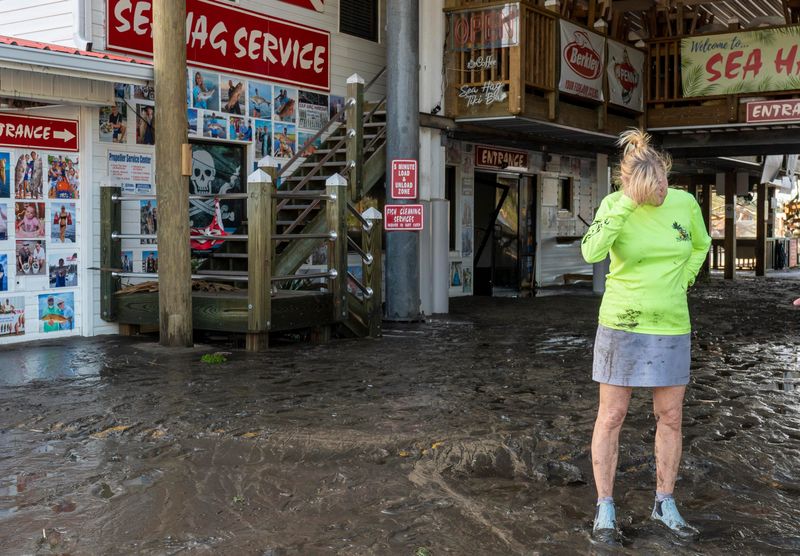
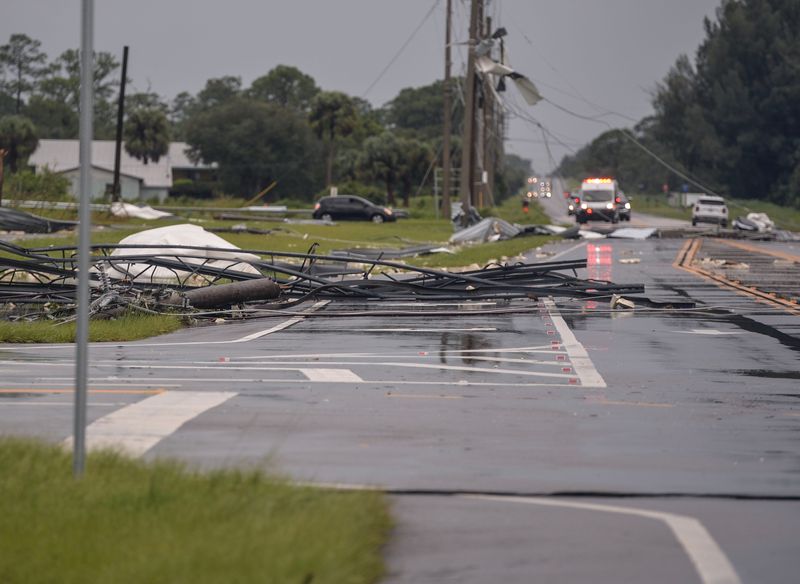
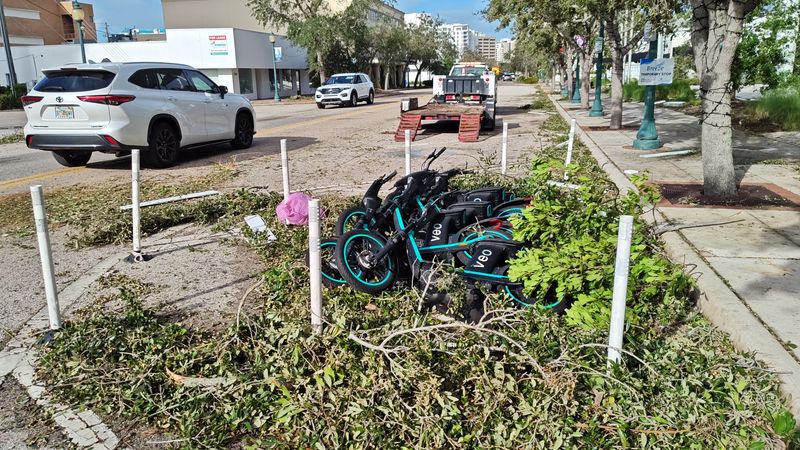
The docks piled like Lego blocks are gone and the Sea Hag Marina stands again — one beneficiary of $10 billion in federal emergency aid that’s flowed to Florida in the wake of three 2024 hurricanes that roared along the Gulf Coast.
It’s a far cry from the muddied and chaotic scene Danielle Norwood surveyed Sept. 27 in the aftermath of Hurricane Helene roaring along the Steinhatchee River’s banks. That’s where she and her husband have operated their multifaceted business with boat and shack rentals, boat storage and bar service for more than 25 years.

Now, thanks to insurance, some $60,000 donated through a GoFundMe campaign, lots of elbow grease and some money from the Federal Emergency Management Agency, the marina has three cash registers working for scalloping season, the busiest part of the year.
“We’re still working on (replacing) the docks,” Norwood said. “You can’t insure the docks, so that’s $1 million in docks we lost in (Hurricane) Idalia (in 2023) and in Helene.”
FEMA is still paying on Florida claims for the damage wrought by 2024’s trio of storms, hurricanes Debby, Helene and Milton, amid debate about whether the federal agency should continue to exist.
As recently as June, President Donald Trump publicly called FEMA “a failed experiment” and said it would be wound down after hurricane season. The Washington Post is reporting, however, that the deadly July 4 flooding in Texas may have the administration rethinking FEMA’s end.
Just days before the Texas floodwaters rose, leaving more than 130 dead and more missing, U.S. Rep. Debbie Wasserman Schultz, D-Hollywood, was on the House floor decrying Trump’s plans for abolishing FEMA. The plan, although not yet fleshed out, calls for states to receive disaster relief funds in block grants when natural disasters strike.
“He says he’s going to phase out FEMA after the 2025 hurricane season. If he shuts it down before we have a chance to legislate about how to reform it, then it’s going to go away,” said Wasserman Schultz, warning that turning disaster relief into a 50-piece patchwork of state-level policies is going to make it even more difficult for people to get reimbursed.
FEMA sends more aid to Florida than any other state
There’s no denying that the way things are, FEMA sends more money to the Sunshine State than any other.
FEMA has been called in for major disasters 21 times over the last 14 years. And as of July 14 — 278 days since Milton’s last winds died down — FEMA reported sending $1.6 billion to individual assistance to Floridians, $1 billion in aid to the state and local governments and $7.1 billion in flood insurance settlements for nearly 75,000 Florida property damage claims for the 2024 storms that ravaged the state between Aug. 3 and Oct. 9.
Norwood was able to open her business 36 days after Helene’s ravages, and she has high praise for how her FEMA claim was handled.
“I thought it was easy, personally,” Norwood said of her FEMA claim. “Someone came out right away, interviewed me, they came back with 10 more things they wanted, I was able to produce all 10 things. And they gave us the money.
“I can’t argue with that,” she added.
To her, though, it makes more sense to move emergency operations to the state level as Gov. Ron DeSantis and President Trump, both of them Republicans, say they believe should happen.
Stories from her neighbors whose requests for aid haven’t gone as smoothly have convinced her. She said the federal bureaucracy is too far removed from the situation — and from understanding why people might not be able to prove their cases.
“I think a lot of people couldn’t produce the 10 things they wanted,” Norwood said, citing the post-storm hardships, heat and bugs. “They make you feel like a number. They don’t know what it’s like.”
Hurricane Debby struck farther north, along the sparsely populated Big Bend, but disaster reports from the county governments hard hit by Helene and Milton’s one-two punch paint a picture of just how much of a financial blow these storms delivered.
The damage cost has come out in recent reports:
DeSantis wants money to go to states directly, says Florida would be fine
None of the governments returned requests for comment on possible changes to the funding for disaster relief. DeSantis has said on numerous occasions that Florida would be just fine without FEMA.
“We’ve got to get to a point in this country where we stop, stop allowing the bureaucracy to grind everything to a halt,” DeSantis said. “We can’t have bureaucracy overwhelm the purpose of why we’re doing some of these government actions to begin with.”
At the State Fair in February, DeSantis offered something of an outline of how it would be done, calling FEMA a “nasty bureaucracy.”
“If a disaster comes, you can take whatever that amount is typically, send 80% of that block grant to the state, cut the bureaucracy of FEMA out entirely, and that money will go further than it currently does at greater amounts, going through the FEMA bureaucracy,” DeSantis said.
What Trump wants to do, DeSantis said, “makes a lot of sense.”
Craig Fugate, former FEMA administrator and director of the Florida Emergency Management Division, disagrees.
What’s called bureaucracy is in place to ensure that disaster aid is reimbursing uninsured disaster expenditures and being done in a way that complies with federal laws, Fugate said.
“What federal agency would give out bags of money without any review or determination that it’s being used for its stated purpose?” Fugate asked.
He could see changes made in FEMA’s process, like using an estimator for the cost of debris removal instead of requiring receipts for reimbursement. But he sees the current discussion oversimplifying the role that FEMA plays in protecting the federal treasury.
The potential for kickbacks, waste, fraud and abuse would escalate if disaster aid became a grant from the government.
“Who would check that?” he said.
Federal study on FEMA’s future due to Trump in November
Trump, four days after his inauguration, established the FEMA Review Council. The council met July 9 in New Orleans and has a report due to the president in November.
The council includes Homeland Security Secretary Kristi Noem, who has called for axing FEMA, but, since the Texas floods, has said it needs to be “remade.”
U.S. Rep. Jared Moskowitz, D-Parkland, noted on the floor of the House that he’s the only former state emergency management chief elected to Congress, serving in that role under DeSantis.
Two months ago, he told the House the cuts already made to FEMA would mean smaller states would be faced with bankruptcy should they suffer a disaster. He urged reform, starting with taking it out from under the Department of Homeland Security.
He said that FEMA’s ability to coordinate with federal resources is the critical piece that would go missing if FEMA is dissolved. Florida and Texas might be able to get through one hurricane without cutting state health, transportation and education resources, but others wouldn’t, Moskowitz said.
“They (states) don’t own those resources. … Most of them are DOD (Department of Defense) resources,” he said, explaining what it takes to respond.
“Without FEMA’s ability to do that (coordination), states that don’t have those resources … Mississippi, Alabama, Louisiana, (if) something comes in from the Gulf of America, it’s going to be very tough for those states to respond.”
Anne Geggis is the insurance reporter at The Palm Beach Post, part of the USA TODAY Florida Network. You can reach her at ageggis@gannett.com.Help support our journalism. Subscribe today
This article originally appeared on Palm Beach Post: Billions in federal 2024 storm aid still flowing to Florida as FEMA’s future debated
Reporting by Anne Geggis, Palm Beach Post / Palm Beach Post
USA TODAY Network via Reuters Connect