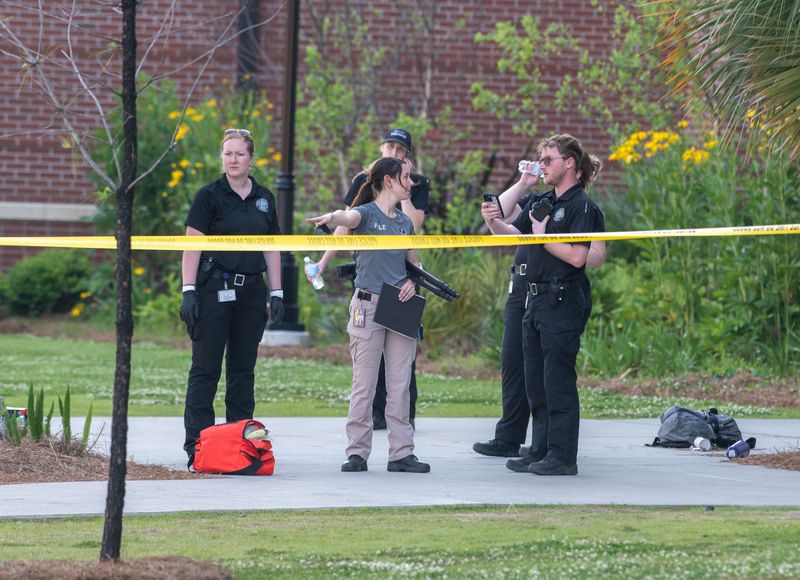
State Rep. Michelle Salzman was at Florida State University in Tallahassee on April17, 2025, when 20-year-old FSU student Phoenix Ikner opened fire at the Student Union, killing two people and injuring six others.
As a student and a lawmaker in those terrifying moments, she said the experience left her looking for solutions to help make college students safer.

“I was sitting in my office when the shooting took place, and I was in group text messages with other students where they were sending videos of the assailant,” Salzman recalled. “They were saying, ‘Oh, I’m not on campus. I’m in this building. We’re on lockdown.’ And then afterwards they were like, ‘What are we going to do about it?’”
Salzman said she collaborated with state education leaders and other lawmakers for answers.
Among their solutions was Florida House Bill 757, a proposed law titled “School Safety” that authorizes public colleges and universities to implement armed “guardian” programs, which would allow trained staff and faculty to carry concealed weapons on campus.
Salzman filed the bill, which includes expanding K-12 school safety policies to higher education, requiring threat assessment teams, active assailant plans, and making it a second-degree felony to discharge a firearm within 1,000 feet of a school.
Escambia Superintendent Keith Leonard worked with the state representative on that last addition to the bill.
He said stiffer penalties are needed to deter violence at or near events on school property and to keep students and faculty safer.
“We are very appreciative of Representative Salzman, and her efforts related to this school safety bill,” Leonard said. “This legislation certainly supports and provides efforts to ensure the safety of our students, our employees and our community at large.”
The 1,000-foot discharge penalty was added as a “broader school safety” measure to the bill.
The legislation primarily focuses on allowing public colleges and universities to join the Guardian Program, which enables trained staff and faculty to carry concealed weapons on campus.
Pensacola State College President Ed Meadows said in today’s environment educators should do all that they can to ensure a safe environment for students to learn and faculty to teach.
He says the proposed legislation will further assist colleges in safeguarding our students, faculty and staff.
“Anticipating the unexpected and being able to react is often the difference between tragedy and safety,” Meadows said. “The expansion of the Guardian Program, as proposed by Representative Salzman, will better prepare higher education institutions to respond to the unexpected and protect our students, faculty and staff.”
The Guardian Program is a Florida school safety initiative enacted in the wake of the 2018 Parkland shooting to provide an immediate response to threats by allowing trained, armed school personnel or hired security guards to protect campuses.
Law enforcement reports that more than half of Florida school districts use the program, which is funded by the state and requires comprehensive training via local sheriff’s offices.
The bill also mandates door locks in all higher education buildings and creates universal reunification plans to help families come together more quickly after a mass attack.
“There is nothing like it in the nation,” Salzman said. “We take the Marjory Stoneman Douglas bill, and we create it in a way that it matches for higher education. We provide funding for all door locks in every higher education building in the state because most of the doors don’t have locks. It’s really a remarkable bill.”
The bill passed the House and advanced to the Senate. If it passes, the legislation will be on the governor’s desk next week. Salzman believes it will get the support it needs to become law.
“It will be the first of its kind in the nation,” she said.
This article originally appeared on Pensacola News Journal: Bill to put armed Guardians in Florida colleges could go to governor next week
Reporting by Mollye Barrows, Pensacola News Journal / Pensacola News Journal
USA TODAY Network via Reuters Connect