Fort Pierce Jetty Park is the most-eroded beach in Florida, costing taxpayers about $15 million every two years for beach restoration projects to replace lost sand, the Army Corps of Engineers said on April 28.
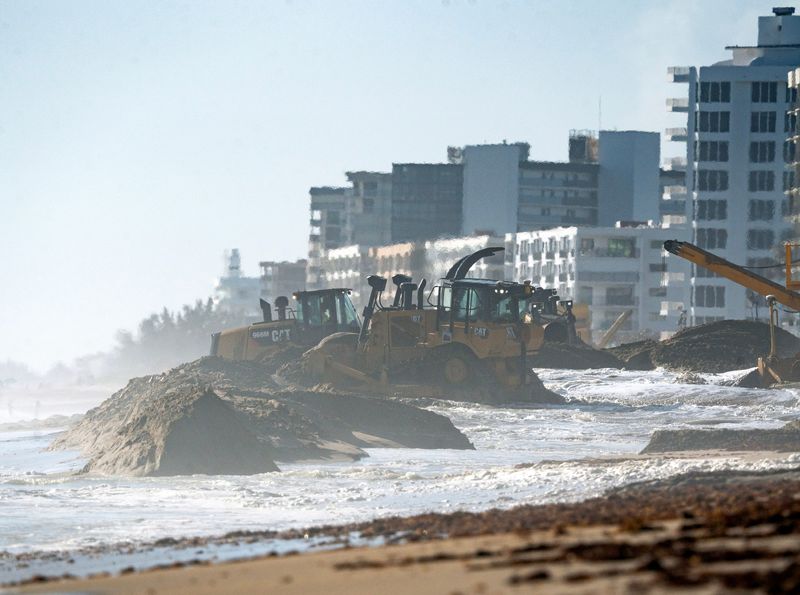
Sand has been placed at the Jetty Park beach 14 times since 1971, said Joshua Revord, St. Lucie County Department of Port, Inlet & Beaches director. The current $15.1 million project, expected to be complete by mid-May, is placing 400,000 cubic yards of sand on a one-mile stretch from the jetty south, according to Col. Brandon Bowman.

That’s enough to cover a football field in 70 feet of sand.
Construction of the north and south jetties to create the Fort Pierce Inlet in 1921 altered the natural flow of sand, causing the northern beach to build and the southern beach to erode. The effect reaches about 3 miles south of the jetty, Revord said.
“We are correcting a man-made imbalance,” St. Lucie County Commissioner Jamie Fowler said of the project at an April 28 ribbon-cutting ceremony, attended by Army Corps and county officials.
How do T-groins prevent beach erosion?
The project was supposed to start in 2025, but was delayed by lack of contractors, equipment failures and windy weather in March and April, according to Revord and the Army Corps.
The first time the Army Corps requested bids, no contractors submitted one. The second time, neither of the two bids met the requirements. The third time, the Army Corps hired Manson Construction Co. for both St. Lucie projects.
Crews this weekend will demobilize their equipment at the Martin County project, Bowman said. The south St. Lucie County line beach project was completed in late March, but crews are still replanting the dune vegetation.
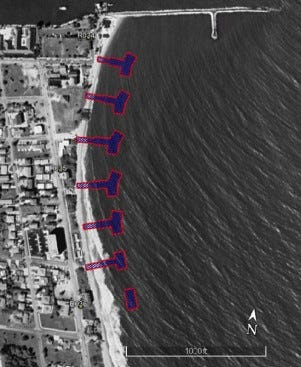
The next step in the ongoing battle against erosion will be placing a half-dozen T-groins at the Fort Pierce Jetty Park beach by 2030. The T-shaped rock or concrete structures, designed to reduce wave energy and trap sand, will run perpendicular from the dune line into the ocean, with the T part submerged, according to an Army Corps rendering.
Revord said he hopes the T-groins will reduce the need to add new sand to every four years instead of every two years, but he did not cite any data or studies that prove they will work.
The county currently is in the planning and designing stage of the project.
Florida turtle nesting season and beach restoration
The Army Corps is wrapping up three beach restoration projects in Martin and St. Lucie counties. They cost $44.4 million and placed nearly 1.08 million cubic yards of sand on the beaches: 500 feet deep
Environmentalists were concerned about the work being done during Florida sea turtle nesting season, which starts May 1 for the rest of the state, but March 1 for Brevard through Broward counties. It ends Oct. 31.
Over 4,100 eggs from at least 45 nests had been relocated as of April 15. TCPalm is awaiting updated numbers.
Leatherback turtles started nesting earlier than usual this year, in March and April. At least one loggerhead nest — the first of the season — was reported in the Martin County project area in April.
All state and federal sea turtle regulations were followed, the work was done before most sea turtles started nesting, and the new sand will give turtles more sand for nesting, Bowman said at an April 27 ribbon-cutting ceremony at the Martin County project area.
The new sand will “benefit the community” and “reduce the risk (from storms) for families and their homes,” Bowman said.
There’s always a concern about new sand being compatible with the existing sand, meaning it should have the same characteristics such as color and grain size, according to the Florida Fish and Wildlife Conservation Commission.
Florida sea turtle eggs relocated
Crews were working 24/7 with bright lights and noisy, heavy equipment, so eggs were relocated to protect them:
Special protections are required on nesting beaches from Brevard to Broward “because of the high density of turtle nests,” FWC says. Noise, activity, obstacles, uneven sand and the wrong kind of sand can stop sea turtles from nesting, the FWC website says.
“If the renourishment is done during nesting season, there is also a possibility nests will be buried too far underground or be run over by trucks,” FWC says. “If the sand is of a different consistency or is too compacted, the nesting behaviors of turtles can be drastically altered.”
The article continues below.
Artificial lights also can disorient mothers and hatchlings, directing them away from the ocean. They can die from dehydration, exhaustion, predation and being hit by cars if they make it to A1A, FWC says.
“Nesting sea turtles look for dark, quiet beaches to lay their eggs. Lights from buildings along the beach distract and confuse the females,” FWC says. “Any distractions may frighten and disorient her, causing her to return to the ocean before completely covering and camouflaging her nest.”
“The fewer obstacles sea turtles have to overcome, the better their chances of successful nesting,” FWC says.
FWC has strict sea turtle nesting season guidelines
Tim O’Hara is TCPalm’s environment reporter. Contact him at tim.ohara@tcpalm.com.
This article originally appeared on Treasure Coast Newspapers: Florida beach is state’s most-eroded, costing $15M every two years
Reporting by Timothy O’Hara, Treasure Coast Newspapers / Treasure Coast Newspapers
USA TODAY Network via Reuters Connect