In 1976, as the country was celebrating its 200th birthday, the bird that symbolized our national spirit was on the brink of extinction.
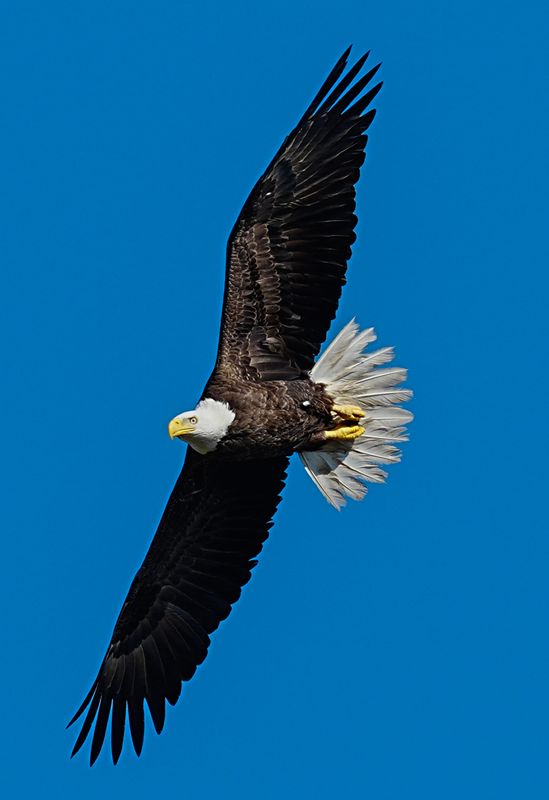
Now, the bald eagle has come soaring back as one of the great success stories of the environmental movement taking root in the 1970s.

But biologists warn climate change, habitat loss, and especially our lead shot threaten the eagle’s future.
When a hunter shoots a deer or other animal with lead ammo, the bullet fragments into dozens or hundreds of tiny pieces inside the kill. Eagles eat the lead pieces in game that escapes and dies later, or in the gut piles hunters leave behind after butchering their kill in the wild. A lead fragment as small as a grain of rice can kill a bald eagle.
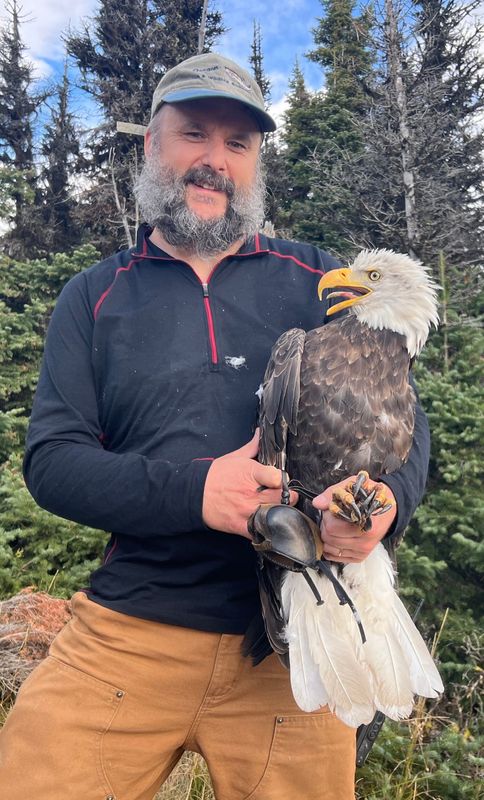
“The bald eagle population has exploded,” said Vince Slabe, a scientist with the nonprofit Peregrine Fund who’s doctoral research focused on lead exposure and poisoning in North American raptors. “If you removed lead poisoning from that equation, they could be doing even better.”
Slabe’s landmark federally funded study published in Science in 2022 found almost half of American bald eagles have lead poisoning, with ill effects that aren’t yet fully understood.
American eagles soar back to life
Bald eagles were once incredibly abundant throughout North America with as many as 500,000 estimated to be in what would become the United States in colonial times.
It was adopted as the national emblem in 1782 when it was used as the centerpiece of the Great Seal of the United States.
Habitat loss, hunting and chemical pesticides all combined to cause the eagle’s numbers to plummet. especially the pesticide DDT, which thinned eggshells and reduced reproduction.
Eagles dipped as low as 417 known nesting pairs in 1963 in the lower 48 states.
A federal ban on DDT in 1972 — preceded by some of the nation’s earliest state restrictions a few years earlier in Florida — and countless other conservation actions brought bald eagles back from the brink.
The comeback has been beyond dramatic:
Florida took a central role in the American bald eagle’s recovery. But bird biologist in the Sunshine State and elsewhere hope we don’t declare victory too early. Our bold, independent symbol still has its headwinds — most of them caused by us.
Endangered Species Act, Florida saves eagles, but not from lead
Florida’s center stage in species protection culminated in the 1970s when scientists, lawyers and activists, such as longtime Florida resident Nathaniel “Nat” Reed, helped write the Endangered Species Act.
Reed, raised in Greenwich, Connecticut and Hobe Sound, Florida, would become Assistant Secretary of Fish, Wildlife and Parks, and would co-write the Act. He’s also credited with helping to stop the use of DDT, an insecticide that caused reproductive problems in birds of prey like the bald eagle.
On Dec. 28, 1973, President Richard Nixon signed the Endangered Species Act, the most comprehensive conservation measure the world had ever seen, giving legal leverage to stop actions that kill or harm the nation’s most vulnerable species — chief among them, the bald eagle.
Eagles bounce back from DDT
DDT, used to kill mosquitoes, also found its way into the eagles through the food chain causing reproductive problems.
The Cape Canaveral area was an early testing ground for DDT. Workers building launch pads for the military couldn’t endure vicious assaults of aggressive salt marsh mosquitoes that swarmed in huge black clouds. There was a Space Race and a Cold War to win. Few knew DDT’s downsides until Rachel Carson’s seminal book, “Silent Spring,” published in 1962.
When the Endangered Species Act passed in 1973, only 88 active bald eagle nests remained in Florida.
By 2007, bald eagle had improved enough to be removed from the Endangered Species List.
And by 2014, Florida had 1,500 nesting eagle pairs, making it one of the densest populations of nesting bald eagles in the lower 48 states.
Bald eagles are not currently listed as endangered or threatened at the state level either, but they remain protected under specific state rules.
Eagle recovery beyond DDT ban, but lead ammo risk persists
Proudly, Florida has one of the strongest bald eagle populations in North America. But recent research shows the eagle’s nationwide plight has shifted from recovery to ecosystem-linked health stress. That includes the decline of estuaries like the Indian River Lagoon, chronic exposure to lead, mercury and other contaminants, and climate and development pressure.
Slabe and other scientists say decades of conservation paid off as we reigned in DDT and other pesticides, habitat destruction and other eagle killers.
But chief among the unsolved threats is the lead shots that last in the environmegnt as eagles and other raptors scavenge untold carcasses riddled with ammo fragments that add up in their bodies over time.
“You’re talking about multiple acute poisoning events throughout the course of a lifetime,” Slabe said. “We’re seeing half of the birds in the United States are ingesting enough lead throughout their lifetimes to be considered clinically lead poisoned.”
As a result, neurological effects on eagles and other raptors can be devastating.
“It can basically negatively affect every system of the body,” Slabe explained. “With birds, one of the most common things it does is ground them.”
Then they can’t hunt, breed or do much of anything but be doomed. But somehow, the eagles keep breeding.
Lead still not letting up on eagles and other raptors
Slabe’s and others’ research shows bald eagles have much lower rates of lead poisoning during their breeding season when they mostly eat fish. Their lead exposure is higher in fall and winter, when they are more likely to scavenge.
Slabe’s landmark federally funded study published in Science in 2022 found almost half the 1,210 bald and gold eagles sampled in 38 states (2010–2018) had chronic, toxic lead levels that slow their population growth by almost 4% per year.
The meat of a deer and other game spoils fast under the Florida sun. So hunters typically remove edible meat but leave behind gut piles. Eagles and other scavengers find those piles, as well as the injured game that escapes the hunter but dies later.
Even one tiny rice-sized spec of lead shot that scatters inside the kills or guts hunters leave behind can be lethal to a raptor that eats it. And lesser levels of the heavy metal stunt an eagle’s growth, in more ways than one.
“This is the first study of lead poisoning of wildlife at a nationwide scale, and it demonstrates the unseen challenges facing these birds of prey,” Todd Katzner, a wildlife biologist with the U.S. Geological Service and a coauthor with Slabe on the 2022 lead study, said at the time.
Getting the lead out
Despite legal protections and population gains, threats to eagles persist from lead poisoning, climate-driven shifts in prey availability and landscape fragmentation, biologists warn.
Slabe, who’s also a hunter, works through the Peregrine Fund and others to promote voluntary alternatives to lead ammo, such as copper and alloy ammo less toxic than lead. “Copper ammo is about the same price a high-end lead ammunition,” he said.
He’s also involved with Hunters for Eagle Conservation, which offers free or reduced-cost, lead-free ammo or rebates to participating hunters.
Since 1991, hunters have been prohibited from using lead shot to hunt ducks, geese, or other waterfowl anywhere in the United States.
California is the only state that bans all hunting with lead bullets, which fully took effect in 2019. Other states have voluntary programs to reduce use of lead ammo.
Slabe prefers voluntary shifts to less toxic ammo. He believes that once hunters understand the problem, they will want to do the right by America’s symbol, and other wildlife poisoned by lead.
“As a hunter myself, for years I didn’t realize that ammunition fragmented in those ways,” Slabe said.
Contact Waymer at 321-242-3663 or jwaymer@floridatoday.com. Follow him on Twitter@JWayEnviro
This article originally appeared on Florida Today: America’s bald eagle’s stunning recovery tempered by lead ammo
Reporting by Jim Waymer, Florida Today / Florida Today
USA TODAY Network via Reuters Connect
By Jim Waymer, Florida Today | USA TODAY Network