Editor’s note: This story will be updated after the 1 p.m. ceremony.
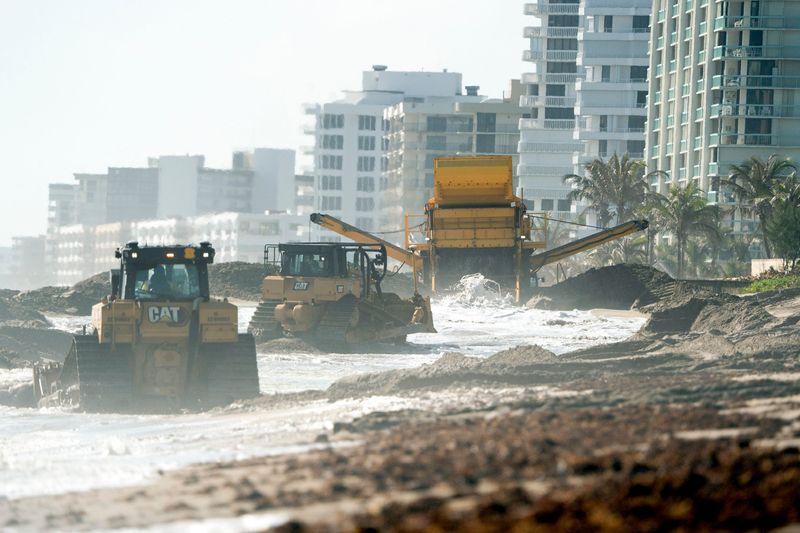
Army Corps of Engineers officials will be on the Treasure Coast April 27-28 for two ribbon-cutting ceremonies on three of their most recent beach restoration projects in Martin and St. Lucie counties.

The first event will be at 1 p.m. April 27 at Bob Graham Beach at 3225 NE Ocean Blvd. near Stuart and the second event will be at 10 a.m. April 28 at Fort Pierce Jetty Park, 2098 Seaway Drive on South Beach.
Environmentalists were concerned about the projects being done during Florida sea turtle nesting season, which invokes special protections from Brevard to Broward counties. Over 4,100 eggs from 45 nests were relocated.
The projects cost $44.4 million and Army Corps contractors placed nearly 1.08 million cubic yards of sand on the beaches:
Sea turtle eggs relocated
Crews were working 24/7 with bright lights and noisy, heavy equipment, so eggs were relocated to protect them:
Special projections from Brevard to Broward
Florida sea turtle nesting season typically begins in May, but it’s earlier from Brevard to Broward counties, according to the Florida Fish and Wildlife Conservation Commission. On the Atlantic coast, the season is March 1 through Oct. 31.
Special protections are required on those beaches “because of the high density of turtle nests,” FWC says. Noise, activity, obstacles, uneven sand and the wrong kind of sand can stop sea turtles from nesting, the FWC website says.
“If the renourishment is done during nesting season, there is also a possibility nests will be buried too far underground or be run over by trucks,” FWC says. “If the sand is of a different consistency or is too compacted, the nesting behaviors of turtles can be drastically altered.”
Artificial lights also can disorient mothers and hatchlings, directing them away from the ocean. They can die from dehydration, exhaustion, predation and being hit by cars if they make it to A1A, FWC says.
“Nesting sea turtles look for dark, quiet beaches to lay their eggs. Lights from buildings along the beach distract and confuse the females,” FWC says. “Any distractions may frighten and disorient her, causing her to return to the ocean before completely covering and camouflaging her nest.”
“The fewer obstacles sea turtles have to overcome, the better their chances of successful nesting,” FWC says.
FWC has strict sea turtle nesting season guidelines
Tim O’Hara is TCPalm’s environment reporter. Contact him at tim.ohara@tcpalm.com.
This article originally appeared on Treasure Coast Newspapers: 3 Florida beach restoration projects celebrated by Army Corps, counties
Reporting by Timothy O’Hara, Treasure Coast Newspapers / Treasure Coast Newspapers
USA TODAY Network via Reuters Connect