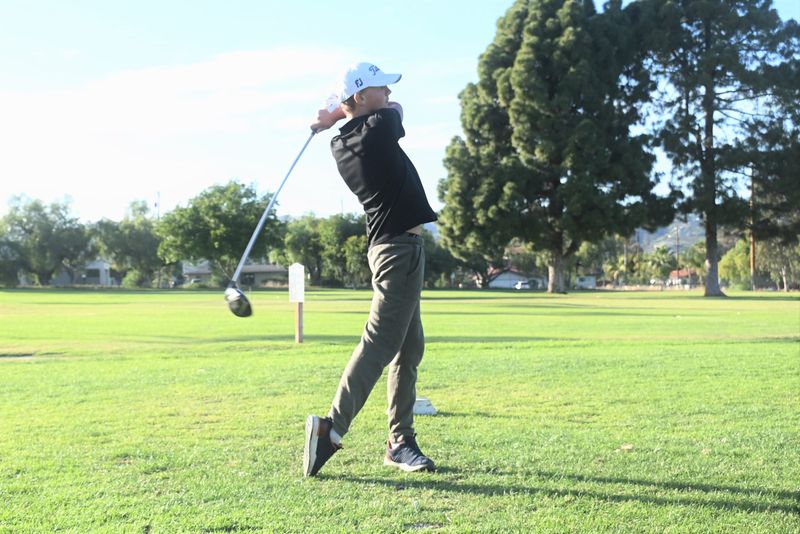
Magnus Kalins likes golf.
The eighth-grader from Ventura whose heart stopped beating when he was 3 plays every Wednesday with his uncle at a small public course in Saticoy. They tackle the holes as a team. If they score a birdie, the reward is dinner, maybe even Magnus’ favorite, fish tacos at Chipotle.

That’s not the best part. What the 14-year-old boy really likes is when he hits the ball just right and it soars.
“I really like seeing the golf ball fly,” he said, eyes widening at the thought.
Magnus will tee off with his uncle, other family membes and many others in an April 26 tournament he inspired. Called Birdies for Breakthroughs, the event at Olivas Links in Ventura will raise money for pediatric cancer research.
When Magnus was 2, his grandfather, then a practicing doctor in Carpinteria, became alarmed at large bruises on the boy’s legs. A series of blood tests showed he had a rare, very aggressive form of blood cancer called juvenile myelomonocytic leukemia.
Magnus had about a 50-50 shot of surviving.
That was 12 years ago. And though his journey motivated his mother to organize the golf tournament through the nonprofit “Unravel” fundraising group, Magnus doesn’t like to talk about leukemia, chemotherapy or the cardiac arrest that came later.
“Let the past be the past,” he said, sitting in his living room with his parents, Anna and Erik Kalins. “Think about what’s in the moment.”
What else Magnus likes
There are a long list of things Magnus would rather do than talk about cancer. One of them is selling things.
At Ventura Charter School of Arts and Global Education, where he’s nearing graduation, Magnus started taking bags of popcorn from his kitchen cupboard. He would tuck them into the microwave oven at school. Then he sold it to the other kids.
He made about $100 in profit before school officials ended the business venture.
He likes American history. Math isn’t quite as high on his list.
He plays the “Team Fortress 2” video game online with his friends in the cubbyhole room under the stairway that he uses as sort of an escape. He plays video games with his uncles, too. Sometimes, they play poker at family gatherings.
“He’s really into that,” said Vince Mammana-Lupo, his uncle and golf partner, noting that Magnus tries to bluff but hasn’t quite mastered it. “He’ll get a smile if he’s got something good.”
Searching for a donor
The leukemia diagnosis at age 2 meant his bone marrow was producing malfunctioning white blood cells that crowded out the healthy cells, severely compromising his body’s ability to fight off infections.
There was one way to treat it — a bone marrow transplant.
His relatives, family friends and many others had their cheeks swabbed to see if they could be donors. They didn’t match.
The search went across the country. The boy’s great-grandparents were immigrants from Latvia and so the search went there. too.
A match was found. It was a 25-year-old man who had been swabbed before Magnus’ need emerged. He donated his stem cells in Poland, not far from Latvia. The cells were infused into Magnus’ body in December 2014 at Children’s Hospital Los Angeles.
Magnus and his family traveled to Latvia several years ago. His mother reached out to a bone marrow donation organization to see if the donor would be interested in meeting them. He didn’t respond.
Magnus usually avoids conversations about leukemia, sometimes leaving the room when the topic comes up. His mom said he just wants to be a teenager, just wants to be “normal.”
But he does have something to say about his donor. He still wants to meet him.
“I would like to say ‘thank you. Thank you for this life,’” he said, thinking about what would have happened without the transplant. “I wouldn’t be here. You know what I mean?”
‘An old soul’
Magnus plays tennis twice a week. He likes the “Lord of the Rings” movies. His favorite foods include pepperoni pizza and tri-tip the way his Uncle Paul makes it.
He likes to catch air while executing curb tricks on his scooter though he’s not sure the complex’s Homeowners Association likes it quite as much.
He’s very direct, willing to challenge a statement he thinks misses the mark. He’s also very polite, thanking people who spend time with him.
“My nephew is a sweet boy,” said Mammana-Lupo. “I think he understands responsibility and duty. He’s very much an old soul.”
His parents said the same thing. Even when he was in the hospital as a toddler, they called him their “little old man.”
Code blue
In the transplant, stem cells were infused into Magnus’ body to replace the bone marrow that was producing abnormal blood cells.
Before the procedure, toxins were used in chemotherapy designed to wipe out all of the cancer cells. The treatment can be life-threatening but is designed to give the transplanted cells a clean slate that allows them to take hold.
“For most people, BMT (bone marrow transplant) is the most intense treatment we have,” said Dr. Francisco Bracho, Ventura pediatric hematologist and oncologist.
The transplant worked and eliminated the cancer. The chemotherapy also damaged Magnus’ intestines, his parents said. Several months after the transplant, he contracted an infection that sent bacteria into his blood stream and caused septic shock.
His body shut down. His heart stopped. His mother was with him when it happened in the pediatric intensive care at Children’s Hospital, watching in stark fear as medical teams used CPR four times before finally reviving him.
“I was like in shock,” she said. “Instead of fight or flight, I was motionless. I couldn’t move. I couldn’t think.”
Because the cardiac arrest stopped the flow of oxygen to the brain, a medical coma was induced to limit the damage. When he came out of the coma, Magnus had to learn again how to walk, talk and eat.
It meant more time in the hospital. He and his family were in and out of children’s hospital for a total of about 18 months, including the transplant. He was tested, poked and prodded. He never complained, rarely cried.
“It was like he said, ‘OK I’m going to do what I need to do,” his mom said.
There were other complications. The family lived in constant fear the cancer would re-emerge.
“The first time when I could breathe easier was five years after the transplant date,” Anna Kalins said. She felt even better after a 10-year anniversary that meant the chances of the cancer coming back were minute.
Other challenges face the family. The chemo increased the continuing risk of other illness and disease. It has affected Magnus’ physical growth and has made some aspects of learning, like reading, more difficult.
‘No other options’
Anxiety remains, too. Anna Kalins won’t read novels about children with cancer. She won’t watch the movie “E.T.” because of the scene when the extra-terrestrial’s heart stops.
She works as associate executive director for Unravel, a nonprofit that raises money for pediatric cancer research. The organization is sponsoring the tournament on April 26. Anna Kalins sees the fundraising as a way to provide kids and families with more treatment options.
She noted that if the bone marrow transplant for Magnus hadn’t worked, the only option would have been to try it again.
“After that it would have been ‘too bad,’” she said. “There are no other options.”
In a rare moment in between conversations about video games, scooter tricks and American history, Magnus answered a question about his journey.
“I’m like very grateful,” he said.
He likes the upcoming tournament because it means he’ll get to golf. In a phone call, he said the fundraising makes sense to him.
“We need more stuff to cure more people,” he said. Then he abruptly ended the conversation. It was time to be a teen again.
“I’m going to give the phone back to my mom. I have to get ready for tennis,” he said.
For more information about the fundraising tournament, go to https://e.givesmart.com/events/O7X/.
Tom Kisken covers health care and other news for the Ventura County Star. Reach him at tom.kisken@vcstar.com.
SUPPORT LOCAL JOURNALISM: To see more stories like this, subscribe.
This article originally appeared on Ventura County Star: Ventura cancer survivor who nearly died just wants to be a teen
Reporting by Tom Kisken, Ventura County Star / Ventura County Star
USA TODAY Network via Reuters Connect