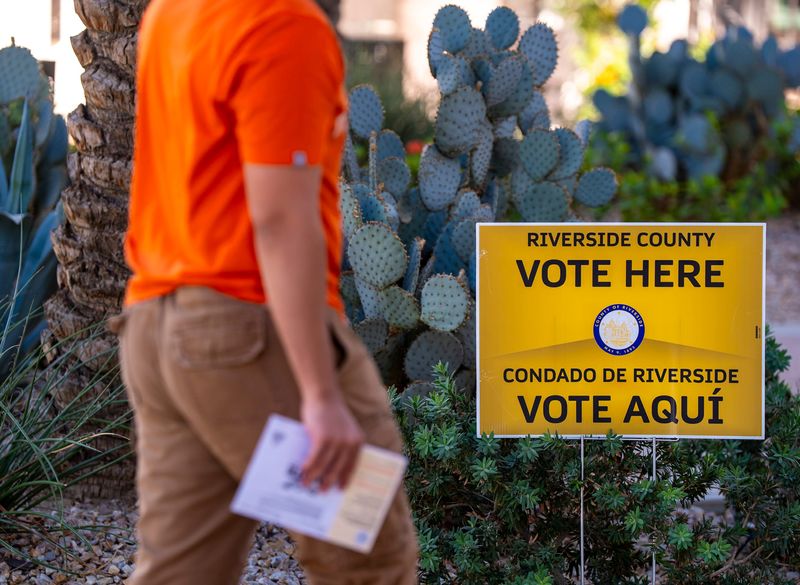
Should taxpayers pay for elections we don’t need? Last year’s State Assembly special election in Riverside County shows that California’s special election system is based upon expensive and unnecessary run-offs that waste taxpayer money and delay voter representation.
Under California’s special election system, a primary is held among candidates from all parties and independents. If none receives a majority, a run-off general election is held between the top two finishers. But what if a clear majority favored multiple candidates from the same party/viewpoint — and upon that, a final result could’ve been easily inferred, if only their votes could’ve been consolidated?

Ranked-choice voting (RCV) does exactly that. RCV empowers voters to rank candidates in their order of preference. If a voter’s first choice doesn’t win, their vote transfers to their second choice and so on, until one candidate receives a majority. RCV is already in place in cities in Alameda, Humboldt, Los Angeles and San Francisco counties. Nationwide RCV is used in 49 municipal, county and state jurisdictions.
In last June’s special election primary for Assembly District 63, two Republicans received 54.6% combined — Natasha Johnson (46.2%) and Vincent Romo (8.4%). In the August run-off vs. Democrat Chris Shoults, Johnson was elected with a similar 53.5%.
The run-off result tells us nearly all Romo voters’ second choice was the other Republican, Johnson. So did we really need the run-off to get to a winner, when it could’ve been decided by a single RCV vote?
This run-off cost Riverside County taxpayers an extra $4 million, a county spokesperson told me. These funds do pay for important democracy functions: production and distribution of ballots and voter information guides, sending vote‑by‑mail packets and outreach materials to voters, and staffing vote centers and ballot‑processing facilities. But why pay twice, when such funds could go towards other pressing county needs?
AD63 residents also had to unnecessarily wait for representation. Johnson was sworn into office on Sept. 8 — more than five months after incumbent Bill Essayli (R) resigned to lead the US Attorney’s Office. It would’ve only been three months under RCV.
By empowering voters to express their preferences over more than one candidate — even from different parties — RCV also eliminates the inherent vote-splitting inherent in the current system that can make it confusing who to vote for — the candidate closest to your views, or one who may have the best chance to make a run-off?
RCV also lessens incentive for zero-sum negative campaigning, because candidates often seek second and third preferences from voters who don’t rank them first. And charting these preferences gives winners a more clear policy signal where their support comes from.
Ultimately, RCV winners are elected with majority support after competing against multiple candidates, rather than by engineered false majorities rendered by two-way run-offs. This means a clearer mandate to govern. Because candidates only run in a single election, they also have to raise and spend less money, diminishing big donor influence.
RCV for special elections can be enacted by the State Legislature. However, Gov. Gavin Newsom doesn’t have a history of supporting RCV. In 2019, he even vetoed SB212, which would’ve given general law cities, school districts and counties the option to use RCV in local elections, contingent upon a local public vote.
This year, concern over a possible Newson veto dissuaded a state senator from introducing an RCV special election bill. Future passage may depend upon the next governor. So where do the major candidates stand on RCV?
Michael Feinstein of Santa Monica, a former Coachella Valley resident, is a 2026 Green Party candidate for California Secretary of State, a former Santa Monica mayor and city council member, and a co-founder of the Green Party of California.
This article originally appeared on Palm Springs Desert Sun: Two elections for one office are a waste. How California could stop
Reporting by Michael Feinstein, Special to The Desert Sun / Palm Springs Desert Sun
USA TODAY Network via Reuters Connect