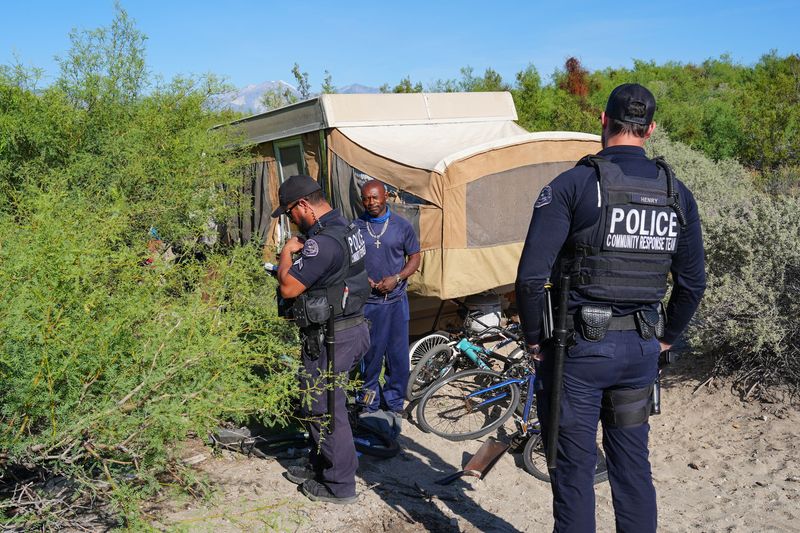
A couple is living in an RV parked in an open desert patch of Desert Hot Springs.
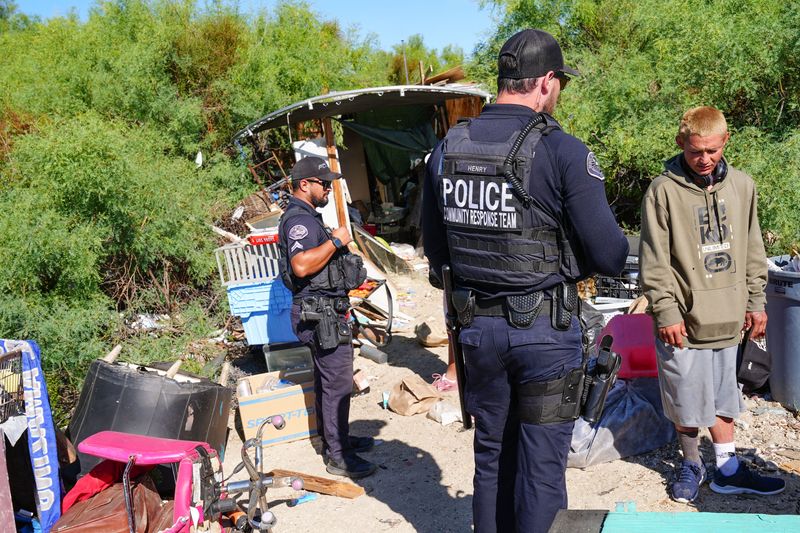
Two police officers speak with the husband, who says he’s been there for almost a year. They ask if he’s spoken with the social workers the city partners with to provide treatment to homeless people. He sidesteps the question, instead saying he wants to return to Las Vegas and he came out to Desert Hot Springs after police killed his son. (He doesn’t say where that killing happened.)

These kinds of conversations are a key part of the officers’ full-time posting.
His wife comes outside about two minutes into the conversation, after an officer asks about her. Her husband tells her to keep their dogs inside — two Cane Corsos and two German Shepherds. When she struggles to close the door, he shouts at the dogs to sit down.
One of the officers, Cpl. Gustavo Ramirez, remembers speaking to the couple before. He tells them he’s always been straightforward with them. The city is planning to clean out encampments in the area, he adds, and anyone still trespassing will be arrested if they don’t agree to go into drug or mental health treatment.
“I don’t want to be arrested,” the woman says.
So Ramirez asks them to start getting their stuff ready to leave soon. The other officer, Officer Matthew Henry, says he’d prefer they take help over going to jail. The woman jokes about Henry’s full name being two first names. Ramirez jokingly asks if the man is still walking around with a machete, which he apparently had in the past.
“All right, see you guys later,” Ramirez says as the officers leave.
A new approach to homelessness
The city says it has noticeably fewer such encampments than it did a year ago. It saw progress after it stopped providing its homeless population temporary shelter first and instead focused on immediate drug and mental health treatment.
Ramirez and Henry have made up the city’s Community Response Team since February, which is one piece of Desert Hot Springs’ new approach to addressing homelessness. The CRT itself was established in 2025, according to a city staff report. They work closely with Social Work Action Group, or SWAG, an organization that reaches out to homeless people to get them into treatment and ultimately reunite them with family.
Deputy City Manager Christina Newsom said the city historically dealt with the effects of homelessness, such as encampments, makeshift structures and fire hazards, instead of the underlying causes. It was not “people-centric,” she said.
It was also reactive, dealing with the negative impacts of homelessness mainly when they were reported. Now the city tries to be more proactive, aiming to contact people who are homeless and get them help.
“Once we started working with the individuals, we understood that hey, there are deeper issues that we need to address here if we want to see some success,” Newsom said.
How many homeless people are there in Desert Hot Springs?
Desert Hot Springs’ point-in-time count surveyed 81 unsheltered and 35 sheltered homeless people in 2025. It previously had 107 unsheltered and 15 sheltered in 2023.
While the totals only differ by six people, its worth noting that the point-in-time count provides only a snapshot of how many unhoused people are in a city on a single day.
City says housing-first approach didn’t work
Desert Hot Springs’ first solution for addressing homelessness in recent years focused on housing.
In October 2023, it opened a homeless “access hub,” purchasing a building for it at 66-753 Hacienda Avenue for $575,000, then spent $629,230 to renovate it. The city made an agreement with Martha’s Village and Kitchen to run the hub for $290,000 initially, but annual operations would cost $1.5 million. That price tag required Desert Hot Springs to dip into reserve funds in order to keep the hub running.
Under Martha’s Village and Kitchen’s control, the hub provided overnight shelter and other services like lunch distribution, use of showers, referral to social services and a cooling center during the summer. Newsom said the organization did exactly what it was contracted to do.
But Desert Hot Springs felt it didn’t get a return on its investment.
“There was no long-lasting stability. What we were seeing at the hub was the same individuals coming back every single day to shelter overnight,” Newsom said. “But unfortunately, they’d go back into the streets and we would see them, you know, encamping on the sidewalks, in the public and in the shopping centers.”
“The hub turned into a problem as well because they would just go there and get high and it kind of turned into we would call it, even the homeless would call it, ‘the drug hub,’” said Henry, one of the Community Response Team officers. “That kind of showed that the resources first kind of option wasn’t really successful, in our city at least.”
SWAG had reached out to 86 people as of a Nov. 4, 2025 city staff report. Of those people, 66 went into treatment, housing or stabilization programs. While 25 of them ended up returning to the street, 45 were no longer homeless.
That same staff report said 721 people used the hub’s day center and 198 stayed overnight in its first year under Martha’s Village. Only 18 of those people got housing.
“Those outcomes and statistics during that model just showed that the temporary sheltering alone was not having the success that we wanted it to have,” Newsom said.
The Desert Sun requested more current statistics about who SWAG has helped, but the city did not provide them by deadline.
As of Nov. 4, 2025, the CRT had made 191 arrests, 67 for felonies and 124 for misdemeanors. Ramirez, the CRT officer along with Henry, said the team isn’t responding to regular calls for service and therefore has time to be proactive.
“Before CRT started, it was depending on how busy you are on patrol, you know,” Ramirez said. “So, if we got really busy, you weren’t able to come here more than like once a month.”
New tactics and a new team
After deciding its approach with the hub wasn’t working, the city switched to a new operator in October 2024.
The hub hasn’t been an overnight shelter since, though Newsom said it is still set up to provide that if necessary. Instead, it’s a headquarters for SWAG to hold meetings and conduct other administrative tasks. The heft of SWAG’s work is done outside the hub, when its workers go out to speak with homeless people and, if they’re willing, start treatment the same day.
And the work doesn’t stop there. SWAG staff will keep in touch with people throughout their treatment and will even visit to check up on them.
“We let them know, like, from the gate, from the beginning like we’re gonna be a part of your process,” said Kathleen Renteria, a SWAG outreach specialist. “Like, we’re gonna be there every step of the way to support you throughout everything.”
Newsom said SWAG’s treatment and accountability-based model focuses on mental health and substance abuse issues, which are the main reasons people are unhoused or not with their families. They want to reunite homeless people with family when possible, finding that relatives will accept them back if they’ve dealt with their issues.
“That really prioritized stabilization, with the ultimate goal being reunification with families,” Newsom said.
The city established its Community Response Team so two police officers, currently Ramirez and Henry, are dedicated full time to addressing homelessness. The CRT meets weekly with SWAG to plan and determine who is a high priority and where major encampments are.
SWAG’s outreach work involves going out to places like shopping centers, thoroughfares and encampments. It keeps meticulous records of its clients, logging things like their mental state, clothing and hygiene.
“We follow these people all the way through. We know when they finish their treatment,” Newsom said. “We know if they leave the facility — we’ll also be alerted of that as well, because if they leave the facility, we go and look for them on the street right away.”
Tough terrain
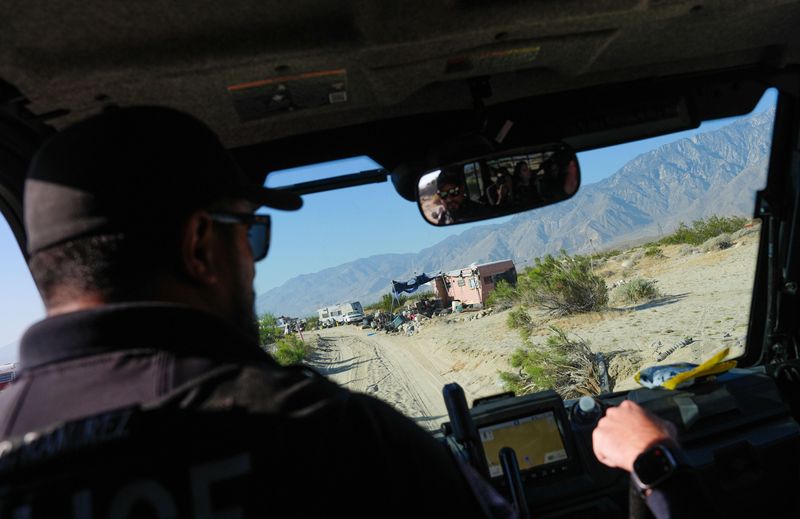
Given the kind of places homeless encampments can be set up, Ramirez and Henry will often drive an off-roading vehicle during their shifts.
It allows them to move through the desert more easily than a patrol car. On one recent shift, they drive over rough and unpaved roads, sometimes having to go over random objects or through narrow paths between shrubs that scrape the car’s exterior. At one point Henry uses his baton to reach out the window and move obstacles out of the way.
Some areas they pass by are scorched from fires over time, and the officers note the difficulty firefighters faced getting equipment there to put the flames out.
Newsom thinks Desert Hot Springs’ sizable vacant land contributes to the number of its encampments.
“I do think that there is a draw here for the unhoused population, simply because it’s easier for them to encamp in the desert than it would be in another desert city,” she said.
Ramirez and Scott started their roles in the CRT a couple months ago, but already knew unhoused residents by name due to prior work in the police department. They are familiar with where they frequent and live, such as an area with RVs parked around 16th Avenue and West Drive or a “watering hole” where there’s water gurgling to the surface that unhoused people will use.
“It’s pretty cool too, like, being on this assignment you kind of build a good rapport with some of them,” Henry said, adding that some unhoused people have even given police helpful tips on criminal cases.
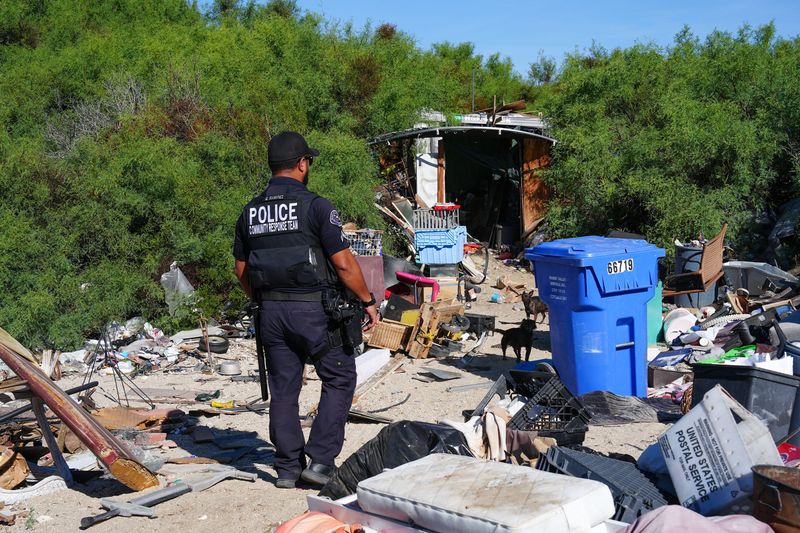
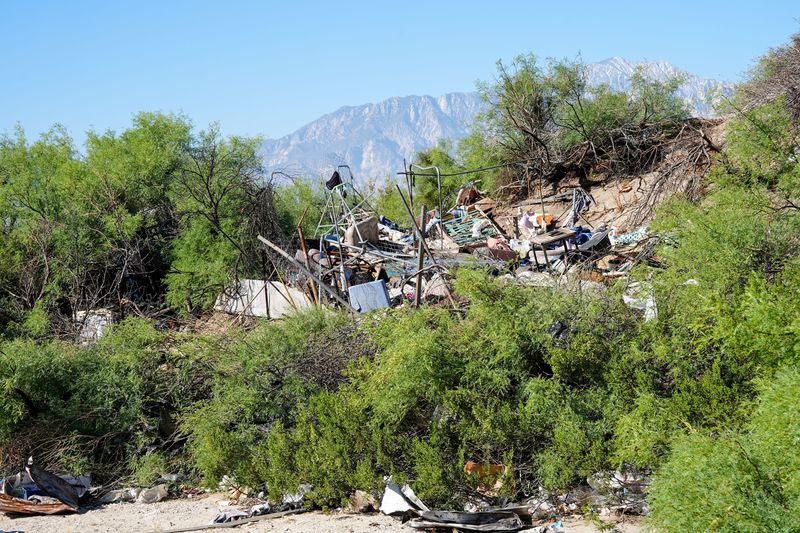
The officers point out areas where there used to be several encampments that are either now empty of people or just have a few left. There are piles of abandoned items and wreckage like empty RVs, stolen cars, boats and furniture that the city will eventually have to clear out.
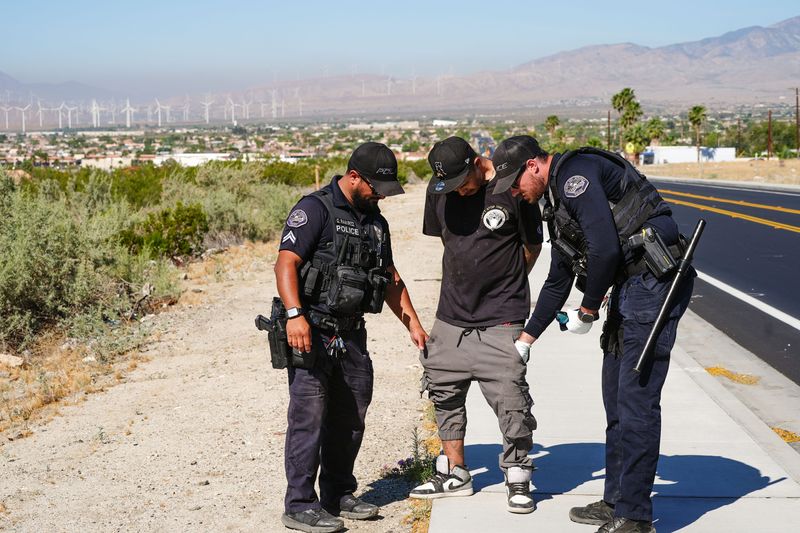
Desert Hot Springs’ unhoused community is familiar with Ramirez and Henry, too. The officers drive into an area where several people live, causing them to scatter. One person they can’t identify at first breaks out into a run through the desert, prompting the two to drive and then run after him, catching up as he’s reached a sidewalk.
It turns out to be someone they’ve dealt with frequently, with Henry guessing he likely thought he had a warrant out for his arrest. They search and question him. Once they confirm he doesn’t have a warrant or anything illegal on him, he is released and promptly crosses the street away from them.
“They know this area very well because they live here and a lot of them have guns and there’s so many spots to hide,” Henry said.
He said that puts officers at risk, especially at night when it’s hard to see. It’s also hard to get backup when there are no clear addresses to direct other officers to.
Desert Hot Springs used to have more homeless people in populated areas of the city, but the officers said their predecessors did a good job clearing them out of highly visible areas like Palm Drive. Now they face the issue of clearing an encampment in one place in the desert and seeing it pop up elsewhere.
A lot of the open desert areas where unhoused people have now taken residence are privately owned. Code enforcement staff work to identify property owners and get them to file forms that state no one is allowed to be on their land. It can sometimes be hard to find contact information, since some owners are corporations based out of the country.
Once those forms are complete, Ramirez and Henry can enforce against trespassing. They spend a recent shift speaking with the sizable number of homeless people who frequent one area. The city gives people advance warning before clearing an encampment, typically 72 hours, to give them time to gather things they want to keep.
Rock bottom
Only one man is by the watering hole when Ramirez and Henry approach the place. Ramirez said they have contacted him 105 times. The man wants to go to Raleigh, N.C., and gave them the names of his family there, though he doesn’t have their phone number.
The city is working with Raleigh police to find them. The city will pay for bus or even plane tickets to get someone where they want to go — but not without knowing they have a place to stay there.
“We’re not just gonna push off our problems to another city,” Ramirez said.
That’s been an issue for Desert Hot Springs before. City officials have complained about police from other cities dropping off homeless people who said they wanted to go to Desert Hot Springs, but had no place to stay in the city.
In 2023, Palm Springs police drove a convicted felon to Desert Hot Springs and dropped him off at a gas station. Police said the man then tied a rag around his face and tried to force his way into a taco truck before being arrested.
When homeless people agree to get treatment, Desert Hot Springs will also house their dogs, though it will only do so for free if they complete the program.
“A lot of them take really good care of their dogs. They do better than themselves,” Henry said. “They really love their dogs. You’ll see it and it’s kind of motivation.”
But despite the city’s efforts, not everyone is willing to accept help. Henry said they’ll encounter people who don’t want to accept the offered resources because it’s easier for them to keep living how they already are.
And so Desert Hot Springs and SWAG want them to hit rock bottom. They discourage people from offering them help so that unhoused people reach that point and are finally willing to seek help. Other than clearing blight, the city will clear out encampments so homeless people don’t have a space to come back to old habits.
“We also encourage them, like, ‘Hey, when you’re going through this and you get out of rehab, don’t come back to the city because you know where all the drugs are, you know the people you used to hang out with, you’re gonna fall right back into it,” Henry said. “Go somewhere that you don’t have these connections and it’s easier to do your rehab, right?”
It often takes several conversations with someone before they actually go into treatment. Even then there is no guarantee that they will complete it. But Desert Hot Springs officials said they have no qualms about putting in that time.
“The whole purpose of the outreach is to continue to be out there every single day,” Newsom said. “Because today they may not be ready, but tomorrow they might be.”
This article originally appeared on Palm Springs Desert Sun: Treatment before housing. See Desert Hot Springs’ new approach to homelessness in action
Reporting by Ani Gasparyan, Palm Springs Desert Sun / Palm Springs Desert Sun
USA TODAY Network via Reuters Connect