Though facing a significant legal roadblock by the state of California, if Shasta’s voter ID Measure B survives, it will need to be implemented in the upcoming November 2026 general election, and County Clerk and Registrar of Voters Clint Curtis is already formulating his plan for how the county might put the measure into action.
Curtis detailed his plan for how he would implement the controversial ballot measure that passed with nearly 56% Shasta County voter support in an email to the newspaper on July 6. It calls for hiring hundreds more poll workers, nearly doubling the number of voting precincts and eliminating an entire elections office location. Using his plan, Curtis told the Record Searchlight he could cut county election costs by half, an assertion that drew the skepticism of one Curtis critic.

Measure B proposes a number of alterations to the elections process in Shasta County, including that:
While some aspects of Curtis’ proposed implementation of Measure B remain unclear, his plan would make big changes to the elections process in Shasta.
It would involve hiring 928 poll workers to handle the count in addition to the 316 “already on board” and the “100 poll closers already on staff,” expanding the number of county voting precincts from 63 to 116, and eliminating either the Court Street or Market Street elections office location entirely.
Curtis said he predicts his plan could save the county roughly $550,508 per election, halving the current cost which he said is about $1 million on average.
But incoming elections chief Joanna Francescut, who served as assistant county clerk and registrar of voters before being ousted by Curtis in May 2025, told the newspaper on July 6 that the “math isn’t mathing” when it comes to Curtis’ estimates.
Curtis said his plans are based on the current number of 116,000 registered voters in Shasta County and a turnout of 70% or less. He also said “it is unknown if in-person voting will increase or decrease participation (in the election).”
Read more about Curtis’ plan, and Francescut’s financial skepticism, below.
The elections office will hire hundreds of poll workers
Curtis said the cost of hiring the extra poll workers would be “a reoccurring $121,984” and the cost of permanent staff would “be a little less” because staff would be required to do less ballot processing.
Curtis also said most “rovers positions” can be eliminated because the polling places are “self-contained,” saving “approximately $10,000 per election.”
Rovers run supplies to polling places and troubleshoot technology malfunctions.
If Measure B is implemented, Curtis said poll closers would “operate more as supplemental poll workers or inspectors.”
Poll closers were an additional group of election workers that Curtis hired for the June 2 primary election to sort ballots at the precincts prior to their transportation to the elections office.
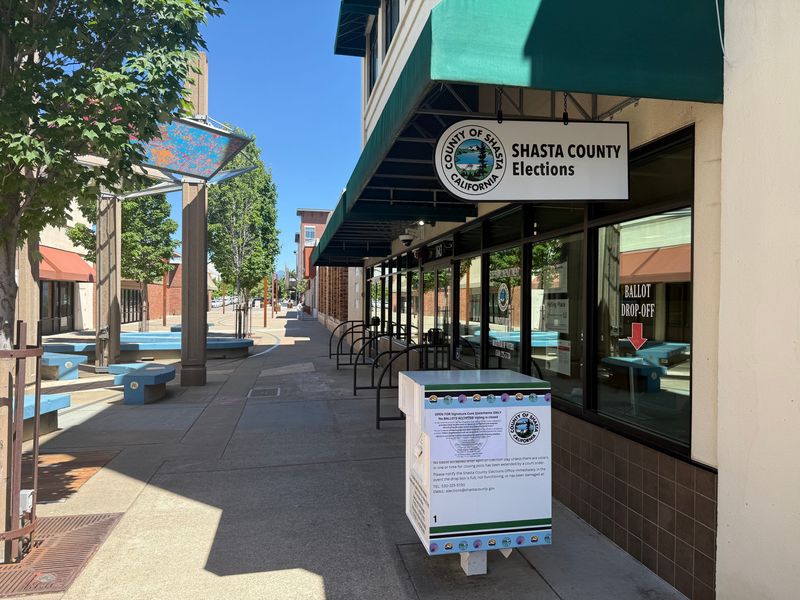
Implementing Measure B would mean big changes for official elections locations
By adding precincts, Curtis said he could allocate roughly 1,000 voters to each location, which he said would be more “cost effective.”
The primary function that the elections office would serve during a Measure B election would be to “signature check” absentee ballots.
Curtis said, “based on past history” of the absentee ballot system in Shasta County, he expects about 1,600 absentee ballots would be cast.
Curtis did not respond to a question inquiring whether the tight in-person voting restrictions of Measure B might incentivize more people to try to vote through the absentee system than had in the past.
Curtis predicts big savings under Measure B, critics say otherwise
In addition to vacating an elections office, Curtis’ plan for Measure B includes eliminating positions of those who work in the call center, those who retrieve and process mail-in ballots, and those who prepare ballots to be processed by the tabulator. Curtis also said money could be saved by getting rid of the Agilis mail sorting machine and the tabulation system, as well as by printing less ballots and eliminating postage costs.
Curtis said these cost-saving measures could save the county $550,508 per election, an estimate that runs counter to the opinion of Francescut.
One cost alone that Francescut said would skyrocket the cost of administering elections in the county is the requirement by Measure B to create open-source software to house county voter rolls, which she said would take years and millions of dollars.
But in a response sent to the newspaper on July 7, Curtis indicated that he believed the exact opposite to be true.
Curtis said, though “lots of questions would have to be ironed out,” the cost would be “fairly insignificant as long as the county has staff that knows (the computer operating system) Linux.”
Francescut also pointed to the cost of adding new polling locations, and with them hiring more poll workers, which she said would dwarf the benefits of the savings Curtis identified.
In 2023, former County Clerk and Registrar of Voters Cathy Darling Allen gave a similar appraisal of the costs to implement a hand-count voting system.
In a 26-page analysis, Allen urged leaders to reject an initiative to implement a hand-count system, which she said would cost the county over $1.6 million.
Curtis said the main cost to the county under his plan, other than additional staff costs, would be a one-time payment of $265,000 to purchase ADA compliant “Touch Writers” for the additional polling locations.
Former Shasta County Public Defender Jeff Gorder declined to comment on the matter.
The R-S also reached out to County Counsel Joseph Larmour who did not respond before deadline on July 6.
Unknowns remain about the implementation of Measure B
Asked how he would implement the voter ID requirement made by Measure B, Curtis said he plans to use “whatever law is on the books for voter ID.”
Measure B facing legal challenge from the state
Though Measure B was passed by a 55.59% majority of Shasta voters, it will need to survive a legal challenge from the state before it can be implemented at the county level.
On June 30, Attorney General Rob Bonta and Secretary of State Shirley Weber filed a lawsuit against the measure in Shasta County Superior Court, contending that it runs counter to state and federal election laws.
“Our position remains unchanged: Measure B is legally indefensible,” Bonta said in a news release, “With our lawsuit now filed in Shasta County Superior Court, we will next seek expedited relief to prevent the measure from interfering with voter registration and election process in advance of the November midterm election. No city or county gets to unilaterally rewrite our election rules.”
Drew Askeland covers Redding and Shasta County government issues, as well as anything else that needs reporting for the Record Searchlight and USA Today Network. Reach him at drew.askeland@redding.com or (530) 225-8247. Please subscribe today to support our newsroom’s commitment to public service journalism.
This article originally appeared on Redding Record Searchlight: Shasta elections will drastically change under a new voting rules plan
Reporting by Drew Askeland, Redding Record Searchlight / Redding Record Searchlight
USA TODAY Network via Reuters Connect
By Drew Askeland, Redding Record Searchlight | USA TODAY Network