A caller’s voice broke as dispatchers asked her to describe the car where a woman hid during an immigration raid at Glass House Farms near Camarillo.
It was shortly after 1:30 p.m. on July 10, 2025. The woman had been hiding for nearly three hours as temperatures climbed, the 911 caller said. Inside the car, the woman had started to feel sick.

“She wants to get out, but she doesn’t want to be deported,” the caller told the dispatcher through tears. “She’s afraid to ask for help.”
Federal officers descended on Glass House’s cannabis facilities in Ventura and Santa Barbara counties that morning. U.S. Department of Homeland Security officials would later report that more than 360 were detained, most at the Camarillo-area farm.
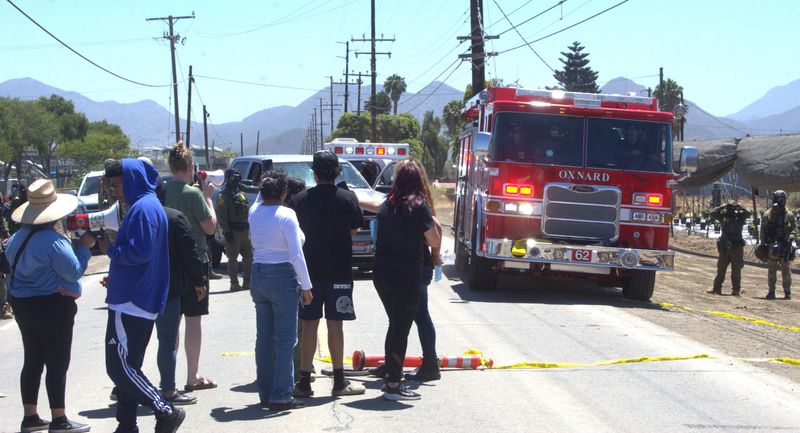
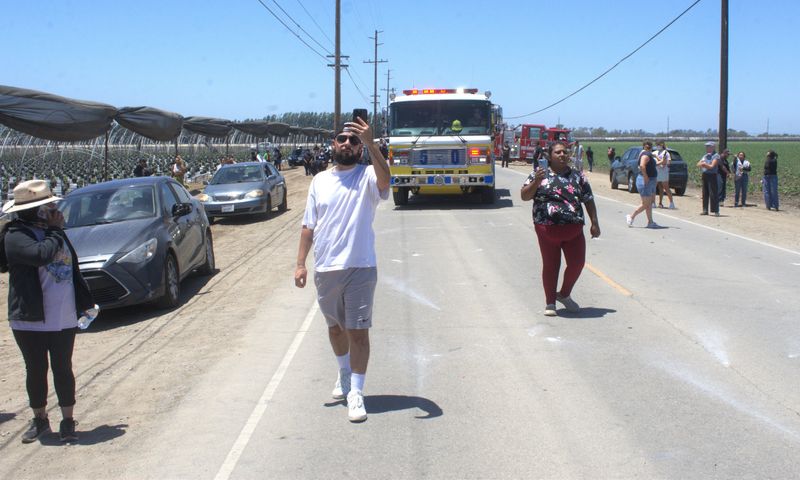
One farmworker died after reportedly falling 30 feet during the raid. Outside the facility, hundreds of protesters and scared family members of farmworkers filled Laguna Road. Federal officers launched rounds of tear gas and smoke bombs.
Fire engines and ambulances were sent to form two triage areas, one on either side of the incident. In all, authorities reported eight people were taken to the hospital.
The Ventura County Fire Department released incident reports and audio recordings — redacted to remove medical and other identifying information — from a dozen 911 calls made from the Laguna Road area on that July 2025 day.
A year later, The Star reviewed the recordings that describe brief moments to help document one of the largest immigration raids during the Trump administration.
A caller reported a group of people on Laguna Road needing help because of tear gas.
“A lot of people are hurt,” the woman told a dispatcher.
“There’s children here,” another caller said.
An ‘incredibly volatile situation’
The first medical call came at 11:29 a.m. A pregnant woman needed medical assistance in the 600 block of Laguna Road. A crew from a nearby Oxnard fire station responded and quickly realized there was a larger incident unfolding.
The raid started around 90 minutes earlier. Federal officers lined up, shutting down the road, and protesters and family members began to gather outside.
Federal agents let the engine through to get to the woman, who was later taken to a local hospital. Within the hour, dispatchers received additional 911 calls. Oxnard and Ventura County fire departments readied for a multiple-casualty incident, setting up the triage points on the east and west sides of the closures and skirmish lines.
Early on, emergency medical personnel headed into the fray to try to track down those who called 911, Oxnard Fire Chief Alexander Hamilton said. As the situation escalated, dispatchers instead directed callers to the triage spots if patients could walk on their own.
“They were just in the middle of an incredibly volatile situation,” Hamilton said of the fire personnel.
There’s no playbook for how to best respond in such a situation, one he described as “confronting” and unlike others the department had faced in the past. But protecting lives is the highest priority, he said.
The fire departments stressed that immigration status is never a factor in the care they provide.
At 1:36 p.m., the 911 caller told the dispatcher about the woman hiding in a car, according to the audio recordings released by county fire.
“Are you able to give me a description of her car?” the dispatcher asked.
“The thing is that she asked me to promise not to say anything,” the caller responded.
The dispatcher urged her to go to the closest triage spot and talk to fire personnel there about what to do next. She called again several minutes later when she couldn’t find the triage spot.
“Heat exhaustion is my concern,” she told another dispatcher. “I don’t know how long a person can be in a car.”
“I don’t know how she has been surviving,” she said.
‘I couldn’t see’
Roni Miranda lay on the road, momentarily stunned when she hit the ground. Her son reached a hand down to pull her up.
Seconds earlier, Miranda, who described herself as 65 and disabled, was giving a line of federal officers “the business” on her bullhorn, she said. She had been at home in Port Hueneme late that morning when one of her sons called and told her what was happening.
“When I pulled up, it was heartbreaking to see the families there,” she said. “No one knew what was going on inside.”
Miranda didn’t expect to change anything or interfere, she said. She was there an hour or so when all hell broke loose, she said.
“I don’t know what knocked me over,” said Miranda, who has multiple sclerosis. “One minute I was standing there, and then the next, it was chaos.”
She looked up through stinging, blurry eyes from the tear gas and saw her son. He told her to run.
“I couldn’t see anything,” she said.
But she tried to run from the chemical cloud that burned her nose and throat. She felt the bite of some kind of projectile hit her in the back before she could find cover behind a vehicle.
Her son then helped her get back to her own car. One of her arms was bloody, and she dumped milk over her head, trying to clear her eyes. It would be the next day before she realized she couldn’t fully extend her right arm and saw “the beauty of a bruise” developing on her right leg, she said.
She didn’t seek out paramedics on Laguna Road or call 911, instead following up with a doctor a day or so later.
“I took a blow, but nothing was broken,” she said.
Help is on the way
At 4:10 p.m., a dispatcher explained to a 911 caller that paramedics could not access the middle of the area.
But those needing medical attention could walk to one of two casualty collection points, the dispatcher said.
“We are sitting right outside there for people that are injured. We will help, …” the dispatcher told the caller.
Another caller dialed 911 to report that federal agents had shot her with a rubber bullet minutes earlier.
A dispatcher sent paramedics to her location. She was on foot with a small group of people, just outside of the incident area, she said. He told her to try to stay still.
“We do have help on the way to you,” the dispatcher said. “It might take us a little bit to get there because we have to, you know, deal with the traffic and whatnot but we do have help on the way, so just go ahead and stay where you’re at.”
‘Approval on the ground’
Atticus Reyes arrived at the intersection of Las Posas and Laguna Roads around 1:45 p.m.
Though he is responsible for monitoring immigration enforcement activity for Assemblymember Steve Bennett, Reyes was not at Glass House to work as a field representative but to protest as the son of a Mexican immigrant.
He soon saw several ambulances and fire department vehicles driving toward the skirmish line of federal agents, prompting panic among the protesters.
“From the moment I get there, there’s a lot of confusion and there’s a lot of fear as to why ambulances are being called in to a federal operation,” Reyes said. “What are federal agents doing to these field workers?”
As the emergency vehicles were exiting, a small number of protesters were concerned that they might be covertly transporting federal agents off site and suggested that the crowd block them, he said. Reyes recalls telling the group that, based on the fire department’s previous public statements, he trusted the agency to help the injured regardless of immigration status and that they should, too.
“And so there was this approval on the ground of, ‘We’re going to let these people come in and out because their job is to help save lives,’” he said.
The crowd parted for each and every ambulance, Reyes said. The glimpses he caught through the back windows of those being treated inside stayed with him long after he and the other protesters rushed to resume their place in line.
Ambulances, engines stay on scene
Battalion Chief Anthony Romero drove down Laguna Road in his Ventura County Fire SUV, the lights and siren on. Traffic had snarled on the rural road lined by farm fields, leaving little room to pull over for emergency vehicles.
He headed to the east triage area, the one closest to the Glass House facility, just west of Las Posas Road. The spot mostly saw patients from inside the property, not the protest outside.
It was a hot day, and one of the first patients Romero remembers was having trouble breathing, likely caused by a heat-related illness.
Exact patient numbers and types of injuries were unavailable, officials said. In all, more than a dozen were treated or evaluated at both triage spots.
Eight people were taken to hospitals. One trauma patient at Glass House needed immediate transport, Romero said.
Department personnel regularly train and respond to multi-casualty calls, he said. The circumstances may differ, but the work is similar — quickly assessing patients, treating immediate injuries and sometimes sending them to hospitals.
“You try to tune everything else out that might be an X factor and focus on your mission at hand,” Romero said.
The mission is treating people, he said.
‘Drive away, turn around’
The question of what happened to the woman in the car was not answered in the 911 recordings. During the raid, the dispatcher stayed on the line with the caller worried about the woman, as he tried to direct her to find the triage spot.
He started to list landmarks for her when she interrupted him with a gasp.
“Oh my god, a fight’s about to break out,” she said.
“Drive away. Turn around,” the dispatcher told her.
“Oh my god. Oh my god, no,” she repeated.
The dispatcher urged her to turn around, saying he didn’t want her to drive into where the fight could happen. Wait until it is all clear, he said.
Cheri Carlson is reporter for the Ventura County Star. Reach her at cheri.carlson@vcstar.com.
This article originally appeared on Ventura County Star: A year later, 911 calls help document Glass House immigration raid
Reporting by Cheri Carlson and Makena Huey, Ventura County Star / Ventura County Star
USA TODAY Network via Reuters Connect
By Cheri Carlson and Makena Huey, Ventura County Star | USA TODAY Network