

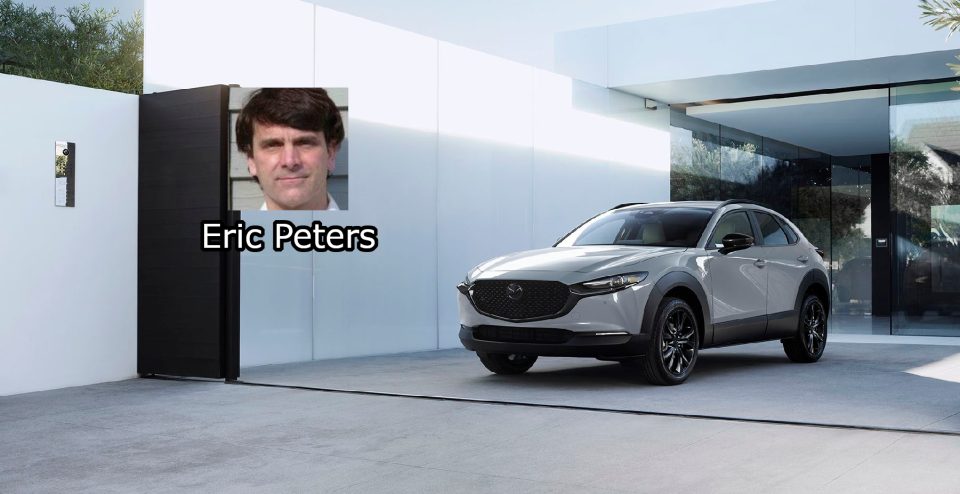
By Eric Peters

Everyone knows crossovers are practical. So are refrigerators. Neither are things most people get much excitement from. You buy them because you need them.
Mazda makes crossovers that are fun and practical — not necessarily in that order. More finely, in either order.

What It Is
The CX-30 is Mazda’s smallest and least expensive crossover.
Base price is $26,375 for the 2.5-liter S trim, which comes standard with a 2.5-liter four-cylinder engine (no turbo) paired with a six-speed automatic transmission. All-wheel drive is standard (it’s optional in several rivals).
The $28,060 2.5 S Select Sport has the same drivetrain but comes standard with larger (18-inch) wheels, synthetic leather seat covers, heated front seats, roof rails and dual-zone climate control.
Moving up to the $29,690 2.5 S Preferred adds a sunroof, larger (10.25-inch) touch screen and a wireless phone charger, among other upgrades.
The $30,250 2.5-liter S Aire Edition is basically an appearance package that’s the same as the Preferred but has unique 18-inch wheels, black roof rails and white synthetic leather seats.
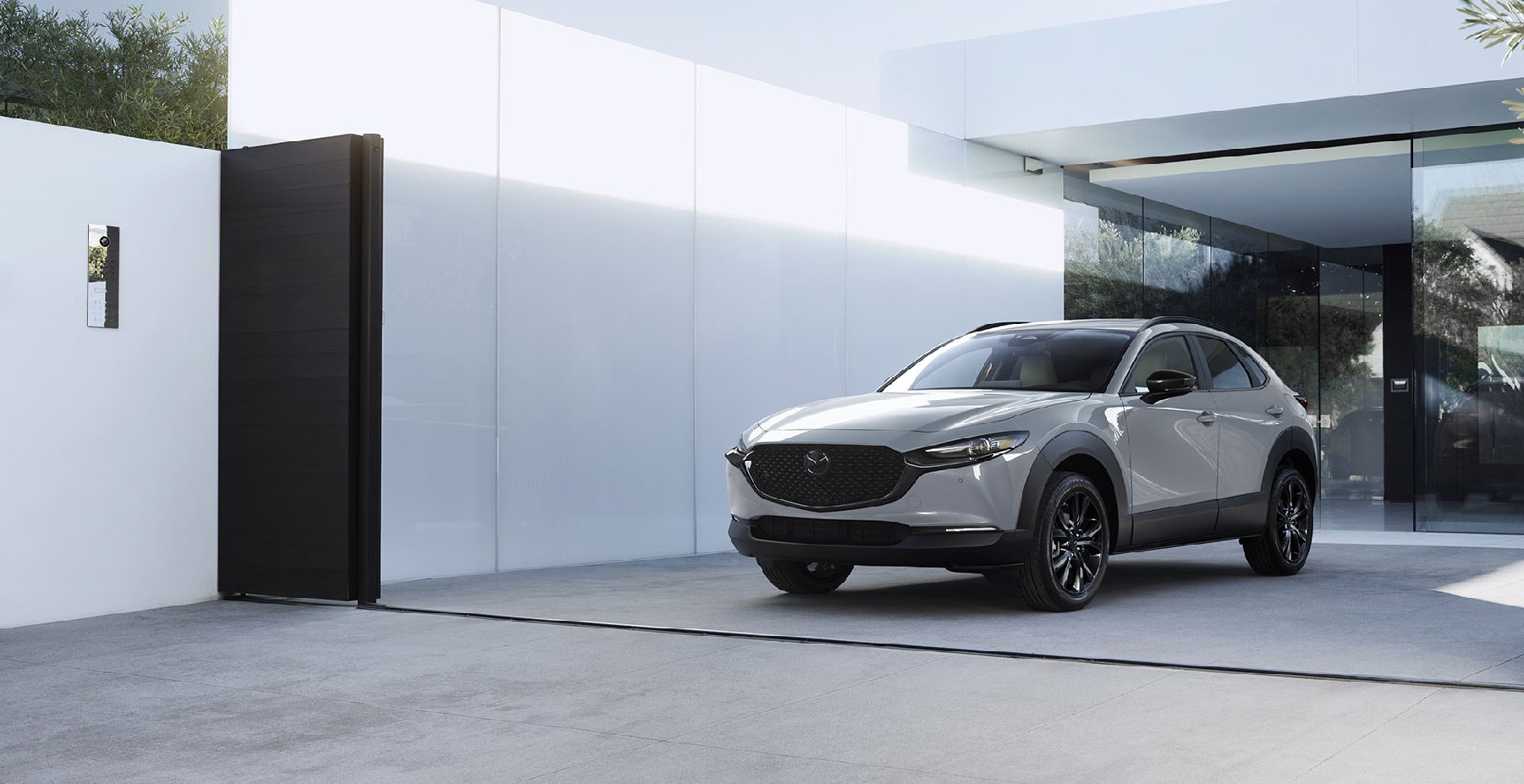
Similarly, the $31,430 2.5-liter S Carbon Edition is basically a Preferred with gray paint, chrome-silver trimmed rear spoiler and roof rails. This version of the CX-30 has red synthetic leather seat covers.
The $33,640 S Premium adds real leather upholstery, a heated steering wheel, adaptive headlights, a heads-up display and a power rear liftgate.
As the name implies, the $34,410 Turbo Aire Edition is the Aire Edition with a turbocharged version of the 2.5-liter engine.
At the top of the roster is the $37,900 Turbo Premium Plus, which gets the turbo’d engine plus enhanced adaptive cruise control, paddle shifters and a gloss black grille.
What’s New for 2026
The Aire Editions are new, and Preferred and higher trims get the larger 10.25-inch LCD touch screen. The CX-30 last got a major makeover six years ago, so the current model is probably the last iteration of the current model before the next major makeover.
What’s Good
— A practical little crossover that’s also a fun little crossover.
— Standard transmission isn’t a continuously variable transmission.
— Standard engine is big enough to not need turbocharging.
What’s Not So Good
— Optional turbocharged engine requires expensive premium gas to deliver its maximum power.
— Visibility to the side and behind is restricted by the relatively tall beltline, short side glass and low roofline.
— Rotary knob/push interface for the stereo system and other secondary systems can be awkward and distracting to use.
Under the Hood
One of the unusual things about the CX-30 is that its standard 2.5-liter four-cylinder engine is an appropriately sized engine. Put another way, it is big enough to make enough power — 186 horsepower — without the assistance of a turbocharger — to adequately power the CX-30. It can get to 60 mph in about 7.8 seconds, which is certainly quick enough to not feel underpowered. Many of the other small crossovers in the segment — such as the Honda HR-V, for instance — have smaller, less powerful engines (2.0 liters, 158 horsepower).
Another unusual thing about this Mazda is that its standard transmission is a six-speed automatic rather than a CVT automatic. Other small crossovers like the Toyota Corolla Cross and Hyundai Kona come with CVTs — and some of them (like the Kona) do not come standard with AWD; it’s an extra-cost option. It’s standard in all CX-30 trims.
Also unusual is the CX-30’s optional turbocharged engine, which makes as much as 250 horsepower if you pump premium unleaded into the tank. Most of the other small crossovers in this class don’t offer an optional engine — or the power/performance that the CX-30 does when equipped with its optional engine. Even if you don’t put premium in the tank, this engine still makes 227 horsepower (and 310 foot-pounds of torque). This is about 60 to 70 horsepower more than is available in the Kona, the HR-V and Corolla Cross.
Gas mileage is 24 mpg city, 31 mpg highway with the standard 2.5-liter (no turbo) engine and 22 mpg city, 30 mpg highway with the turbo’d version of the same engine. It’s interesting to note that there is almost no difference in gas mileage with the much stronger turbo’d version of the engine — although you will (per above) have to spend a little more on premium gas to get the most power out of this engine.
On the Road
The CX-30’s an easy sell relative to the other small crossovers in this class because it’s the only crossover in the class that is more than just an appliance. The Kona and HR-V and the Corolla Cross and Volkswagen Taos are fine little appliances. There is nothing wrong with appliances. We all need them. The CX-30 is something you might want.
There’s an important distinction there.
It’s not just the available power/performance either. You will understand as soon as you sit behind the wheel and see the instrument cluster. Not the digital display. The CX-30 has real (analog) gauges, dials and needles. There’s also no eye-movement monitor. Not yet. Mazda — unlike a number of other car companies — hasn’t yet, in anticipation of the federal requirement that goes into effect next year, put the “drowsy/distracted” driver tech into the CX-30. It will have to be there next year. But it is still this year.
The same theme carries over to the other “safety” tech that has leached its way into the standard equipment roster of every new vehicle, regardless of make or model. The CX-30 does have Lane Keep Assist, but the “assistance” can be fully turned off; same for the Forward Collision Mitigation (Mazda’s term for automated emergency braking).
The long and short is that this Mazda accepts that you’re the driver — and it is a car that likes to be driven (as opposed to trying to control your driving). It’s also 80% a Speed3 — the no-longer-available high-performance version of the Mazda3 hatch (last sold back in 2013). The Speed3’s engine was only a little stouter (263 horsepower), but what made it such a hellion was that all its power was sent to the front wheels exclusively, and exclusively via a six-speed manual transmission. It was hilarious fun to drive because of the skittering left-right torque steer and the rubber smears it could leave all over the road. Fast-forward to now and what you’ve got here is a more civilized hellion, with the 250 horses (in the turbo trims) sent to all four wheels, so no left-right skittering and no greasy smoldering smears of rubber — and it’s automatic only — but it gets the same job done more discreetly.
Less attention from the cops — and the insurance mafia too.
At the Curb
The CX-30 has the silhouette of a large-caliber bullet — something like a hollow-point .45 — slightly pinched and tapered. The roof seems almost chopped due to the relatively short door side glass. It looks great, but like many other things that look great, there are some practical downsides. Visibility to the side isn’t as good as it is in some other crossovers, but it’s a small price to pay for something that’s nice to look at. Something that doesn’t look like everything else. Also something that hasn’t got kabuki face (or angry catfish face).
You also don’t need a lot of room — to park.
The CX is only 173 inches long. To get a sense of that, the compact Mazda3 sedan is 185.3 inches long — nearly a foot longer overall. Even so — being a small sedan — it has a small (13.2-cubic-foot) trunk. The CX-30 has a 20.2-cubic-foot cargo area behind its backseats, and if you fold the backseats down, that more than doubles, to 45.2 cubic feet. That is almost four times as much space for whatever you need to carry than the Mazda3 sedan can carry in its trunk. This is why crossovers have largely taken over the role that cars once played. A small car like the Mazda3 is a fine commuter car or single person’s car, but it is too small a car for a family. A smaller — on the outside — crossover like the CX-30 can serve as a family car. It’s much more practical. Of course, this is true of all the other crossovers too. The difference is, the CX-30 is more than just practical.
The console-mounted dial/push wheel that is used to do things like find the station you want to listen to is not the greatest thing since sliced bread. Or a simple/separate “tune” knob. To find the tuner controls, you have to go through a process of pushing the wheel left then down to select the menu you want, then again to control the function you want. It’s an “all-in-one” arrangement that does declutter the car’s interior, but having a separate knob to change stations is a control interface that’s probably not possible to improve upon. So why try to “improve” upon it?
All CX-30 trims are equipped with the necessaries as well as many features (such as LED headlights) that would have been considered luxury features not that long ago. Even the base 2.5-liter S trim compares very favorably with Audi and BMW and Lexus crossovers, and when you factor in the availability of the 250-horsepower turbo’d powerplant, it compares even more favorably.
The Rest
One small gripe about this CX-30: If you rotate the lefthand stalk that controls the headlights from “auto” to “off,” the headlights will turn off. Assuming the car isn’t moving. Once it starts moving, the lights come back on. This means driving around in broad daylight with your headlights on, which is kind of silly — as well as an annoyance to the people ahead of you.
There may be a way to keep them from coming back on, but I wasn’t able to find it.
The Bottom Line
In a class of appliances, the CX-30 stands out as something more than just another appliance.
Eric’s latest book, “Doomed: Good Cars Gone Wrong!” will be available soon. To find out more about Eric and read his past columns, please visit the Creators Syndicate webpage at www.creators.com.
COPYRIGHT 2026 CREATORS.COM
