Over the years, I have expressed my general opposition to the trimming of desert fan palms, Washingtonia filifera, on public lands owned or managed by Coachella Valley cities. I have expressed this opposition in letters to city councils, mayors, and The Desert Sun. On two occasions, letters from myself and many other have succeeded in halting widespread trimming, saving cities thousands of dollars.
But time passes, new employees arrive, new council persons are elected, and the wisdom of past practices fades away. Palm Springs has been considering a new tree-trimming plan, and the city council was scheduled to discuss it at a public meeting the evening of Wednesday, July 8. So, for the record, the information I have shared previously is still valid.

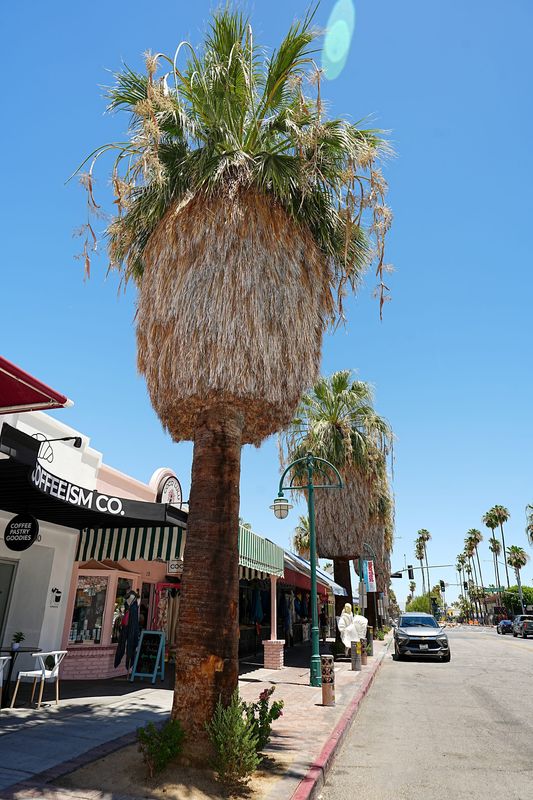
Desert fan palms, by far the dominant palm species lining Palm Canyon Drive in Palm Springs, are more likely to shed fronds and flower stalks when there is no skirt to support them. Leaving the skirt intact supports the plant parts that have expired and greatly reduces the chance that chunks of the skirt will fall away. I do recommend removing dead skirts below 12 feet from the ground when adjacent to structures, so that the skirt is beyond the reach of ignition sources (cigarette butts, for example). However, the skirt must be tapered so that its bottom contacts the trunk. The crew cutting of the bottom of the palm skirt initiated by former Palm Springs mayor Steven Pougnet actually increased the hazard of falling palm debris.
I have no objection to trimming the Mexican fan palms (Washingtonia robusta). The Mexican fan palms are very tall and have narrow trunks. Unlike desert fan palms, they shed their leaves in high winds.
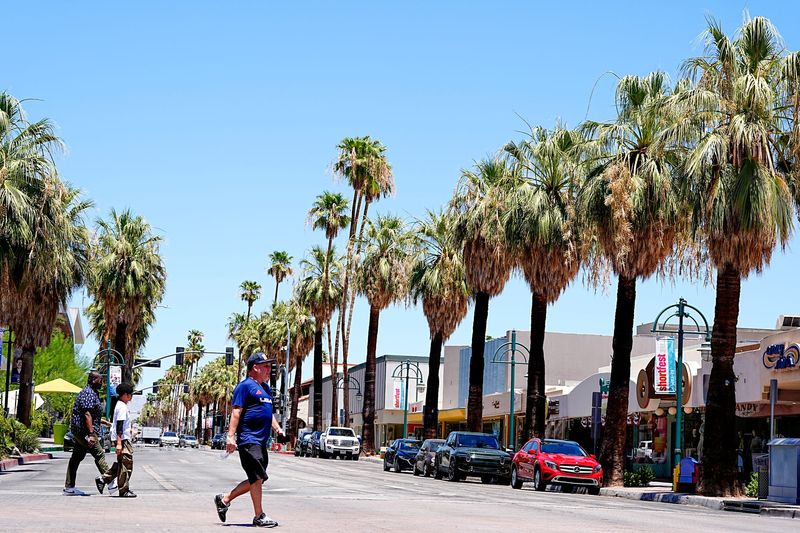
Our native desert fan palm is unique in many ways. It is the most cold-tolerant palm in the world, the only native palm tree in the American Southwest, is the largest palm tree in North and Central America, and reaches its greatest abundance in the Coachella Valley, particularly within the city limits of Palm Springs. As the saguaro cactus is the icon of Arizona’s Sonoran Desert and the Joshua tree the icon of the Mojave Desert, the desert fan palm is the icon of Palm Springs and the Coachella Valley. It was no wonder that the founders of Palm Springs chose it as the most distinctive feature of downtown Palm Springs.
There is one other unique characteristic of the desert fan palm. Of the approximately 2,500 palm species in the world, the desert fan palm is the only palm tree species whose dead fronds adhere to the trunk throughout its life. It is this skirt, sometimes called a petticoat, that visually distinguishes the desert fan palm from all other palm species. Remove the skirt, and you remove its most distinguishing feature. That is why the founders of Palm Springs left the skirts on the palms, and why we should leave them on today.
Some details regarding frond removal are worth mentioning. Rats do not live in the palm skirts. I have never found a rat nest in a skirt and have never been shown one. I once offered $100 to anyone who could show me a rat nest in a desert fan palm. Not surprisingly, no one ever collected the $100.
Our most beautiful nesting bird, the hooded oriole, fixes its nest to the underside of a green, horizontal frond. Remove fronds before July 1, and you destroy their nests.
The hanging flower and fruit stalks provide abundant food for birds. Many people, however, find the flowers and fruits that eventually fall to the ground to be a nuisance. Consider trimming off the flower and fruit stalks, but leave the fronds.
In closing, it is worth remembering that all trees shed something, are always a potential fire hazard, generally require trimming, and can be toppled by high winds. The desert fan palm generally does not require trimming and never topples over in high winds. It is, therefore, always an excellent landscape choice in Palm Springs.
James Cornett is a desert biologist living in Palm Springs. Contact him at JWCornett@aol.com.
This article originally appeared on Palm Springs Desert Sun: Palm Springs’ palm tree trimming plan is misguided. Here’s why
Reporting by James W. Cornett, Special to The Desert Sun / Palm Springs Desert Sun
USA TODAY Network via Reuters Connect

By James W. Cornett, Special to The Desert Sun | USA TODAY Network