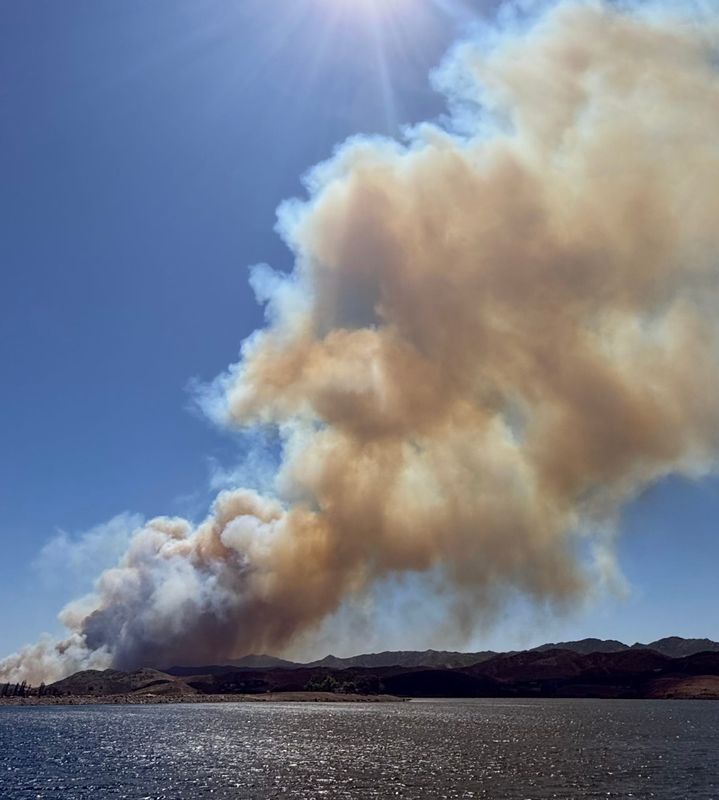
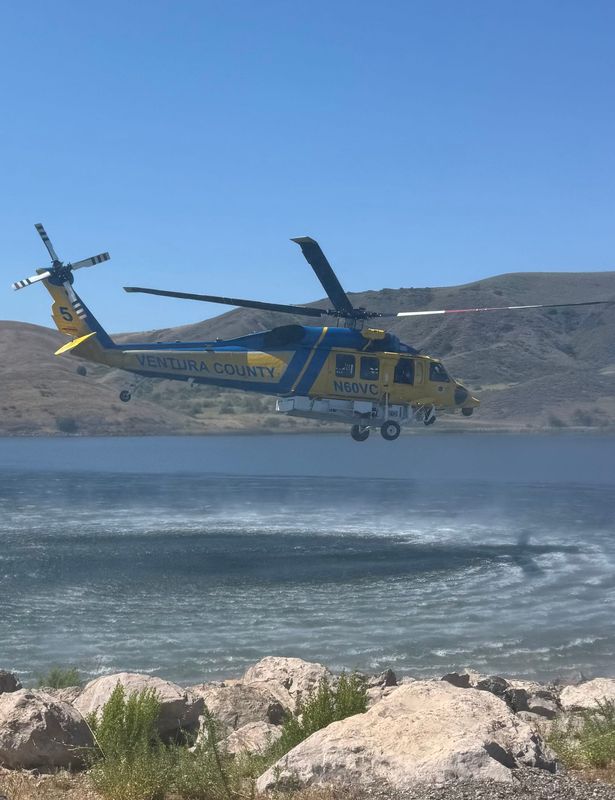
Crews fighting the Sandy Fire in the Simi Valley area flew to a nearby reservoir, filling water tanks hundreds of times over multiple days and nights, as officials said they repeatedly topped off the lake.
The Calleguas Municipal Water District’s Lake Bard in Thousand Oaks allowed for a turnaround time of a matter of minutes, fire officials said. The reservoir, also on the edge of Simi Valley, holds an emergency water supply and became the primary source for aircraft fighting the fire.

The aerial operations started shortly after the blaze was reported around 10:15 a.m. on May 18 and continued for the next four days. The blaze had immediately threatened homes and prompted evacuation orders and warnings for tens of thousands of local residents.
By May 27, the Ventura County Fire Department reported the nearly 2,200-acre fire was 94% contained.
Calleguas typically would have dozens of firefighting dips in the lake every year, officials said. The tally in the Sandy Fire totaled 808.
“Even with these hundreds of dips that the firefighting helicopters performed in Lake Bard, it is really still a very small amount of the water that’s in the lake,” said Ian Prichard, the wholesaler’s deputy general manager.
Aircraft pulled water from the lake day and night, some that can carry up to a 1,000 gallons of water and others up to three times that amount, officials said. At times, multiple aircraft dipped in the lake at the same time.
How much water did Sandy Fire aircraft get from Lake Bard?
Calleguas buys imported water from Metropolitan Water District of Southern California and supplies at least a portion of the water for roughly 75% of the county’s population, from Simi Valley to the Oxnard Plain.
In all, helicopters and larger tankers used more than 787,000 gallons of water over the four days. That’s around 2.42 acre-feet, more than four times what a family of four would typically use in a year.
But it is also a small fraction of the water kept in the lake or even what would be lost annually to evaporation, Calleguas officials said. Around 930 acre-feet are lost to evaporation per year in the reservoir of more than 3.4 billion gallons of water, or around 10,500 acre-feet, Prichard said.
Who pays for the water dropped on the Sandy Fire?
Calleguas provides water for a regional emergency response, and the wholesaler does not send out a bill to fire departments or individual water districts in the area of a blaze, officials said.
Instead, the cost is one item built into annual operating costs, like water lost to evaporation would be part of the equation, officials said. Those costs are then spread out over the entire customer base.
The cost of water purchased from Metropolitan totals $1,528 per acre-foot. Firefighting aircraft used 2.42 acre-feet for a total cost of nearly $3,700.
How much did water use rise as the Sandy Fire ignited?
Water use jumped up within the first 90 minutes of the Sandy Fire.
“We get instantaneous reads on how much water is coming through the tunnel from Metropolitan Water District,” Prichard said. “That jumped 40% over the course of the morning, which is significantly more than the normal increase.”
Demand regularly spikes in the morning, when people wake up and get ready for work and school. Water use then dips over the course of the morning, until it spikes again in the evening. But on May 18, demand spiked later than normal in the morning and stayed high throughout the day, officials said.
It then remained above normal before tapering off in the evening. Prichard attributed the jump at least partly to officials and others reacting to the blaze. That included water districts topping off their tanks, he said.
Cheri Carlson covers the environment for the Ventura County Star. Reach her at cheri.carlson@vcstar.com.
This article originally appeared on Ventura County Star: How much water did aircraft drop on the Sandy Fire, who pays for it?
Reporting by Cheri Carlson, Ventura County Star / Ventura County Star
USA TODAY Network via Reuters Connect