Fungi are taking the U.S. by storm — and California is emerging as one of the nation’s most active hotspots.
What scientists sometimes call “fungal storms” are not a new type of weather, but a dangerous overlap between climate conditions and airborne biology. Strong winds, dust storms, flooding, and dry soil can all lift microscopic fungal spores into the air, where they can travel long distances and be inhaled.

In California, that combination is becoming more concerning as the state cycles between heavy-rain years, extreme heat, and prolonged dry periods — conditions that can both promote and spread soil-dwelling fungi.
What ‘fungal storms’ actually are
Fungal storms aren’t storms in the traditional sense. Instead, they describe situations in which weather systems help move fungal spores through the air, often carried on dust and soil particles.
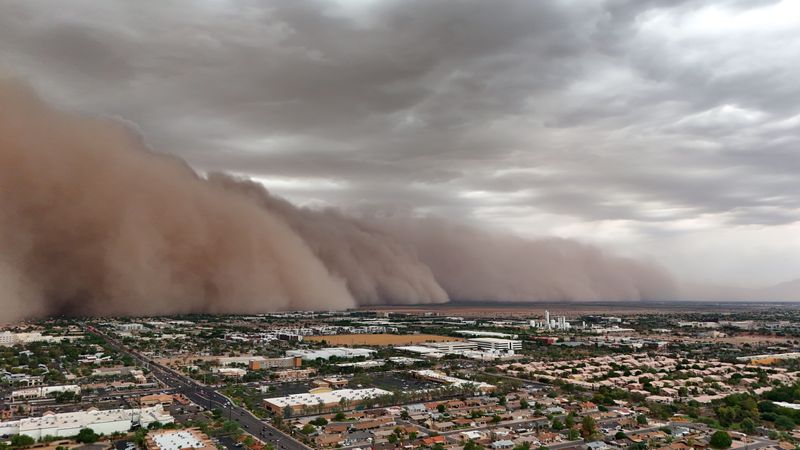
When wind disturbs dry ground — especially during dust storms or haboobs — spores can be lofted into the atmosphere and carried across regions. Heavy rain and flooding can also play a role by promoting fungal growth in soil, which is then dispersed when the ground dries out, and winds pick back up.
Construction, agriculture, and wildfires can also disturb soil and release spores into the air.
Once airborne, these particles are easily inhaled without people realizing it.
“Sand and dust storms do not just mean dirty windows and hazy skies,” Celeste Saulo, secretary-general of the World Meteorological Organization, told BBC Science Focus Magazine. “They harm the health and quality of life of millions of people and cost many millions of dollars through disruption to air and ground transport, on agriculture, and on solar energy production.”
Why California is a hotspot
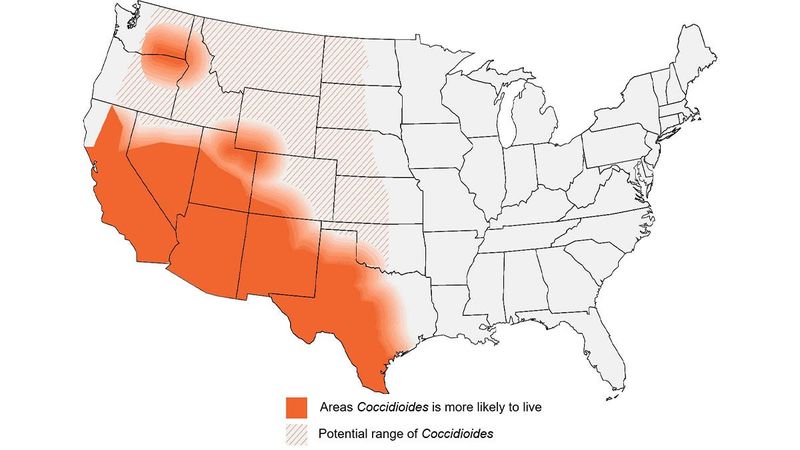
In the United States, the highest risk for airborne fungal exposure is in the Southwest, particularly Arizona, California, New Mexico, and parts of Texas, where fungi naturally live in dry, sandy soils.
California stands out because it combines large stretches of arid and semi-arid land with dense population centers and frequent soil disturbance from development, farming, and wildfire recovery.
Public health data shows how quickly exposure has increased. California reported about 1,400 Valley fever cases in 2002. By 2024, that number reached a record 12,444 before falling to about 10,700 in 2025, according to the California Department of Public Health. Early 2026 data shows lower activity so far, though officials continue to monitor trends closely.
At the same time, cases have appeared farther north and west in recent years, including Oregon and Washington. Researchers say that does not necessarily mean the fungus is rapidly expanding everywhere, but may reflect a mix of changing environmental conditions, shifting exposure patterns, and improved detection.
What Valley fever is — and how it spreads
Valley fever is not contagious and cannot spread from person to person. Infection occurs when people inhale spores of the fungus Coccidioides, which lives in soil and can become airborne when dirt is disturbed by activities such as construction, agriculture, and wildfires. High winds are a key driver of larger-scale exposure events.
These events, sometimes called fungal storms, occur when wind and dust storms lift microscopic spores into the air. In the Southwest, this can include spores that cause Valley fever (Coccidioidomycosis). The particles can travel long distances in fast-moving dust systems, including haboobs, increasing the likelihood of inhalation.
Weather patterns can also contribute. Periods of heavy rain followed by dry conditions may promote fungal growth in soil, while subsequent dry, windy weather can disperse spores. Flooding, monsoon activity, and tropical storm remnants can all play a role in this wet-dry cycle, according to researchers and public health officials.
Once inhaled, the microscopic spores can infect the lungs. Many people who are exposed do not develop illness, but those who do can experience symptoms ranging from mild respiratory issues to more severe disease.e.
Could weather patterns increase Valley fever risk this year?
Climate patterns such as El Niño and marine heat waves can influence rainfall, storm activity and wind patterns in the Southwest, including California, where forecasts have suggested an increased chance of tropical system remnants affecting the region this season.
Those shifts can affect environmental conditions linked to Valley fever exposure, including periods of heavy rain followed by dry, windy weather that can disturb soil and spread fungal spores. Public health experts say those are the types of conditions that can contribute to increased exposure, but there is no clear indication Valley fever cases will be higher this year.
A similar pattern occurred in 2013 when Hurricane Hilary brought heavy rain and strong winds into Southern California and the desert Southwest, prompting public health warnings about potential exposure risks.
“I’m not sure we can prevent people from getting valley fever,” Christie Michie, assistant director of public health in California’s Monterey County, told USA TODAY during a September 2025 outbreak. “It’s very difficult to avoid dust in our environment. But what we don’t want is for people to get really sick with Valley fever.”
However, higher potential exposure does not necessarily lead to more reported cases of Valley fever.
Expanding concern as climate patterns shift
Scientists say warming temperatures and shifting moisture patterns may be helping some fungi survive in new areas or become more resilient.
Species such as Aspergillus thrive in warmer conditions, and some fungi are also showing signs of increased drug resistance, according to reporting from Earth.com.
“We’ve already seen the emergence of the fungus Candida auris due to rising temperatures, but, until now, we had little information on how other fungi might respond to this change in the environment,” Dr. Norman van Rhijn of the University of Manchester told Earth.com.
Climate patterns like El Niño and marine heat waves can also influence rainfall and storm tracks across California, shaping the very conditions that determine when and where spores become airborne.
While these shifts may increase the potential for exposure, public health experts caution that higher risk conditions do not always translate into higher case counts in any given year.
Common fungal species in airborne exposure
Several fungi are most often linked to airborne soil exposure:
Of these, Coccidioides and Aspergillus are generally considered the most medically significant for humans.
Are all fungi dangerous?
Most fungi are not harmful to people. Many play essential roles in ecosystems by breaking down organic matter or supporting food production, including mushrooms, bread, and cheese.
Only a small fraction of fungal species can cause disease in humans, and serious infections are typically limited to those with weakened immune systems.
Even so, scientists say changing environmental conditions are reshaping when and where exposure happens — especially in regions like California, where dry soils, wind, and development increasingly overlap.
Stay informed. Get weather alerts via text
Brandi D. Addison covers weather across the United States as the Weather Connect Reporter for the USA TODAY Network. She can be reached at baddison@gannett.com. Find her on Facebook here.
This article originally appeared on Palm Springs Desert Sun: Are fungal storms becoming more common? Why California is a hotspot
Reporting by Brandi D. Addison, USA TODAY NETWORK / Palm Springs Desert Sun
USA TODAY Network via Reuters Connect