While Detroit officials and community members are celebrating the city’s third straight year of population growth on May 14, city attorneys are preparing to return to court in an ongoing fight against the U.S. Census Bureau’s methodology that they say has been undercounting residents for years.
The lawyers are scheduled to be in federal court for a hearing Friday, May 15, in front of District Court Judge Matthew Leitman in an attempt to get the census bureau to stop using the so-called County Cap Rule in its population counts, which would resolve the third issue from a 2024 lawsuit filed against the bureau. The city still is fighting to correct what it says is the undercount from the 2020 decennial census, which showed a 10.5% decline.

The County Cap Rule basically says that if the sum population of all local municipalities within a county is higher than the census bureau’s estimate for the county as a whole, the bureau will adjust all municipal population figures downward to match the total county estimate.
The bureau also uses different methods to estimate county populations versus city populations: relying on birth, death and migration data to estimate county populations, but using housing data for city population estimates — and counting demolitions and rehabs as population loss.
“The County Cap is an artificial redaction to the city’s population based on the county’s total,” Trisha Stein, the city’s chief strategy officer, said. “It means that the total population of all the cities and towns within Wayne County — and all the counties, this is across the country — can’t be greater than the county’s population. That seems to make sense, except that they estimate the county’s populations different than they do the cities. They’re different data sets.”
Detroit officials have argued that, because of all this, the census bureau has been undercounting its residents by the thousands for years as the city pushed forward with an aggressive demolition program that took down thousands of abandoned homes and structures. Simultaneously, local officials say, the bureau has not given the city credit for the thousands of vacant homes and structures that have been sold and rehabbed.
Collectively, the County Cap Rule and differing population estimate formulas for counties and municipalities, are stripping down Detroit’s population, which saw about a 1% growth of 5,060 residents in 2025, according to Stein.
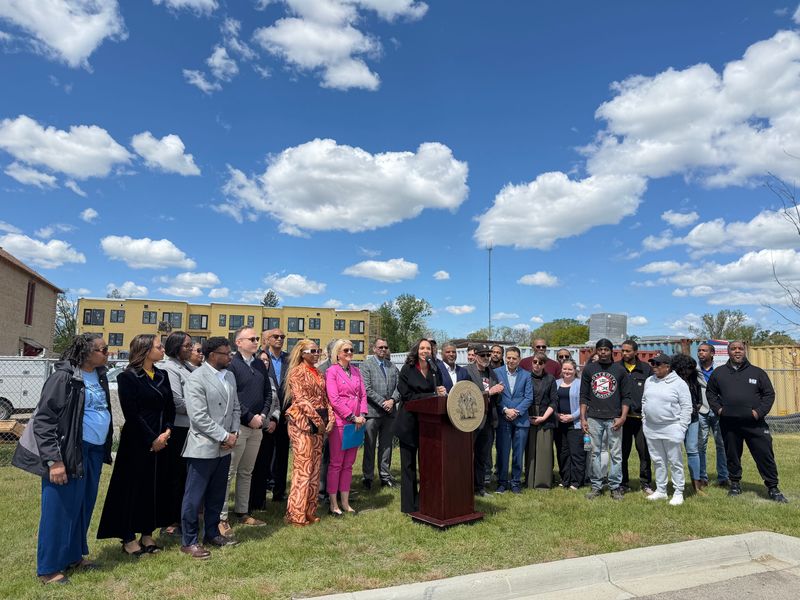
Despite the legal wrangling, Mayor Mary Sheffield, Stein and dozens of other city and community members celebrated Detroit’s growth Thursday afternoon, May 14, in front of the former Higginbotham School — which is being redeveloped into 100 residential units — near the U of D Jesuit Johnson Recreation Center.
Sheffield said she expects boosts in housing, businesses and neighborhood investments will put Detroit’s population on a path toward continued growth.
Sheffield touted May 14 — when the Census Bureau released the latest figures — as an important day for the city, which “led the state of Michigan in population growth this year.” Detroit’s population has grown by nearly 15,000 residents over the past three years.
“For decades, the story told about Detroit was always one of decline. Year after year, families left, population shrank, and too many people counted Detroit out,” Sheffield said, noting the three years of growth did not happen by accident.
“Today, the numbers tell a different story. And they tell the real story of what is happening in our city: a city that is rising higher; a city that is growing stronger, gaining momentum and vitality; a city where opportunity, momentum, and possibility are,” she said.
“It is a result of intentional investment, strong partnerships and the hard work of Detroiters who never gave up on this city,” Sheffield said, praising investments toward safer neighborhoods, growing economic opportunities, housing, city services, longtime Detroiters choosing to stay, and new residents moving in.
As for the ongoing debate about the city’s population, Data Driven Detroit founder Kurt Metzger predicted Detroit has at least 25,000 more residents than counted. Stein added that one of the city’s experts, Jeffrey Morenoff, a University of Michigan professor at the Gerald R. Ford School of Public Policy, found the bureau systematically underestimates Wayne County’s population.
“It’s so important that every Detroiter gets counted. It results in federal and state dollars. That’s how our funding gets calculated, is by our population and that’s why we’re fighting to ensure that the dollars that come back to the city go to education, go to roads, go to housing development and go to support our transportation and our vital city services,” Stein said.
Florida native Shauna Jones is a new resident to Detroit, having lived in multiple big cities, including Miami, Orlando, Atlanta and Memphis. But of all places, she chose to settle in Detroit due to a variety of reasons, including affordability, access to business grants, sports teams and more, Jones said.
“Detroit checked every box for me. One of the first things that attracted me was the accessibility of a world-class international airport that keeps me connected globally. As someone who travels often, that matters,” Jones said.
She added that housing was another driver, particularly for first-time homebuyers who can take advantage of down payment assistance programs.
“In many major cities today, home ownership feels out of reach for everyday people, but Detroit still offers real opportunities to own a home without being priced out,” Jones said.
She also touted Detroit’s public green spaces, the riverfront and access to organized sports leagues for adults. Despite the city’s, and state’s, unpredictable weather, Jones said the four seasons also convinced her to move to the city.
For newcomers like herself, Jones said she has found “welcoming neighbors, strong community, authenticity, pride, and resilience. There’s a spirit in this city that can’t be manufactured. It has to be experienced.”
Dana Afana is the Detroit city hall reporter for the Free Press. Contact: dafana@freepress.com. Follow her: @DanaAfana.
This article originally appeared on Detroit Free Press: Detroit celebrates population growth, but court battle is not over
Reporting by Dana Afana, Detroit Free Press / Detroit Free Press
USA TODAY Network via Reuters Connect