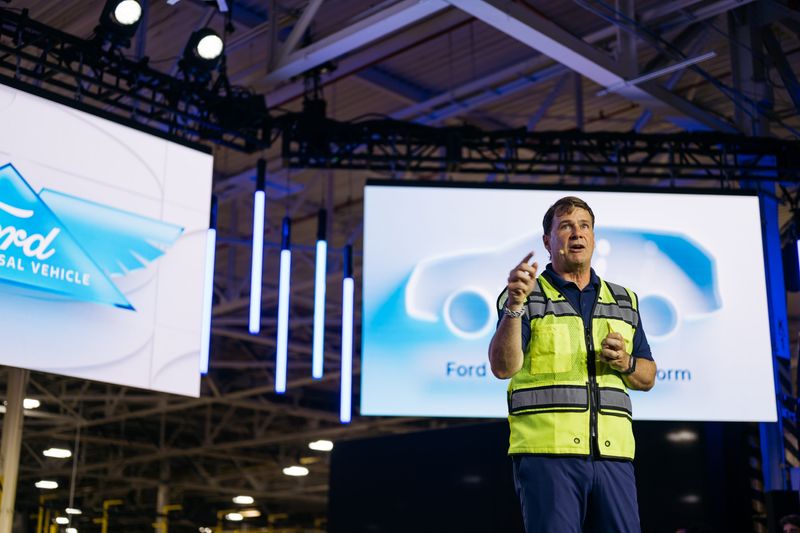
Ford Motor Co. leaders spent the morning of May 14 making a plea to investors as to why they should continue to support Ford during a massive business shift and as the world teeters on economic uncertainty.
Ford’s management addressed investors during the company’s annual meeting — a mandatory meeting companies hold with shareholders so that management can discuss the financial performance and future strategies of the business as well as allow stakeholders to ask questions and vote on proposals or other matters.

Inside Ford’s meeting, CEO Jim Farley and Executive Chair Bill Ford outlined their vision for making Ford more competitive by bringing to market vehicles of high quality, top engineering and exciting design in an array of powertrains. They reiterated Ford’s firm commitment to electric vehicles and to bringing a more affordable new lineup to consumers in the next few years.
Farley and Ford also fielded some tough questions from investors, though offered little detail in their answers.
During the meeting, shareholders demanded accountability for a massive write-down and business overhaul, questioned the impact of President Donald Trump’s autos tariffs and they wanted to know how the conflict in the Middle East will impact Ford’s supply chain.
Farley assured investors that a “more modern” Ford is emerging, especially as it launches its new Universal Electric Vehicle program and the first vehicle to come off it, an all-electric midsize pickup priced at about $30,000 next year.
“It will be a rigorously efficient, midsized truck, with aerodynamics, driven by all of our engineers, what we’ve learned from Formula 1 and we’re learning in the Skunkworks model that produced the UEV to improve all of Ford,” Farley said. “UEV is a step-change for us in efficiency, affordability, as well as capital efficiency. The result is reduced cost, improved quality across the board, as we execute an aggressive product pipeline … refreshing 80% of our North America portfolio and 70% of our global portfolio by 2029.”
The company is on track to achieve $1 billion in cost savings this year, Farley said, adding: “Our internal data is showing us fully competitive with Toyota, on quality in North America plants — exactly where we want to be.”
Bill Ford told investors the company is studying various scenarios of how the war in Iran could impact the Dearborn automaker if the conflict continues, assuring them that Ford has a variety of fuel-efficient powertrains to offer consumers if gasoline prices remain elevated.
“We are actively planning scenarios with that,” Ford said. “The one issue that is in the news every day is the price of oil per barrel, which translates into the price of gasoline in the pump. You talk about the (Universal Electric Vehicle) platform that we’ve got coming and, that obviously is something that if the price of gasoline stays higher for longer, that product will be, it’ll be in great demand anyway, but (high gas prices) accelerates the demand for that.”
Here are some of the questions shareholders posed, not necessarily in order, to Farley and Ford and their answers:
Ford posted a large net loss in 2025 and took a massive write-down for unsuccessful investments; where’s the accountability?
For context, this question refers to Ford’s 2025 adjusted earnings before interest and taxes plunging 34% to $6.78 billion compared with $10.2 billion in 2024 as the company navigated added costs of tariffs, struggled with production issues after a supplier fire and redefined its lineup including ending production of the popular Ford Escape compact SUV.
Part of that hit included a write-down that Ford had warned Wall Street in December it would record of $19.5 billion related to pulling back its all-electric vehicle investments to shift focus to gasoline and hybrid vehicles and enter the battery storage systems business, Ford Energy. Ford said it would record most of the charges during fourth quarter 2025, followed by $5.5 billion in cash to be charged through 2027.
Bill Ford answered the question saying: “I think taking the write-down was exactly the accountable thing. The regulations changed virtually overnight on us, and when that happened, we could have chosen to do nothing and limped along, but we took what we thought was the right shareholder action, which was to recognize that the market had changed dramatically. We took the write-down, so that going forward, you’d have a much healthier business as shareholders. We believe that’s happening.”
Bill Ford said the company was able to find usage for some of the factories it had built initially to make EV batteries, but when it become clear EV demand would not require that much factory space, it still found a use for them by starting Ford Energy, its subsidiary that will make battery energy storage systems.
“Look, no one likes to take a write-down, but it was the accountable thing to do recognizing that the business reality had changed,” Ford said. “Rather than hope that that wouldn’t happen, we took decisive action and now you have a profitable business going forward, which I think you’re gonna be very proud of.”
There’s a lot of economic uncertainty; what impact will tariffs have in the long run?
Bill Ford said: “First of all, we have a very good relationship with the administration. They listen to us, they take our input, and we have dialogue with them on a variety of issues almost every day. And, we’re the most American company. So that really kind of squares nicely with the administration’s goal of strengthening American manufacturing and that’s what they’re trying to do. We’re very supportive in that.”
Ford said the 25% tariffs Trump put on imported cars and auto parts do add to Ford’s costs, but “we’re well positioned relative to others on that. We took a deliberate decision to be the most American company. Are there places we could have gone in the world which would have made things less expensive? Yeah, there are. But we decided, no, we want to be the most American company. We’re very proud of that. It’s our heritage, it’s our future and that’s actually stood us in very good stead as we go through these economic times because our country is rebuilding its industrial base, and Ford is recognized as the heart and soul of that industrial base.”
What is the impact of the war in the Middle East having on Ford’s business?
Jim Farley took on this subject: “We have deep expertise in dealing with these kind of events, like the (COVID-19) pandemic, chip shortages, and we pull out that playbook and use it daily and it certainly helped us with this latest crisis. Our team is very resilient. To date, our customers have been resilient as well, and I’m happy to report that customers in the U.S. continue to find our products very attractive, despite some of the costs going up on gasoline.”
Farley pointed to Ford’s strong balance sheet as offering it flexibility to address economic challenges. Ford ended the first quarter with $22 billion in cash and $43 billion in total liquidity, which includes cash and credit lines. In the first quarter, Ford’s revenue rose 6% to $43.3 billion compared with the year-ago period.
“There are some asymmetric impacts to our business in southeast Asia, of course, Middle East,” Farley said. “We’ve seen some headwinds. They haven’t been headwinds that we haven’t been able to offset. We’ve had some cost increases, but we’ve also had some good news … on the revenue side and our controllable costs. So far we’re in good shape. We have a hybrid lineup. Hybrids continue to be in more higher demand, like the F-150 hybrid … and that’s been a huge asset to give customers choice as they adjust to their pocketbook. Outside the U.S., even though there’s been some headwinds, we’ve been able to manage those successfully. So, we’ll see how things go.”
What steps is Ford taking to reengage aggressively in growing the EV market segment?
Farley said Ford recognizes the vibrant EV business globally and “we are completely committed to electric vehicles. Not just here in a home market, but on a global scale. It’s essential for our competitiveness as a company, and we continue to learn that not only are EV customers super loyal to EVs, and so it will continue to grow as a market, but it’s incredibly important for innovation in our industrial system. Last year, we explained our plan to better align our EV strategy to the market realities, and establish a path for Ford Model-E, our products … to reach profitability in 2029.”
He said the Universal Electric Vehicle platform that Ford will launch next year at its Louisville Assembly Plant in Kentucky will allow it to scale up several new and affordably priced EVs for the market.
“This will be an enormously important vehicle for us and platform,” Farley said. “We’ll start with a midsize truck, but we have lots of plans for other vehicles off the platform. We’ve designed this vehicle to be the most affordable and have the lowest operating costs of any EV for customers and this will be really exciting development for the company.”
Does Ford have too large (of) a board of directors that lacks diversity?
An investor posed this question about the size of Ford’s board of directors, which has 13 members, not including Farley and Bill Ford. According to the National Association of Corporate Directors, a typical board of directors for a public company has about 10 to 12 members. General Motors, for example, has 11 members on its board.
Bill Ford’s reply was to say he felt the size and diversity of the board is working.
“It’s got a lot of global experience, and you want a board that is well equipped to change in a rapidly changing world,” Ford said. “To do that, you really need world-class business people on your board that can help us all make decisions and I think that’s exactly what we’ve got. You can hire skill sets, but what’s most important … for a board, is judgment and helping navigate a very uncertain world that we’re in. Our board does that for us, and I’m very happy with it. I don’t think the board is too big. You kind of run into issues if you shrink it too much in terms of filling your committees. We have a little bit of flexibility in our board size.”
There’s a lot of interest in the new battery storage system subsidiary Ford Energy especially since it’s moved the stock (price), can you talk about that?
As the Detroit Free Press reported, Wall Street firm Morgan Stanley is betting on Ford’s $2 billion investment in Ford Energy to improve Ford’s electric vehicle unit’s pretax profits once the new business reaches full capacity. Ford’s Model-e unit has been losing about $5 billion a year. Ford stock surged 14% in midday trading on May 13 after Morgan Stanley’s endorsement.
Farley said: “With Ford Energy, we see a path to diversify our revenues of the company and de-risk the core automotive business. Battery energy storage systems have the potential to be high-growth, high-margin … and that energy business will provide United States assembled battery energy storage systems to utility partners, the data center buildout for our country, large industrial and commercial customers in the U.S. at a great, low cost, high-quality option to store energy.”
He said Ford will own the plants and employees for Ford Energy with the energy storage systems made in Marshall, Michigan, and in Kentucky, starting production late next year.
“We have a great sales and service support team for all of our customers across the U.S.,” Farley said. “We have seen tremendous interest from customers, and we’re actually in the contracting phase for our early capacity as we speak, with several customers. So, we’re off to good start both on the supply side, building the plants, building the cells, getting the machines up and running, as well as the demand creation side.”
A few shareholders asked about Chinese automakers and Ford’s position on that front
Farley said as America’s largest auto producer, Ford is dedicated to a thriving U.S. auto industry and to safeguarding the industrial base.
“Protecting this is a matter of America’s economic vitality, and, of course, it’s critical for a national security as a country,” Farley said. “While we leverage global partnerships, including Chinese (automakers), to grow our business around the world, I would just simply say, our commitment to a level playing field here in our home market and safeguarding that home market remains absolute at Ford.”
Why is Ford involved in racing?
Bill Ford said racing is the foundation of Ford and offers many benefits.
“Our company was born on a racetrack,” Ford said. “My great-grandfather bet on a race, that he raced a professional driver, and nobody else bet on him, I don’t think, but he bet on himself. He won the race and took the money and started Ford Motor Company. And we’ve been racing ever since as a company. But why do we do it? We do it for our brand reputation.”
He said people see the Ford Oval and get emotional about it. In Australia, for example, people not only wear Ford gear, but they have Ford tattoos.
“It just shows how passionate people are. You go to any racetrack, and you see people wearing full colors of whoever their favorite race team is and a disproportionate amount of that is the Ford oval,” Ford said. “But also, we do it for business reasons. Our engineering team loves to work on race-related things. It’s cutting edge. There’s a lot of tech transfer from what we prepare for race day, and then what ultimately comes back to all of you as buyers of Ford products.”
Finally, he said Formula 1 puts Ford on a global stage and the demographics that follow Formula 1 are now younger and more female than in the past, opening the company to a new audience and potential car buyers.
“So, for all those reasons, I think it’s important that we race and that we continue to race,” Ford said. “I’m very proud of how we’ve done on the racetrack, and I expect us to continue and continue to win.”
Jamie L. LaReau is the senior autos writer who covers Ford Motor Co. for the Detroit Free Press. Contact Jamie at jlareau@freepress.com. Follow her on Twitter @jlareauan. To sign up for our autos newsletter. Become a subscriber.
This article originally appeared on Detroit Free Press: Ford leaders take on tough shareholder questions at annual meeting
Reporting by Jamie L. LaReau, Detroit Free Press / Detroit Free Press
USA TODAY Network via Reuters Connect