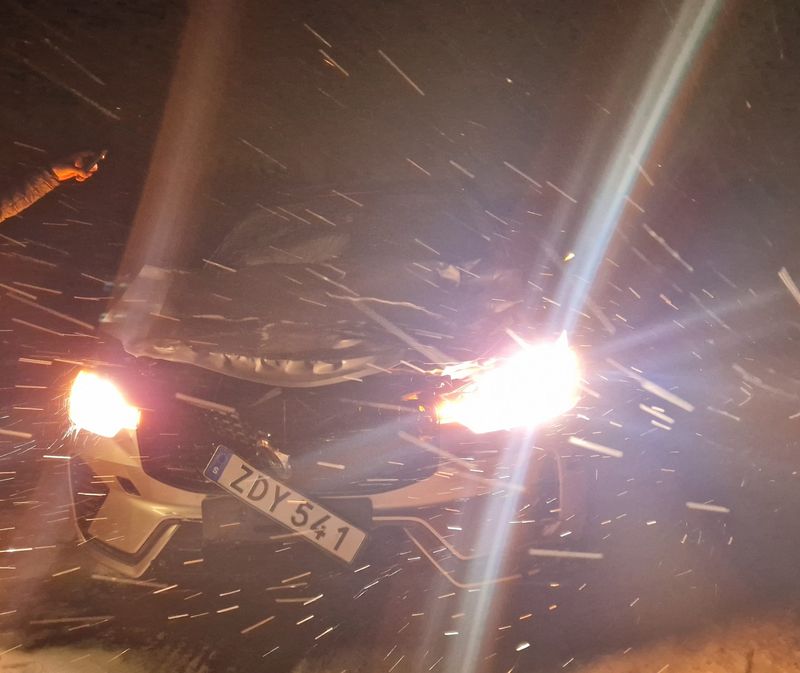
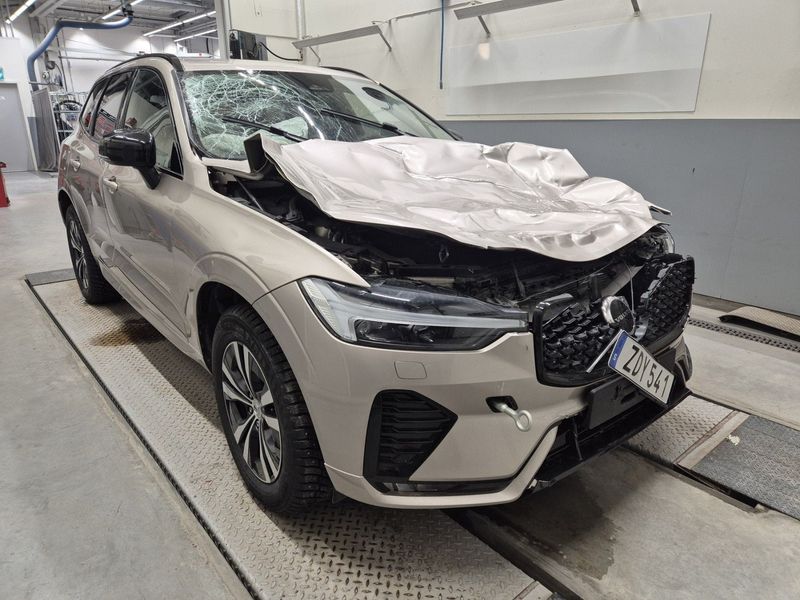
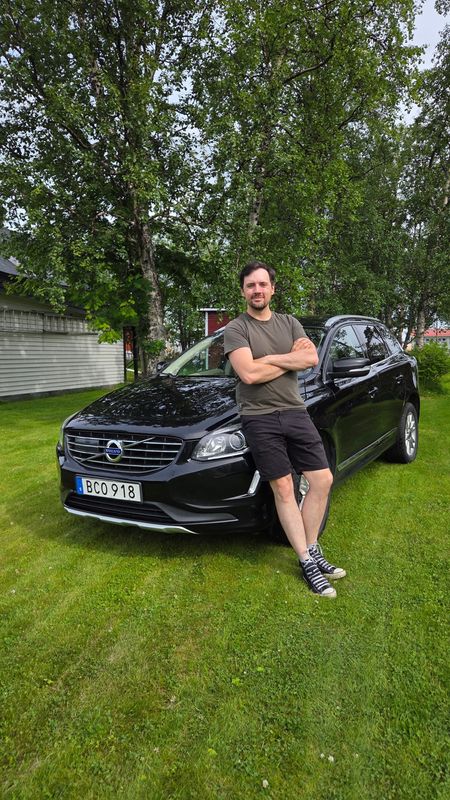
In the early morning hours of Nov. 13, 2025, Adam Dresh, of Kiruna, Sweden, and a colleague had rented a 2026 Volvo XC60 SUV to drive from northern Sweden to a business event in Norway, when a snowstorm struck.
Inclement weather is not unusual for that part of the world given it is 90 miles north of the Arctic Circle and it is considered “Europe’s last wilderness,” Dresh said. He grew up there and knew the rural roads could get dangerous.

But when an oncoming truck created a snowdrift as it passed, Dresh, who was going about 50 mph, everything would change. In a flash, a large moose “teleported right in front” of Dresh.
“I had no chance to detect her or to see her, especially in the snowdrift. So we crashed head-on. The strike was shocking,” Dresh, 34, told the Detroit Free Press. “I had a Coke can sitting in a cupholder. And I … remember it being stationary, actually, this entire time we hit the moose. She went up on the bonnet (hood), and then touched the screen (windshield). So it did crack. But I put my toes on the brake, and the car halted to a stop.”
The car stopped due in part to Volvo’s large animal detection alert system. Through cameras and radar, it was able to detect the animal’s approach and started braking even before Dresh saw the moose and hit the brake pedal. The car’s seat belts retracted hard, to pull Dresh and his colleague as far back from the windshield as possible in case this animal did break through the glass. The air bags deployed and the car’s reinforced steel A-pillars and roofline absorbed the animal’s impact. Volvo put many of those safety features in place after years of testing its cars for situations such as this one.
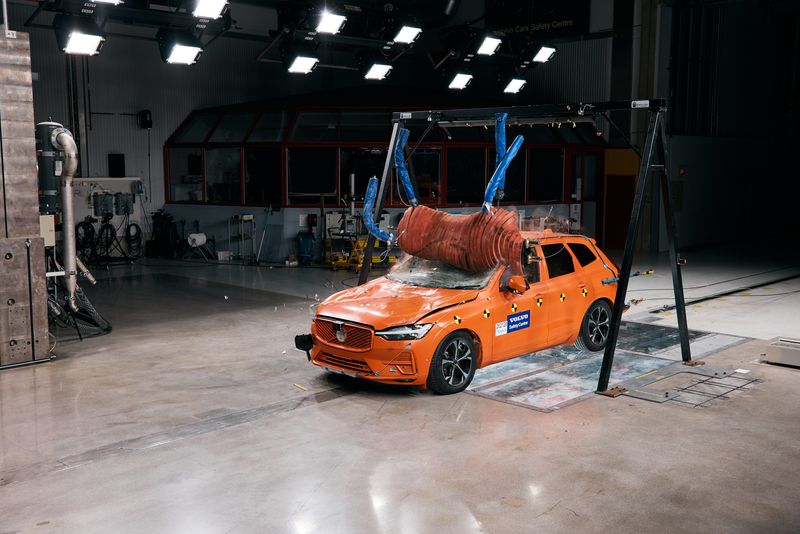
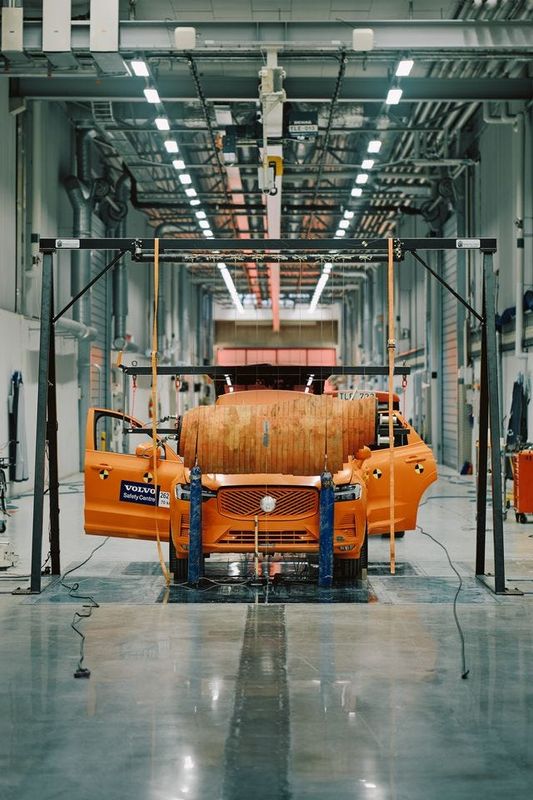
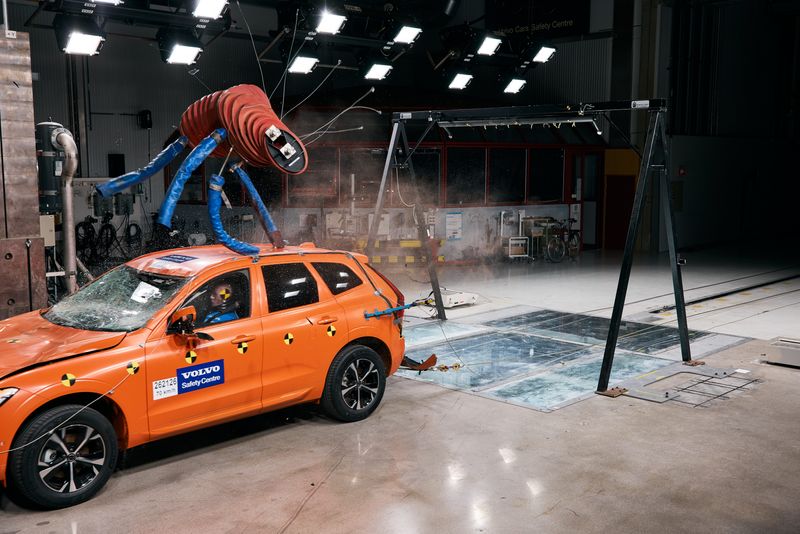
In fact, Volvo has one of only two nearly 800-pound crash test dummies in the world that replicate a large animal for vehicle safety tests. The other such crash test dummy is at the Swedish National Road and Transport Research Institute in Linköping, Sweden.
Volvo, which is majority-owned by Chinese-automaker Geely, introduced large animal detection technology to its cars in 2017 and it is now standard across the lineup.
“We design for real-life collisions,” Thomas Broberg, senior safety expert at Volvo Cars, told the Detroit Free Press. “Large animals, if you look at the northern parts of the world, you find that those are quite common and usually quite severe because it’s all rural roads, where speeds are a little bit higher.”
On that day, however, Dresh and his colleague walked away without a scratch despite the fact that the moose died in the crash. It was later estimated to weigh about 880 pounds.
“The surreal thing was, that I felt like I should have been at least injured, possibly have died. I had no neck pain, no broken bones, nothing at all. The Coke can was even standing still in the cupholder and I can still hardly believe it,” Dresh said. “I have a 100% certainty that if I had been driving perhaps an older car or a different brand, I could have died, or I would have been injured, badly injured.”
The proliferation of large animal crashes
In Sweden, there are about 70,000 collisions with large animals, including deer, each year, Broberg said. About 5,000 to 6,000 of those crashes are with a moose.
In Michigan, collisions with large animals tend to involve deer. In the state, there were 58,324 motor vehicle-deer crashes in 2024, that is down 0.8% from the 2023, according to the Michigan Traffic Crash Facts website, a data repository that uses facts gathered from Michigan State Police reports. Of those vehicle-deer crashes, 1,816 people were injured and 14 people were killed in 2024.
For the United States, the National Parks Service estimates that 2 million collisions with animals such as deer and moose kill approximately 440 people, injure about 59,000 people, and cause more than $10 billion of economic losses annually.
The problem of large animal-vehicle collisions happens in other parts of the world, too, Broberg said, citing research he has seen out of Saudi Arabia.
“They have camels walking around in the desert, and they have elevated this as a problem there as well,” Broberg said. “We got a letter from a customer in Brazil, when we first launched the XC60, and that was more than 10 years ago now. He had impacted two cows. He stated that the police asked where the driver was when they came to the scene. And he said, ‘It’s me.’ They didn’t believe him because the collision was that bad.”
U.S. large-animal-vehicle collision safety
Despite the proliferation of large animal-vehicle collisions over the years, it’s unknown how many automakers actually test for it as specifically as Volvo does. A spokesman for Center for Automotive Research in Ann Arbor said it does not track such testing. A spokeswoman for the University of Michigan’s Transportation Research Institute also said that is not testing they monitor.
A spokesperson for the National Highway Traffic Safety Administration said it does not have any applicable safety standards for large animal crashes, but NHTSA understands that this issue represents a larger proportion of the safety problem in some regions of the world. Of the 36,297 U.S. fatal crashes in 2024, 204 crashes, or 0.5%, listed it as a collision with a live animal — domesticated or wild, NHTSA said.
Additionally, every manufacturer puts their vehicles through a series of internal use tests based upon anticipated customer use cases and while NHTSA is aware of industry efforts to develop and offer features that help drivers detect and avoid crashes with large animals, it could not comment on specific manufacturers or their systems.
Ford Motor Co. spokesman Dan Barbossa told the Detroit Free Press the automaker does not do crash testing for large animal impacts. General Motors spokesman Kevin Kelly declined to comment when asked whether GM tests for large animal impacts.
In a statement provided by Stellantis spokesman Dale Jewett, the company said that “Stellantis regularly reviews third-party safety evaluations. Real-world vehicle safety remains central to our product development process, and we are committed to delivering vehicles that support evolving customer expectations for safety, quality and the overall ownership experience.”
Volvo’s moose crash test dummy
Lotta Jakobsson, senior technical specialist for safety at Volvo Cars, said the moose crash test dummy they use weighs about 360 kilograms or about 794 pounds. It is constructed from 116 rubber discs connected by steel parts. It is third-generation model.
The current version provides better robustness and easier handling for testers than previous models, Jakobsson said. It is meant to represent the characteristics of a large animal with long legs and significant body weight.
“They are tall, and the majority of their weight is in their body,” Broberg said of the large animals that collide with cars. “So basically, when you impact an animal with a car, that whole mass ends up in your windshield area. So, the safety cage design needs to be designed accordingly, and of course, you need to have a methodology to actually evaluate them and design for it.”
Jakobsson said large animal-to-vehicle crashes are included in the Volvo Cars Safety Standard across the lineup. It has been part of the brand’s vehicle design since starting in the 1980s, based on the learnings from the real-world crash data that Volvo continuously collects.
“A test using a moose cadaver was conducted in the mid-1980s by researchers at Chalmers University of Technology in collaboration with Volvo Cars,” Jakobsson said in an email. “The purpose was to better understand the kinematics and mechanisms involved in collisions between a large animal and passenger cars. The results from this test have also served as validation data for the development of moose crash test dummies.”
Volvo typically starts a vehicle design using virtual crash testing, which allows vehicle designers and engineers to evaluate a wide range of large-animal impact scenarios early in the car development process, Jakobsson said. Additionally, it then conducts full-scale physical crash tests in its lab at various speeds and impact points as a complement to virtual simulations.
The safety improvements made
Broberg said one of the main hazards animals present is that it’s difficult for drivers to see them, because they are usually moving about at dusk or dawn and, by nature, many are camouflaged to blend in with the environment.
“In later years, we have also developed systems for detecting them and activate autonomous braking and so forth,” Broberg said.
Here are some of the advancements Volvo has made to its cars as a result of its large-animal collision testing:
Broberg said about a decade ago Volvo was the first to introduce its large animal detection system, which provides a driver with warnings and braking of the car.
“It’s using the front radars and cameras, trying to detect if there are large animals next to the road, and if a collision is likely. Then, it warns the driver, so that they can try to steer, or apply the brakes,” Broberg said, “not necessarily to avoid the collision, but to try to help reduce the speed of the impact, because it’s quite a bit different if you impact a large animal at 80 kilometers an hour (50 mph) or 70 kilometers an hour (43 mph). It makes quite a huge difference in sort of the damage.”
The system is a combination of a sound, to alert the driver, as well as visual signals on the instrument panel. Some cars also jerk the seat belt as added warning for the driver to apply the brakes.
“And then, of course, if you apply the brakes, then the car will support with activating full-on brake, but it will also autonomously or brake automatically as well,” Broberg said.
The safety advancements Volvo made does give it a marketing advantage, said Ayalla Ruvio, a marketing expert and associate dean of the MBA program at Michigan State University. While most consumers consider a variety of factors when buying a car, for some, safety is the determining factor especially when they’re choosing between similar vehicles, Ruvio said.
“That’s where Volvo’s animal crash testing really stands out,” Ruvio told the Detroit Free Press. “It gives consumers a tangible example of the company’s commitment to safety, rather than just another advertising claim. More importantly, it’s authentic to the brand. Volvo has built its identity around safety for decades, so this kind of investment is consistent with its core values rather than a one-time marketing effort.”
Ruvio said such testing goes beyond engineering to build trust and strengthen the brand by creating consumer confidence that Volvo’s reputation for safety is backed by real investment and innovation.
Dresh’s guardian angel
Dresh said he often replays that early snowy morning in his mind knowing that he almost did not make it home to his wife and two small children, with a third child on the way.
The crash also haunts him because his grandfather was killed in a traffic-related accident in the 1970s and his father was in a car collision when Dresh was a child. His father lived, but had ongoing pain for life from his injuries.
Out of gratitude, Dresh wrote to Volvo to thank the company for making a car that protected him. Volvo replied and asked Dresh if he’d talk to one of the automaker’s senior engineers who had some questions.
Dresh described the accident to the engineer who told Dresh, “In a big snowstorm, the cameras shouldn’t have been able to pick up an animal like that,” Dresh recalled. “I told him that it did. It actually did, because I remember both the sound and the visible light, went off. So the camera did see the animal. Then, they did all the diagnostics and could see how the car had handled it.”
Dresh said immediately after hitting the moose, he asked his colleague if he was OK and then he heard a voice that he initially thought was mechanical then realized it was a human speaking to him — an operator from Volvo’s On Call, the automaker’s connected car service, which knew the car had been in an accident and was asking whether they were OK.
Later, Dresh and his family visited Volvo’s crash test center in Gothenburg, Sweden, to see the moose crash test dummy that helped to save his life. There, he learned that Volvo had constructed the entire hood to keep the animal at the front ahead of the windshield.
“The other part is that, imagine if I had become unconscious from this crash. The car stopped itself. Put on the hazard lights, did all of that and that’s just amazing,” Dresh said. “Back in the day, if you would crash into an animal, like this and became unconscious, your feet would perhaps push on the gas pedal. You would ride out right into the woods, crash into a tree or something like that. Here, the car took over. It was like a guardian angel.”
Jamie L. LaReau is the senior autos writer for USA TODAY Co. who covers Ford Motor Co. for the Detroit Free Press. Contact Jamie at jlareau@freepress.com. Follow her on Twitter @jlareauan. To sign up for our autos newsletter. Become a subscriber.
This article originally appeared on Detroit Free Press: Volvo pioneered moose-crash safety testing. It saved a driver’s life.
Reporting by Jamie L. LaReau, Detroit Free Press / Detroit Free Press
USA TODAY Network via Reuters Connect

By Jamie L. LaReau, Detroit Free Press | USA TODAY Network