A Powassan virus case on the East Coast is a reminder of the dangers posed by tick bites, with experts urging caution on your summer foray into nature.
The tick-borne illness, mainly spread by blacklegged or deer ticks, has been reported in a 66-year-old man in New Hampshire who has been hospitalized in recent weeks, USA TODAY reported.

The illness is caused by a bite from an infected tick and can lead to headaches, fever and vomiting, according to the Centers for Disease Control and Prevention.
“Although still rare, the number of reported cases of people sick from Powassan virus has increased in recent years. Most cases in the United States occur in the northeast and Great Lakes regions from late spring through mid-fall when ticks are most active,” the CDC says.
Dressing in long, light-colored clothing and avoiding tall grass can help you steer clear of tick bites.
Here’s what to know about Powassan virus.
Where was Powassan virus detected?
A case of Powassan virus has been reported in a 66-year-old man in New Hampshire who has been hospitalized for weeks, USA TODAY reported.
After feeling worn down from a tick bite, the man was admitted to Concord Hospital for about two weeks before being transferred to Massachusetts General Hospital for more intensive care, sources close to the patient told WMUR and the Concord Monitor.
What is Powassan virus?
Powassan virus is named after Powassan, Ontario, in Canada, where it was first discovered in 1958, according to the Minnesota Department of Health.
Powassan virus is spread to people through a bite from an infected tick, typically deer ticks, according to the Commonwealth of Massachusetts. Although the virus is rare, according to the CDC, the number of reported cases of people sick from the virus has increased in recent years. It does not spread through coughing, sneezing or touching, but in rare cases, it has spread person-to-person through a blood transfusion.
Most cases of Powassan virus in the United States occur in the Northeast and Great Lakes regions from late spring through mid-fall, when ticks are most active.
Is Powassan virus in Michigan?
While Michigan is in the Great Lakes region at risk for Powassan virus, the illness is rare in the state, with only one reported case to date, according to Michigan Emerging Disease Issues.
What are the symptoms of Powassan virus?
Initial symptoms can include fever, headache, vomiting and weakness, according to the CDC. In some cases, Powassan virus can cause severe disease, including encephalitis, an infection of the brain, or meningitis, an infection of membranes around the brain and spinal cord.
Someone with severe disease can experience confusion, loss of coordination, difficulty speaking and seizures, and the CDC says approximately 1 in 10 people with severe disease die.
Approximately half the people with severe disease can have long-term health problems, including recurring headaches, loss of muscle mass and strength, and memory problems.
There are no vaccines that can prevent Powassan virus or medicines to treat the disease. The CDC recommends that people avoid ticks to reduce risk of infection.
How to tell if a tick has bitten you
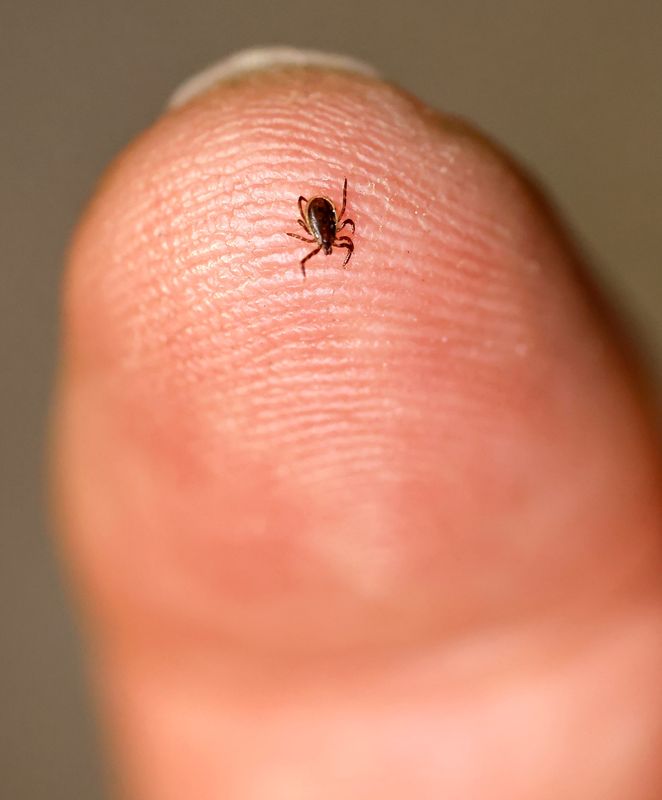
If you’ve been bitten by a tick, you’ll typically see the parasite, a small, oval-shaped bug with eight legs, and light to dark brown to brownish-red color, depending on the species, burrowed into your skin.
Key areas to check for a bite are your scalp and neck, groin, behind the knees, belly button, armpits, around your waist, and in or around your ears, the Cleveland Clinic advises. The bite area may be bumpy, swollen or itchy.
Tick bites sometimes will form a reddish “bull’s-eye” pattern around the bite site.
What are blacklegged or deer ticks?
Blacklegged ticks, or deer ticks, account for 15% of Michigan’s ticks and are present on low forest vegetation, and along human and animal trails throughout the state.
The species can be active year-round, depending on life stage and temperature, though spring, summer and fall pose the highest danger for tick bites, according to the Ohio State University Extension and the Centers for Disease Control and Prevention. Blacklegged ticks have a reddish-brown back and a black scutum, with eight legs, according to PetMD.
Blacklegged ticks, which can be found in every Michigan county, are 1-3 millimeters long, slightly smaller than a sesame seed.
Blacklegged ticks can pass Lyme disease to their bite victims, posing a serious health risk. Lyme is caused by a bacteria. People often notice a red, bull’s-eye circle around a tick bite.
What keeps ticks away?
Following these tips from MDHHS, CDC and Johns Hopkins Medicine can help you avoid tick bites:
What diseases can be transmitted by tick bites?
In addition to Lyme disease, the CDC reports that ticks also can carry pathogens that can cause the following diseases:
USA TODAY contributed.
Contact Jenna Prestininzi: jprestininzi@freepress.com.
This article originally appeared on Detroit Free Press: Tick-borne Powassan virus sickens East Coast man. Do we need to worry?
Reporting by Jenna Prestininzi, Emily Vetter and Sara Moniuszko, USA TODAY NETWORK / Detroit Free Press
USA TODAY Network via Reuters Connect
By Jenna Prestininzi, Emily Vetter and Sara Moniuszko, USA TODAY NETWORK | USA TODAY Network