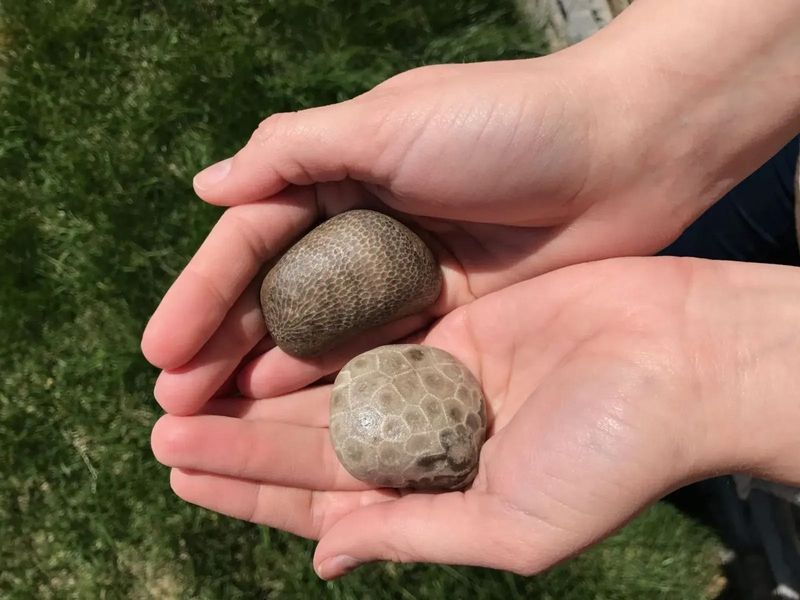
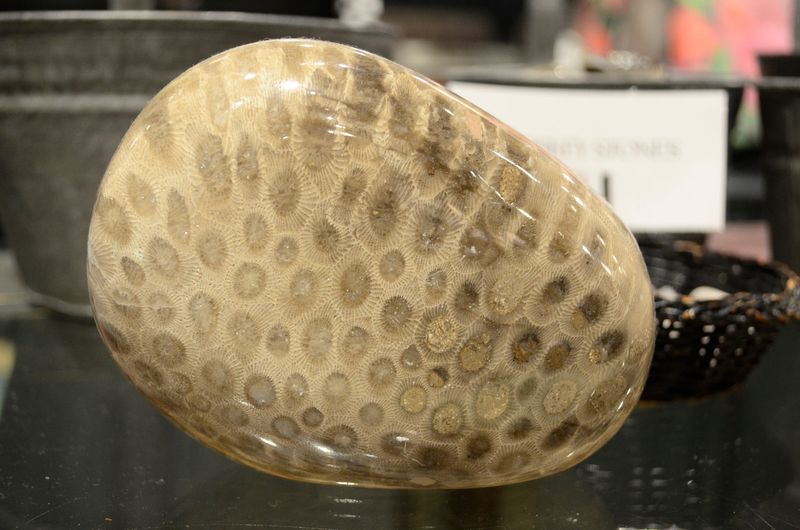
Rock collectors in northern Michigan often find what they believe are Petoskey stones, only to later find out they are the lesser known Charlevoix stones — which can leave some disappointed that they didn’t find Michigan’s state stone.
Both types of stone are fossilized prehistoric corals that are about 350 million years old, according to Visit Charlevoix.

The Charlevoix stone, although similar in appearance to its cousin, has its own unique features and structure.
Here’s what to know about Petoskey and Charlevoix stones, and where you can find them in Michigan:
What are the similarities/differences between Petoskey and Charlevoix stones?
The Petoskey and Charlevoix stones are fossilized pre-historic coral that is roughly 350 million years during the Devonian Age. Both Petoskey and Charlevoix stones have a honeycomb appearance.
Both stones are found in in shades of gray and beige, and are found in the northern part of the state.
Petoskey and Charlevoix stones are made up of hexagonaria percarinata which consists of tightly packed, six-sided corallites, which are the skeletons of the once-living coral polyps.
At the center of each polyp, on a Petoskey stone, was the mouth that contained tentacles that reached out for food. The hexagon shape of each cell and thin lines radiating out from the dark “eye” in the center are distinguishing features unique to this fossil, according to Visit Charlevoix.
The Charlevoix stone has a smaller exoskeleton compared to its cousin the Petoskey stone. The Charlevoix stone is a favosite coral which has a smaller pattern and a lighter or white color set of small rays radiating from the eye forming the characteristic hexagonal shape which are lighter and they don’t always attach to the center dot, the website explains.Petoskey and Charlevoix stones are both are different species of coral. It’s not uncommon to find both fossils while exploring area beaches.
How do I know if I have a Petoskey stone?
You have a Petoskey stone when the appearance is symmetrical and honeycomb like. Additionally the fossil has deep lines.
How do I know if I have a Charlevoix stone?
You have a Charlevoix stone when the specks on the stone are frequent and are inconsistent.
Charlevoix stones in some cases, are duller than a Petoskey stone.
The easiest way to tell the difference is that Charlevoix stones have a smaller hexagonal exoskeleton pattern compared to Petoskey stones.
How Petoskey and Charlevoix stones formed
Michigan once was covered by an ancient saltwater sea. As seas became shallower, sand and dirt covered corals. Coral skeletons hardened into stone over time, according to the Torch Conservation Center.
Petoskey stone corals are known as Hexagonaria percarinata, and consist of tightly packed, six-sided corallites, which were the skeletons of once-living coral polyps.
The center of each polyp was the mouth of and contained tentacles that reached out the food, according to Petoskey Area.
When did the Petoskey stone become the state stone?
On June 28, 1965, Gov. George Romney signed a bill making the Petoskey stone the official state stone, a report from the MDEQ shows.
Techniques for identifying rocks
These identification techniques, according to the EGLE, can help rock hunters determine the type of rocks they have:
Appearance
Unique properties
Unique properties
Is there a limit on how many rocks a person can collect?
According to the EGLE, one person can not exceed 25 lbs total per year on state-owned and public trust lands.
Jalen Williams is a trending reporter at the Detroit Free Press. Contact him at jawilliams1@freepress.com.
This article originally appeared on Detroit Free Press: These patterned stones are often confused. What to know about Petoskey, Charlevoix stones
Reporting by Jalen Williams, Detroit Free Press / Detroit Free Press
USA TODAY Network via Reuters Connect