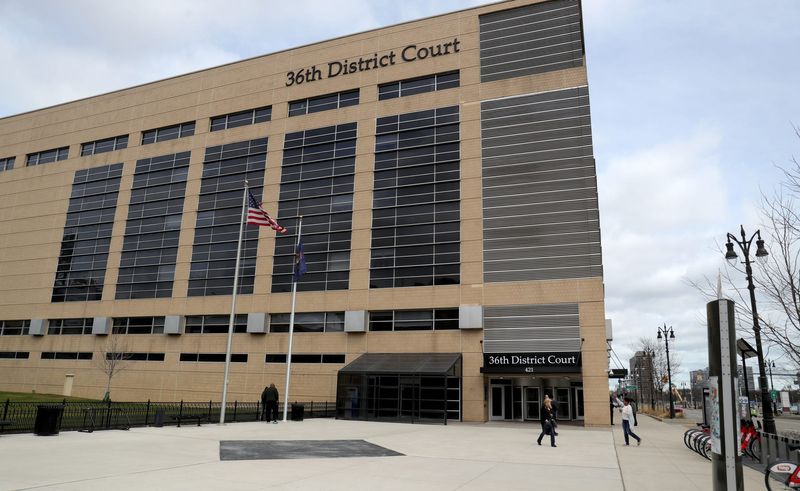
Detroit’s 36th District Court and Michigan Attorney General Dana Nessel have issued warnings about a text message scam that’s making the rounds, urging consumers to be on alert.
Separately, 36th District Court is once again offering an amnesty program that waives late fees and penalties for cases where a judge has made a final ruling. Starting Monday, March 9, the program will relieve all late fees, penalties and warrant costs after a person pays the original amount due.

Here’s what to know about the text scam and the court’s real amnesty program.
What is the 36th District Court text message scam?
A text message with an image claiming to be a “Notice of Civil Infraction Hearing” for a toll violation from the 36th District Court is making the rounds among Michigan residents.
The fake notice says the recipient must appear for a hearing and pay a penalty and other costs. It’s signed by a “John Smith,” a supposed clerk for the 36th District Court, according to an image provided by Nessel’s office this week.
It includes a QR code that leads to website claiming to be the Michigan Department of State, Nessel’s office said. And it’s not the only one − similar scams have been reported using the likeness of private companies and the Michigan Department of Transportation.
A banner on the 36th District Court website reads: “SCAM ALERT We’ve received reports of a text message scam claiming you owe court fines and must pay immediately to avoid severe penalties. These messages are NOT from the court or any official agency. Do NOT click links or provide payment or personal information. The court will never contact you via text message demanding payment. If you receive a suspicious message like this, please report it to local authorities and do not engage with the sender.”
What are the signs of a text message scam?
Here are some ways to spot a text message scam (also know as “smishing), according to the AG’s office:
Should someone respond to a suspicious text?
No, the AG’s office said. Consumers shouldn’t reply or click on any links or attachments.
What do I do if I receive a suspicious text?
The AG recommend’s using built-in spam blocking tools on phones. Consumers should report texts suspicious texts by forwarding them to SPAM (7726) and sending them to the Federal Trade Commission. That website is: https://reportfraud.ftc.gov/
Government agencies won’t ever ask for money through text, email or phone. They will mail a notice, Nessel cautioned. They won’t take payments by prepaid gift cards, wire transfers, a payment app or cryptocurrency, either. The government agency will instead provide payment options.
The 36th District Court, in a Feb. 9 news release about fake parking ticket texts, said to not click on scam links or provide personal information. It directed people to delete the message. Official notices from the court are through U.S. mail. To verify a case or citation, call the 36th District Court at 313-965-2200. Those who have clicked on any links or provided information should contact their bank, the court said.
What is the 36th District Court’s amnesty program?
The court’s amnesty program will be available from Monday, March 9 through Thursday, April 2 and will apply to cases that have gone before a judge, with a final ruling, and where fines and other costs have been assessed, according to a news release posted on the 36th District Court’s website. It includes traffic tickets and other violations where the court has determined how much a person owes. If someone has an outstanding balance from their case, including late fees, penalties or warrant costs, they’d likely qualify for the program, Chief Judge William C. McConico said in an emailed statement to the Free Press. The program does not include driver’s license reinstatement fees.
Late fees may range from $40 to $50, depending on the case and penalties can pile up.
“On average, it’s estimated that participants can save approximately $100 per traffic ticket through this program, though that’s a general estimate and the actual savings will vary by case. The program waives late fees, penalties, and warrant costs entirely upon full payment, meaning people can settle their cases at the original, lower amount,” McConico said.
The last time the court offered the program was in 2024, when it reported 3,727 transactions. The waivers were also available in 2020 when the court recorded 10,812 transactions.
How can someone pay fines at 36th District Court?
People can pay fines in-person, online or through a DivDat payment kiosk. For more information, and ways to pay fines, go to https://bit.ly/36thDistrictCourtAmnestyProgram. People can go to the court’s website at https://www.36thdistrictcourtmi.gov/home, call its phone number at 313-965-8700 or visit a DivDat kiosk to find out how much they owe.
Free Press staff reporter Nour Rahal contributed to this report.
Reach reporter Nushrat Rahman at nrahman@freepress.com.
This article originally appeared on Detroit Free Press: Text scam involves Detroit’s 36th District Court: What to know
Reporting by Nushrat Rahman, Detroit Free Press / Detroit Free Press
USA TODAY Network via Reuters Connect