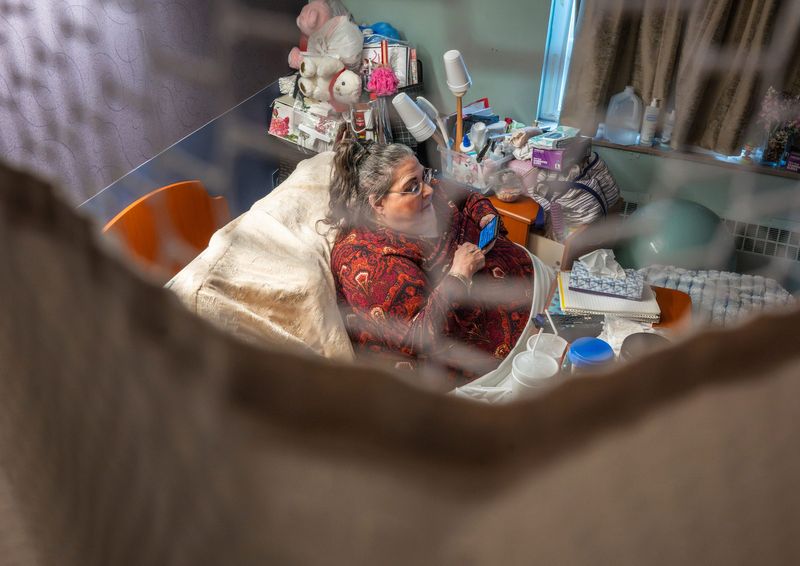
Lori Youssef is a nursing home resident on a tight budget, leaving little for even the most basic of purchases — a birthday card for one of her six grandchildren, or personal items like deodorant, shampoo and conditioner.
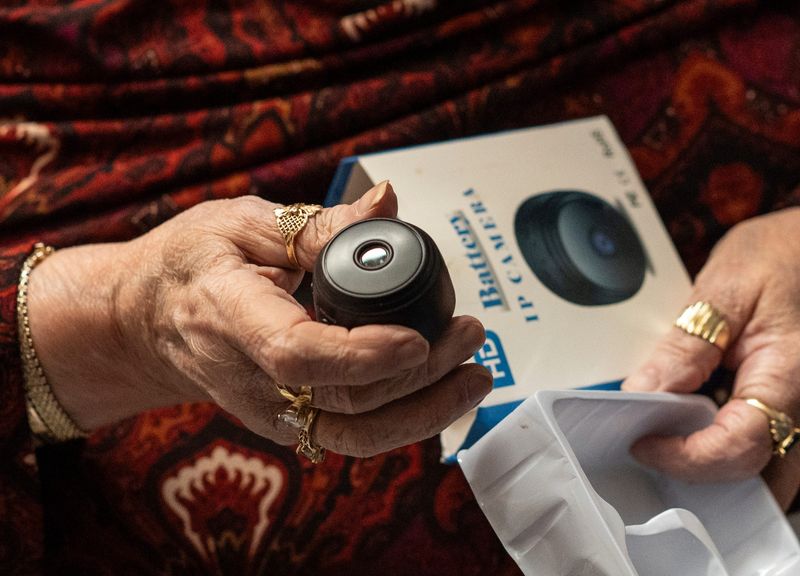
So when the gift cards her kids bought her went missing, they followed up with another present for Christmas: a video camera.

But staff at Belle Fountain Nursing and Rehabilitation Center in Riverview, part of Optalis, one of Michigan’s largest for-profit nursing home chains, told her cameras were not allowed in her room, she said.
Michigan, unlike 21 other states, has no laws governing the rights of nursing home residents to have electronic monitoring devices in their rooms.
Youssef, 65, set the camera up anyway to test it and make sure it worked — with a family member’s help and with the ability to see the recordings on her phone. Four other residents also had lost items that week, including cash from a graduation card and a ring, she said.
“I was shocked when the gift cards went missing, nothing like that had ever happened before,” she said, adding that her kids had just moved farther away and couldn’t easily check in with her.
The sense of safety and connectedness that cameras can bring is what many residents and their loved ones say they crave in an industry that faces continued criticism for low staffing and poor care.
Other states have established residents’ rights to cameras, even paying the cost if families suspect abuse or neglect.
But, in Michigan, efforts to establish residents’ rights to electronic monitoring devices have been stalled in Lansing for years, despite initial bipartisan support.
That has left residents and families to navigate monitoring decisions alone, with some facilities allowing cameras and others banning them.
Frustration with policy
For one southeast Michigan man whose 90-plus-year-old mother recently moved into a nursing home, the lack of a camera has made a difficult situation more stressful.
The man, who requested anonymity because he fears retaliation against his mother in the home, told the Free Press that she is supposed to receive two showers a week and that hasn’t been happening.
Her favorite chocolate nutrition drinks are not opened for her daily, despite their requests. And the clocks in her room are regularly set forward, a sign he believes means that staffers are sending her to bed earlier than normal.
Now they want a camera but the facility won’t allow it.
“It is not about what we are going through, but what she has to suffer through,” his wife said. “That is poor quality of life and it is just not fair.”
Before his mother moved to the nursing home, the family kept a camera in her apartment, positioned toward the television, to check on her and stay connected.
“It gave us peace of mind to make sure she was OK,” he said.
Pushing for Michigan to codify residents’ rights to such devices include the Michigan Long Term Care Ombudsman Program. It’s a government-funded statewide program with 40 local ombudsmen, who advocate for residents’ rights in nursing homes, licensed homes for the aged and adult foster care facilities.
“Some residents are not able to physically use a phone or computer, but newer devices allow residents to connect through simple voice commands,” Salli Pung, who leads the program, wrote in an email to the Free Press.
“The ombudsman program believes that cameras can have a great benefit to residents to ensure their needs are being met and care is being delivered timely.”
What are Michigan’s nursing home camera policies?
In Michigan, camera policies are left to individual facilities, said a spokesperson with the Health Care Association of Michigan, based in Lansing and representing the state’s long-term care industry
The devices in nursing homes and other similar facilities can cause thorny legal issues and uncertainty, experts and advocates say.
Clara Berridge, an associate professor at the University of Washington School of Social Work who studies ethics of digital technologies in elder care, said a nationwide facility survey she conducted on camera use in nursing homes and assisted living yielded three core ethical concerns:
First is the risk that in-room cameras pose to residents’ privacy and dignity, she said. Second, the presence of the devices could make staff feel as if they are not trusted and third is the possible use of cameras by facilities to monitor staff and residents.
“Surveillance can make workers feel that they aren’t being treated as capable of moral professional behavior,” she said. “And that’s something to take seriously, especially when we think about the racial and gender dynamics of this workforce.”
A spokesperson for SEIU Healthcare Michigan, a union which represents health care workers, including nursing home staff, declined to comment on the issue of electronic monitoring in residents’ rooms.
Although the survey was conducted 10 years ago, she said the third concern has really come to pass, “facilities themselves are increasingly using monitoring or surveillance technologies for their own purposes.”
Many of the state’s largest facilities would not respond to Free Press questions on their camera policies and the reasoning behind it.
Some of Michigan’s largest for-profit chains according to federal data, comprising about one in three of Michigan’s licensed nursing homes, Ciena Healthcare/Laurel HealthCare and NexCare Health Systems/WellBridge did not respond to requests for comment, though a staff member who answered the phone at WellBridge told the Free Press cameras were not allowed.
A spokesperson for Medilodge, operated by Prestige Healthcare, declined to comment on its camera policy. When the Free Press called individual facilities, staff at two Medilodge nursing homes said cameras are allowed in residents’ rooms.
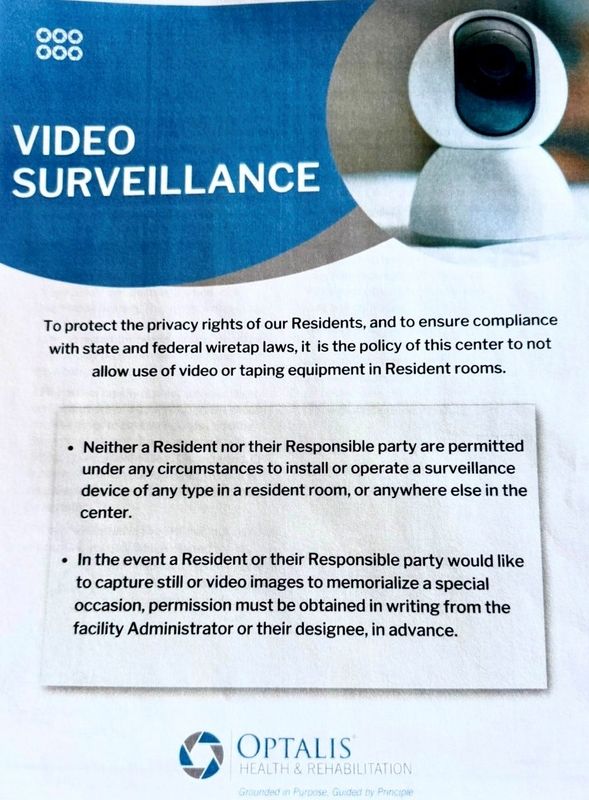
Optalis Health and Rehabilitation did not respond to requests for comment, but the Free Press obtained a handout distributed at a Michigan facility outlining its no-camera policy.
“To protect the privacy rights of our Residents, and to ensure compliance with state and federal wiretap laws, it is the policy of this center to not allow use of video or taping equipment in Resident rooms,” the flyer reads.
Michigan is considered a “one-party” state which means it’s legal to record conversations as long as one person participating consents. But a person recording a conversation they aren’t participating in could violate the eavesdropping statute, experts say.
The Optalis chain operates 41 nursing homes in Michigan and Ohio. In 2021, Ohio lawmakers passed legislation to allow nursing home residents or their guardians to install cameras in residents’ rooms.
About 15% of nursing homes are operated by nonprofits in the state. Trinity Health, one of the state’s larger nonprofit nursing home chains according to federal data, declined the Free Press’ requests for comment.
Michigan’s 34 county-owned nursing homes operate independently and set their own policies, but most do not support cameras in residents’ rooms, according to Renee Beniak, executive director of the Michigan County Medical Care Facilities Council.
“A resident’s room is a private space,” she told the Free Press in an email. “That being said, it is possible that upon a very specific request, once all privacy laws have been addressed, notifications, consents signed, a specific policy might be created to allow for a camera.”
Some states allow them, but not Michigan − yet
A growing number of states have passed legislation allowing cameras in nursing home residents’ rooms — a total of 21 states, according to the National Consumer Voice for Quality Long-Term Care.
In Ohio, a measure — named for Esther Piskor, a nursing home resident in her 70s living with dementia who was abused and neglected — was signed into law in 2021.
Esther’s Law allows nursing home residents or their guardians to install a video camera, audio recording device, or both in a resident’s room, with roommate consent when applicable. The law bars denial of admission, discharge or retaliation against residents who use one.
Esther Piskor has since died, but her son Steve Piskor, who uncovered her abuse with a hidden camera, pursued the law.
Other states, including California, Maryland and New Jersey, have guidelines or programs in place that allow cameras, but no laws. For example, the New Jersey Division of Consumer Affairs loans video cameras to residents for free if they suspect abuse or neglect, called Safe Care Cam.
In Michigan, a bill giving nursing home residents the right to camera surveillance passed the Legislature with bipartisan support in 2020.
That bill, SB77 of 2019, was left unsigned by Gov. Gretchen Whitmer after passage, without explanation, what is called a pocket veto.
“We went through hours and hours of 30 or more stakeholders, over and over again, going through every conceivable problem and addressing it,” said state Sen. Jim Runestad, R-White Lake.
Since then, he has introduced similar legislation three additional times
The latest version of the bill, SB 412, looks similar to the original bill that passed the Senate. The bill allows for audio and video recording in nursing home residents’ rooms and includes a provision giving low-income residents access to free equipment managed by the Michigan Long Term Care Ombudsman Program.
The bill isn’t without its critics, though. Donna MacKenzie, a Michigan attorney with more than two decades of experience in nursing home abuse and neglect cases, said the current bill, like its predecessor, restricts residents’ rights in two important ways.
Residents would have to fill out a written form and, if they share a room, to get their roommate’s permission before using a camera.
Also, if a resident records video or audio without completing that paperwork first, the footage can’t be used as evidence in a lawsuit against the nursing home.
“This is not a bill that is in the best interests of nursing home residents,” MacKenzie said.
Whitmer’s office did not respond to the Free Press request for comment on why she did not sign SB77 of 2019 or whether she would support SB412 of 2025 if it passed.
Residents could press for cameras
At least one national expert told the Free Press that nursing home residents in Michigan could force the issue.
“If there’s no state law, then it’s a little bit of a question of wills,” said Eric Carlson, directing attorney at Justice in Aging, a national nonprofit organization, about the use of cameras in residents’ rooms at nursing homes.
Federal law gives residents at any nursing home accepting federal money, such as from Medicaid or Medicare, the right to furnish their own room, explained Carlson.
“And if you have the right to furnish … if you could put up a bobblehead or a picture of your kids or a lava lamp, why wouldn’t you be able to put up a camera?”
The argument against cameras is that it would be violating the privacy rights of other people, but that applies only to people living in the room, Carlson said.
“Staff have no reasonable expectation of privacy in that situation,” he said. “In fact, the purchasers of the service and their family members have an interest in making sure that the services are actually provided in the way that they are paying for.”
If somebody wanted to set one up, they would need consent from the resident and roommate, if any, and should post notice to anyone entering.
“It’s simpler if the state has a law,” Carlson said. “But what you don’t want is this sense that a law is absolutely required.
“If you’re a nursing home resident and you just do whatever the nursing home says and assume that they can never be wrong … then you’re in a bad situation because you’re just stuck with whatever they proclaim.”
The rules around cameras are unclear, and getting answers about them is even harder, Youssef said.
A self-described meticulous researcher, she said that shortly after arriving at the nursing home three years ago, she was elected president of the resident council and promptly read through the nursing home residents’ rights that she got from the Michigan Long Term Care Ombudsmans Program.
Youssef told the Free Press she knows her rights and acts on them. She keeps detailed records of every grievance, has reached out to the governor’s office directly with questions on facility operations and as resident council president, sometimes requires staff to attend her meetings.
That’s why she felt she had the right to set up the gift from her kids.
A representative for the Belle Fountain Nursing and Rehabilitation Center declined to comment and referred the Free Press to Optalis, who did not respond to a request for comment.
Youssef tested her camera but didn’t end up using it because items stopped disappearing, she said. The camera is put away in the bottom drawer of her dresser.
“I am not crazy about the idea,” she said, of the camera recording her daily activities in her room even though she is the only one that can see the footage.
But she might put it back up this summer to make her kids feel better: “If I felt unsafe I would.”
Contact information for local ombudsmen can be found on the Michigan Long Term Care Ombudsman Program website: mltcop.org or by calling 866-485-9393.
Kristi Tanner is a data reporter. Contact her at ktanner@freepress.com.
This article originally appeared on Detroit Free Press: Michigan nursing homes set the rules on cameras — and many say no
Reporting by Kristi Tanner, Detroit Free Press / Detroit Free Press
USA TODAY Network via Reuters Connect