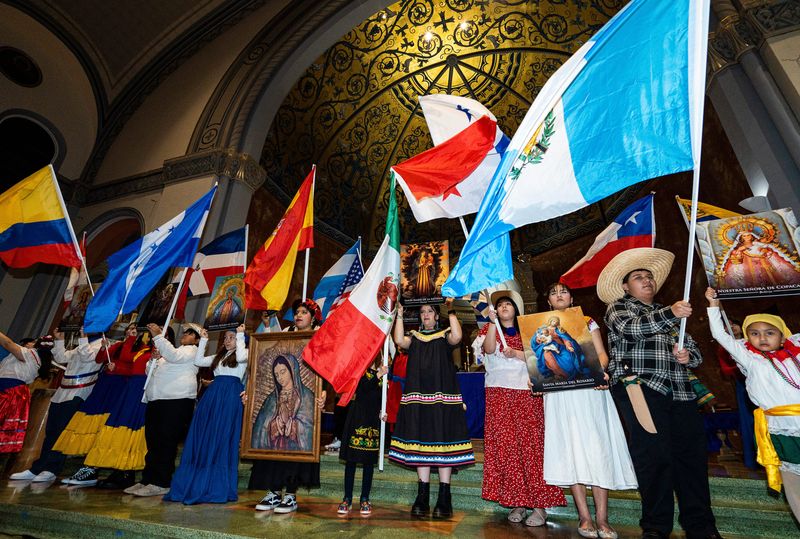
Celebrations of Latino and Hispanic heritage are set to take place over the next month in Michigan surrounding the independence days of several Latin American nations.
Hispanic Heritage Month, from Sept. 15 to Oct. 15, honors and uplifts diverse Hispanic and Latino communities throughout the state.

The timing of the period centers around Latin American nations, with five Central American countries — Costa Rica, El Salvador, Guatemala, Honduras and Nicaragua — marking their national independence days Sept. 15, followed by Mexico Sept. 16, Chile Sept. 18 and Belize Sept. 21, the National Museum of the American Latino said.
Michigan is home to about 572,000 Latino residents, 5.7% of the state’s population, as of 2022, according to the Julian Samora Research Institute at Michigan State University. Nationwide, there are 65.2 million Hispanic or Latino residents, 19.5% of the U.S. population, as of July 1, 2023, per the U.S. Census Bureau.
Latino communities make up part of the rich social fabric of the U.S., tracing their origins to dozens of Latin American and Caribbean nations across a variety of racial and ethnic groups, with significant contributions to U.S. society over several centuries, the National Museum of the American Latino says.
“Hispanic Heritage Month provides an additional opportunity to explore the incredible impact Latinas and Latinos have had on the United States for generations. The Latino presence in America spans centuries, predating Spain’s colonization of what is now part of the United States, and they have been an integral part of shaping our nation since the Revolutionary War,” the National Museum of the American Latino’s website says.
Gov. Gretchen Whitmer and Lt. Gov. Garlin Gilchrist recognized the month in an official proclamation.
“Hispanic Americans have provided Michigan and the United States with unique social and cultural influences, fundamentally enriching the extraordinary character of our state and nation,” the proclamation read in part, “and, whereas, Michigan is fortunate to count among its population a large number of residents of Spanish and Latin American descent, who grow businesses, offer innovative ideas, strengthen our economy, create jobs, and contribute to our daily lives.”
Here’s what to know about Hispanic Heritage Month in Michigan.
What is Hispanic Heritage Month?
The month honors Hispanic and Latino heritage and culture and contributions to U.S. society, the National Museum of the American Latino says.
“Latinos continue to help fuel our economy and enrich our nation as entrepreneurs, athletes, artists, entertainers, scientists, public servants and much more,” the museum’s website says.
When is Hispanic Heritage Month?
Hispanic Heritage Month is from Sept. 15 to Oct. 15.
How are Hispanic, Latino different?
Though the terms may often be used in similar contexts and share some overlap — Hispanic and Latino possess distinct meanings and represent different ways of describing people.
Hispanic generally refers to Spanish-speaking people or people whose origins are from Spain and other Spanish-speaking nations, according to New York University Libraries.
Latino refers to people of Latin American and Caribbean descent, including non-Spanish speaking countries in the region, the National College Attainment Network and National Museum of the American Latino say.
Who are American Latinos?
American Latinos can trace their ancestry to 33 countries in Latin America and the Caribbean.
The origins of Latinos in the present-day continental U.S. date back several centuries prior to the country’s founding and include a mix of Indigenous communities, European settlers and enslaved Africans, per the National Museum of the American Latino.
The U.S. gained new territories with Latino populations in Puerto Rico and present-day western U.S. states through treaties after wars with Mexico and Spain in the 19th century, according to the National Archives and the Library of Congress.
Though the Latino presence traces back to the 16th century, immigration from Latin America and the Caribbean to the U.S. began in the mid-19th century and picked up traction in the 20th century, the University of Washington notes.
Latinos span diverse racial, national, ethnic and religious origins across Latin America and the Caribbean and communities in the U.S. range from recent immigrants and refugees to third-generation Americans and beyond, per the Pew Research Center.
What ethnicities, races are most represented among American Latinos?
In a 2021 Pew Research Center survey, 58% of American Latinos identified their race as White, 27% some other race, 8% two or more races and 2% Black or African American. Though their self-identified race or ethnicity may vary, Afro-Latinos, Latinos of African descent, make up 12% of the adult Latino population and 2% of the U.S. adult population, according to the Pew Research Center.
Among national origins, 58.9% of American Latinos are of Mexican descent; 9.3% Puerto Rican; 3.9% Salvadoran; 3.8% Cuban; 3.8% Dominican; 3% Guatemalan; 2.3% Colombian; 1.9% Honduran; 1.5% Spaniard; 1.4% Ecuadorian; 1.3% Venezuelan and 1.2% Peruvian, as of 2022, according to the Pew Research Center. Less than 1% each traced their origins to Nicaraguan, Argentine, Panamanian, Chilean, Costa Rican, Bolivian or Uruguayan descent.
How did Hispanic Heritage Month come to be?
Efforts to recognize Hispanic and Latino Americans trace back to former President Lyndon B. Johnson declaring Hispanic Heritage Week, starting Sept. 15, 1968, according to the American Presidency Project.
Former President Ronald Reagan then expanded the week to a month-long celebration. Congress passed a law to recognizing Hispanic Heritage Month in August 1988, according to the National Archives.
What is Michigan’s Latino population?
In Michigan, 67.6% of Latinos are of Mexican origin; 8.9% Puerto Rican; 8.4% others including Spaniard; 6% Central American; 4.8% South American; 3.3% Cuban; 0.9% Dominican, as of 2022, according to the Julian Samora Research Institute at Michigan State University.
The state’s Latino population has consistently increased in recent decades and is spread out across Michigan’s Lower Peninsula, MSU data shows.
Here are the top 10 Michigan counties by Latino population, as of 2020:
Where can you celebrate Hispanic Heritage Month in Michigan?
Here is a look at upcoming events celebrating Hispanic and Latino heritage across Michigan:
Contact Jenna Prestininzi: jprestininzi@freepress.com.
This article originally appeared on Detroit Free Press: Michigan honors Hispanic, Latino cultures. Where to celebrate this month
Reporting by Jenna Prestininzi, Detroit Free Press / Detroit Free Press
USA TODAY Network via Reuters Connect