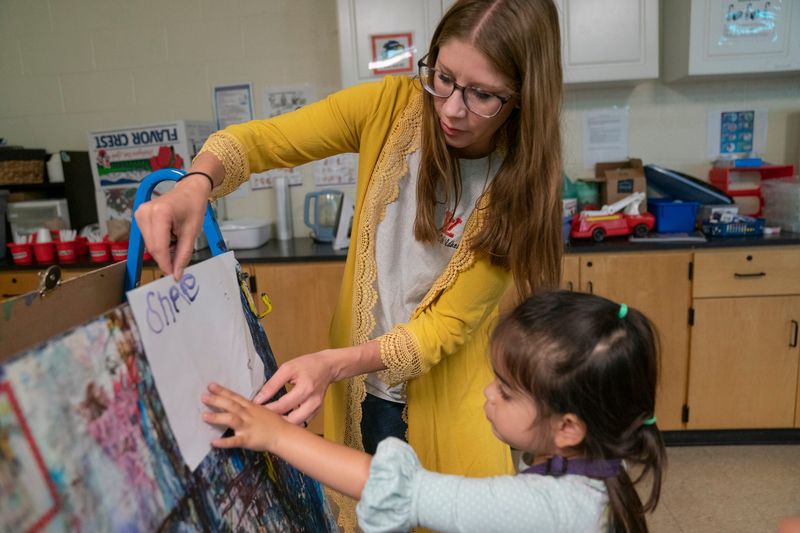
State officials say 51,000 4-year-olds have enrolled in Michigan’s Great Start for Readiness Program for the 2025-2026 school year as of October, a nearly 21% increase from last year’s number.
State early education leaders announced the pre-K numbers at a press conference on Tuesday Nov. 18 held at St. George Preschool in Flint. It’s an increase of about 9,000 more kids than were enrolled this time last year, said Beverly Walker-Griffea, director of MiLEAP, the state agency overseeing early childhood education.

The increased participation marks a boost in enrollment for the state-funded program that offers free pre-K to all 4-year-olds in the state and continued progress towards Michigan’s goal of eventually reaching 75% enrollment by 2027.
Officials said increased enrollment has come as a result of more families becoming aware of their eligibility for the program through a robust public awareness campaign over the last year.
“We’ve surpassed last year’s enrollment numbers so we know we’re making progress,” said Emily Laidlaw, deputy director of MiLEAP. “There are no income restrictions, it’s not just for low-income families or middle-income families but everyone. It means every family can go to work knowing their kid is safe and learning.”
Since the program became universally available to all 4-year-olds, the state has continued to push pre-K enrollment for all Michiganders, citing child care cost savings of up to $14,000 annually for families.
Laidlaw said an exact updated enrollment percentage for the state’s publicly-funded pre-K programming is not yet known and will be available around spring 2026. At that time, the public will get a clearer idea of how close the state is to the 75% enrollment goal. Publicly-funded pre-K programming includes not only GSRP, but also Head Start, which provides preschool to kids in low-income families, developmental kindergarten, and early childhood special ed.
The state’s enrollment rate for the 2024 school year was at 56% of 4-year-olds, or around 66,000 of the 118,000 4-year-olds in Michigan, according to the most recent census data released in March 2025.
Michigan’s enrollment progress may bring it closer to enrollment rates in leading states, including Washington, D.C., which has 95% of 4-year-olds enrolled in state-funded pre-K, Vermont, which has 76%, Colorado, which has 70% and West Virginia and Iowa, which each have 67% enrollment, according to a 2024 National Institute for Early Education Research’s national report on state-funded preschool programs.
State and local leaders were quick to make clear that enrollment for GSRP is still open and available to all families in Michigan who have a child who is 4-years-old by December of this year. All school districts currently still have space for families to enroll, said Laidlaw.
To enroll, families should go to Miprekforall.org and search for local options by inputting their zip code. For an exact cut-off date by which families must enroll, they should check with their local Intermediate School District (ISD), though enrollment will continue for the next two months into February, said Laidlaw.
“This is a no cost option for families,” said Steve Tunnicliff, superintendent of Genesee Intermediate School District. “When I talk to families, they think there must be a catch. There is no catch. This is an investment in our state and I encourage families to take advantage of that opportunity.”
Early learning is important for healthy brain development and research shows that high-quality preschool has the ability to boost academic readiness in kindergarten and beyond — one recent MIT study of Boston Public School’s preschool program found attendees had fewer high school suspensions and were more likely to graduate high school, take the SAT and enroll in college.
In addition to school readiness, the program offers wrap around services like free breakfast and lunch and free developmental screenings for autism or other developmental delays so that needed supports can be provided early, said Walker-Griffea.
Foster adoptive parent Blake Kish has children who’ve attended GSRP programming, including the one at St. George Preschool. At the press conference, Kish said that he wants families considering enrolling their kids to understand how transformative the program can be.
“High-quality pre-K means our kids are in a safe and caring environment,” said Kish, who also talked about how impressed kindergarten teachers have been by how advanced his two children who went through GSRP were.
“You’re giving them the head start and opportunity to prepare for success in school. Pre-K for All is an exceptional program,” he said.
Tunnicliff touted Genesee County’s variety of 130 GSRP classroom options and program options. Parents can choose between a four-day or five-day program, and a full-day or half-day program depending on their needs. These options exist in other counties across Michigan but access to a variety of GSRP program options depends on how many GSRP classrooms are open in both schools and child care centers.
While state funding for opening GSRP classrooms is distributed through school districts, Michigan’s pre-K for all plan cites the necessity of a “mixed delivery system” to ensure new and existing child care providers are also able to receive state funds to participate and offer families the program.
Child care centers often offer more flexibility to parents than school district programs can, like extended hours that meet working parents’ needs. Currently, around 30% of GSRP classrooms are offered through child care centers (referred to by the state as community-based organizations).
In order to help more GSRP classrooms open, the state has provided start up grants to both schools and child care centers to help offset the costs of opening a GSRP classroom, like needing to pay for renovations to a building to make opening a classroom possible, said Jen Mooney, GSRP director at St. George Preschool.
Tunnicliff also made an appeal to Michiganders, encouraging anyone interested to enter the field of early childhood education since new classrooms require qualified teachers to staff them.
“There’s no better time to be a part of early childhood as an educator,” he said, citing the state’s recently expanded investment in pre-K. “The program can only grow to the extent that we have loving adults who want to be educators.”
In addition to GSRP, Laidlaw said there was $25 million in this year’s state budget to expand the 3-year-old version of GSRP, known as Strong Beginnings.
Some child care providers say they worry that publicly funded programs will push them out of business as 3 and 4-year-olds leave their centers to enroll in free programs elsewhere. With them goes the revenue that allows them to pay for infant care, the most expensive due to high staff to children ratios set by the state.
Laidlaw said providers should be assured that Michigan’s mixed delivery system includes them and that they are essential partners in opening publicly funded classrooms. She said she wants child care providers to continue “working with us to find ways to support the whole system” as the state moves to expand publicly funded early learning options for families across the state.
While expanding program enrollment increases access to early education in Michigan, experts caution against focusing only on enrollment speed at the expense of program quality. In this year’s state budget, Michigan’s legislature appropriated additional funds to sustain the expanding program and the state has maintained per pupil funding at around $12,000 per pre-K student, said Laidlaw.
According to the NIEER report, Michigan’s state-funded pre-K is ranked nationally in terms of quality as one of only five states in the U.S. that meet all 10 of National Institute for Early Education Research’s quality benchmarks for pre-K programs, including standards like classroom sizes and teacher credentials.
“This is a model across the nation,” said Tunnicliff. “It’s something we can be proud of in Michigan.”
Beki San Martin is a fellow at the Detroit Free Press who covers child care, early childhood education and other issues that affect the lives of children ages 5 and under and their families in metro Detroit and across Michigan. Contact her at rsanmartin@freepress.com.
This fellowship is supported by the Bainum Family Foundation. The Free Press retains editorial control of this work.
This article originally appeared on Detroit Free Press: Michigan announces boost in pre-K enrollment, urges parents to sign up
Reporting by Beki San Martin, Detroit Free Press / Detroit Free Press
USA TODAY Network via Reuters Connect