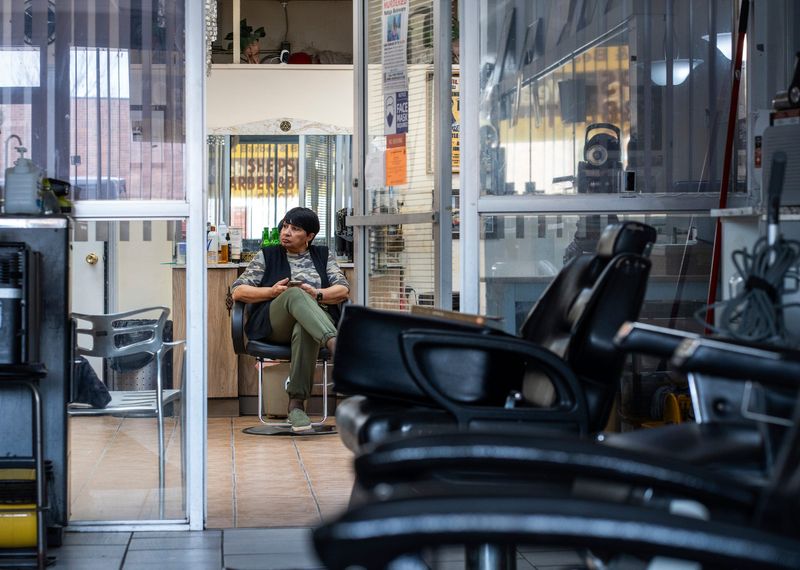
HIGHLAND PARK – She wasn’t at the beauty shop for a haircut. She came for the down-home food.

“How you doing, honey?” said Joan Haywood, 67, walking through the door of Shep’s Barber and Beauty Shop. “I want three.”
Dorothy Grigsby, the shop’s 76-year-old owner, took a break from styling her client’s hair and walked over to a counter, where there were several jars of a green relish flecked with yellows and reds. Seven dollars each. They sat next to the wrapped vanilla pound cake that a customer had ordered.
“I sell chow chow,” Grigsby explained. “It’s an old Southern recipe of a relish. It’s got green tomatoes, peppers, onions, cabbage, and you grind them up and they have special seasoning.”
“I cooked beans last night without it, and it wasn’t right,” Haywood told her. “I said ‘Oh, I got to get over there today and see Dottie.’ That’s why I came here this morning.”
“You can’t hardly find people who make it anymore,” Grigsby replied as she bagged the jars. “It originated in the South during the slavery days, because they were using up the extra stuff that was left over. I’m one of the few still doing it. And I have a steady clientele, so I have to keep it made.
“My UPS man came and he saw it and said, ‘Is that chow chow? I haven’t had that since my grandma passed.’ So now he comes, too.”
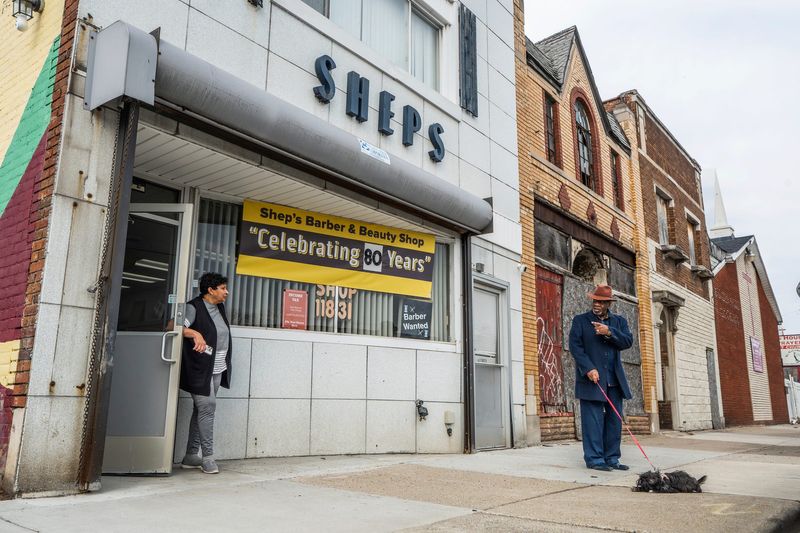
Shep’s has been in Highland Park since 1944. As the city thrived back then, so did Shep’s, where there were barbers behind every chair of the shop in the front, and beauticians at every station in the salon at the back.
Now, the shop is down to a mother and son keeping it alive.
They say it’s the oldest barbershop in the area. It’s likely one of the last, authentically old-school places to get a haircut around Detroit. And it’s almost certainly the only place where people can buy homemade pound cakes and chow chow made by a grandmother.
“This reminds me of my mother,” Haywood, said, taking her jars. “She was from North Carolina.”
“That’s how I learned,” Griggs said. “I learned from my mom.”
***
Everything at Shep’s has likewise been passed down from an earlier time.
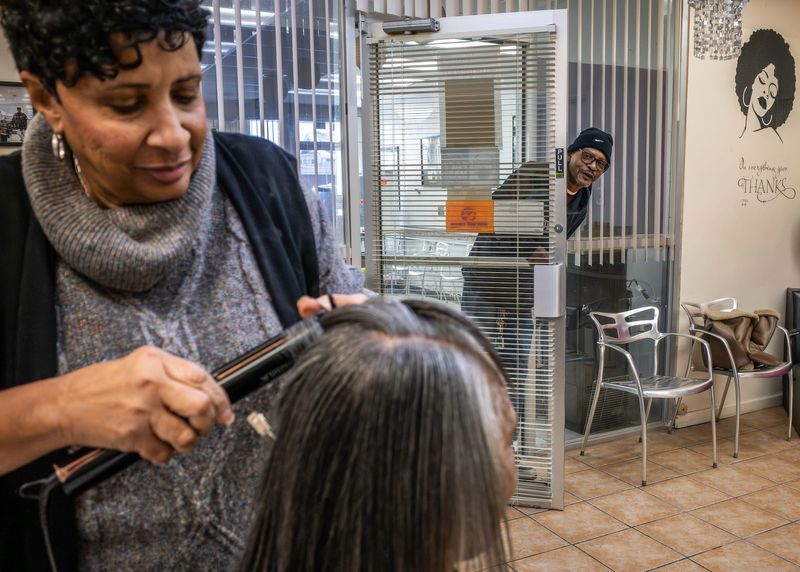
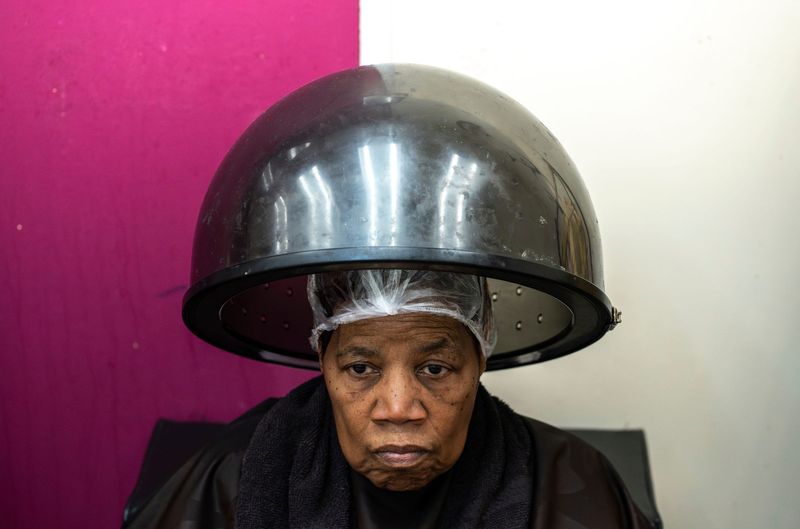
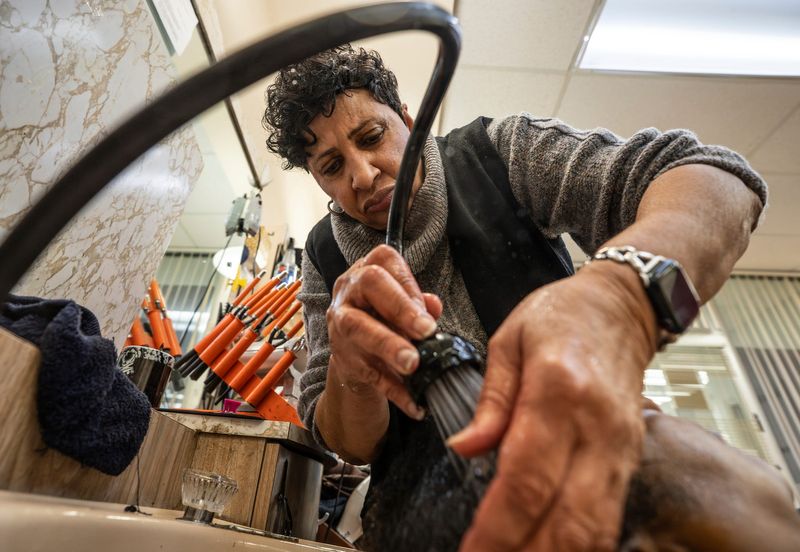
The beauty shop still has its old cabinets, its vintage shampoo bowl, its curling irons that go way back. The barber shop has kept the same landline phone number from the 1940s, the same straight-razor shave it’s always offered, the same old cast-iron radiator that Grigsby’s 57-year-old son, barber Terrance Harris, uses to warm up his leftovers at lunchtime. “Now this is old school,” he said, putting his food on top of it.
And they still do things the way they used to be done.
“She has rules,” said Shirley Walker, 73, glancing at Grigsby. She was sitting in the beauty shop portion of Shep’s on a weekday morning, talking with everyone while waiting her turn. “She’s not one of these shop owners where anything goes. You have to have an appointment and, depending on what you got to get done, you don’t have to wait all day long because she don’t have the stragglers coming in.”
“Just like my customer that was here this morning, she always tells people she likes to come, because I stand on business,” Grigsby replied as she combed a client’s hair. “I don’t play around, mess around, keep you here all day. I still run it like an old-school business. And that’s what I’m supposed to do. See, hairdressers in Detroit have made a bad name for hairdressers in Detroit, because they will keep you all day, doing nothing. And then they charge you big fees.”
“And their hair look like the devil when it gets finished,” Walker said. “It don’t look like nothing. You spend all this money on nothing.”
“Most of them tell me, ‘I want an old-school hairdresser to do my hair,’ ” Grigsby said of her clients. “They want an older hairdresser that can do a press and a curl, and it’d still be pressed and curled when they got home; because by the time they get home, all the curl’s gone, and they were tired of giving their money away to these hairdressers, getting no results. They know that if I’ve been in the business that long, that I could do what they needed me to do.”
Shep’s was founded 82 years ago by Grigsby’s uncle, Richard Shephard, on the other side of town, on Oakland Avenue. It stood there for two decades until Chrysler expanded its facilities in 1965 and took the land out from under Shep, who moved his shop to Hamilton Avenue, where it’s been ever since.
Back then, Highland Park was still bustling.
“I wouldn’t trade my upbringing in this city for nothing,” said Ken Rembert, 64, as he got a trim in the barbershop. “When I was growing up here, it was a clean city. Let me tell you something: You could tell when you walked out of Highland Park into Detroit. We had some friends come in town from Ohio, and we was walking up Woodwood, and it was all clean. ‘Yeah, this is Highland Park. It’s always clean right here.’ And so we walked into Detroit he said, ‘Man, I thought the city was always clean.’ I said, ‘We’re in Detroit now.’ You could tell the difference.”
That distinction got blurred as both cities began a steep decline in the 1960s and ’70s. Yet even as everything crumbled around him, Shep refused to move out of Highland Park. “Things will change for the better again,” he’d always say. “We’ll be here when they do.”
Things never did really change for the better in the neighborhood, but he was right about the barbershop still being there. It’s now the only functioning building left on its block.
“We had all types of businesses here,” Grigsby recalled. “And as they started one by one closing down, people moved away, the buildings just sat empty until they fell apart, and that was the decline. We just slowly watched the decline.”
Grigsby came here in 1998 after another in a series of layoffs from her job as a welder at Chrysler. She was born right here in town at Highland Park General Hospital, got married at 16 and became a pregnant widow at 21. Fifteen years at Chrysler, then beauty school, then the beauty shop.
“Chrysler called me back about three or four times, and I told them, ‘No,’ I was doing fine here,” she said. “I had a big clientele. So, I never went back.”
As Shep aged into his 90s, he offered his niece the shop. “I’m getting older, and none of my children are interested in the hair business,” she said he told her. “You’re the only one in the family that’s interested.”
Almost three decades later, she and her son are the last ones left working here — usually for only a handful of hours a day. He runs the barbershop, she handles the salon. He accepts walk-ins, often from strangers looking for an experience they thought had vanished; she’s deliberately down to a handful of devoted regulars who come for an experience they never want to lose.
“We don’t make any money,” Grigsby said. “We haven’t made any money in this shop, probably the last 20 years. But the clients are more like friends now, like family. They won’t let me retire. If I’m talking retirement they get upset. They say, ‘Lord, what am I going to do if Dottie retires?’ Well, what you gonna do when I hit that Lotto?”
***
There’s nothing trendy about the barbershop. There’s no gaming system or pool table where the men can pass the time as they wait, no high-end grooming products for sale on shelves, no wide screens on the wall showing ESPN highlights.
“This is close as we can get to ESPN,” Harris said, gesturing toward the free streaming sports channel on the modest TV in the corner. “But they don’t really show highlights. They just talk all day.”
He prefers the cooking channels that stream for free. So do the customers, who’ll watch a recipe unfold and discuss it like it’s a football game.
“I started watching these shows, man,” Harris said. “I learned a lot of stuff, for real.”
“Sitting here in the chair or waiting in the chair, you see stuff that you can tweak what you already know,” said Michael Hall, 67, a retired Detroit firefighter waiting for his cut, eyes locked on someone smoking a brisket. He first came here when he was 8 years old, when he lived only blocks away.
“Two weeks ago, there was this show, I can’t think of the name,” he continued. “They were by a riverbank. What’s it called, Terry? Do you know?”
“I can’t remember, man. Just found that show,” Harris replied. “But they are good. They wrap those hot dogs and sausages with bacon.”
“That was just the light end of it,” Hall replied. “They did some stuff with corn that was ridiculous.”
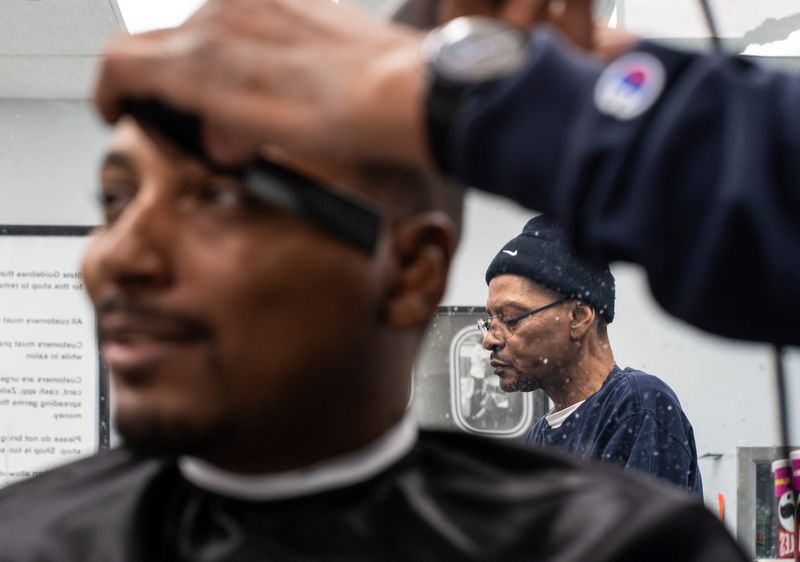
Thirty-five years ago, Harris was a commercial roofer enduring another seasonal layoff when he switched careers and came to work with his Uncle Shep. Now, he’s the only barber left. No other barbers means no income from chair rental. And no camaraderie between haircuts, either. “You don’t have nobody to talk to,” he said. “You just end up on your phone like everybody else.”
But when customers do come, it’s not much different than it was in the old days.
“You sit in here, it’s a good atmosphere, a family atmosphere. I love that part,” Rembert said. “I started coming in high school, been coming ever since. It’s always good conversation every day — sports, a little politics, a lot about food.”
“We’re grassroots,” Harris said. “Ain’t nothing special, nothing we’re doing nobody else can’t do. But those other places, you’re paying for a lot of bells and whistles. They probably have a fancy TV, video games. The closer you get to, like, New Center area, it’s going to be 50 bucks for a haircut. Here, it’s $20; if they want a shave too, it’s $40. Sometimes, simplicity never goes out of style.”
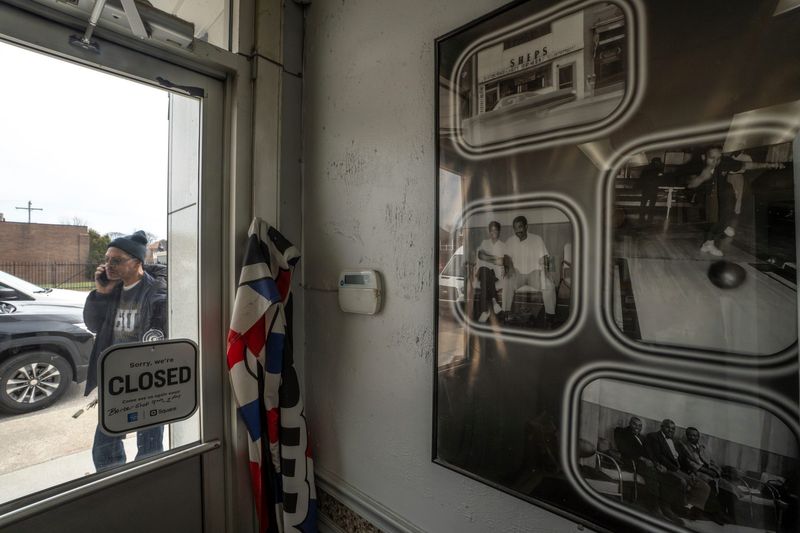
The wall was covered in framed photographs of the black-and-white past: Shep out bowling with the guys. Men in suits and overcoats seated against the wall, waiting for their haircut. Beauticians in the salon wearing white dresses and white shoes. A seated woman in her curlers, reading Ebony magazine. The storefront of the shop just as a 1973 Chrysler New Yorker passed through the frame. Everything and everyone in those photos is now gone, except Shep’s itself.
“This is a nice tradition to be a part of,” Harris said. “When I was 18, 19, I never thought I’d be working with my mom the rest of my life. It’s been the best experience.”
***
She was right on time, as always.
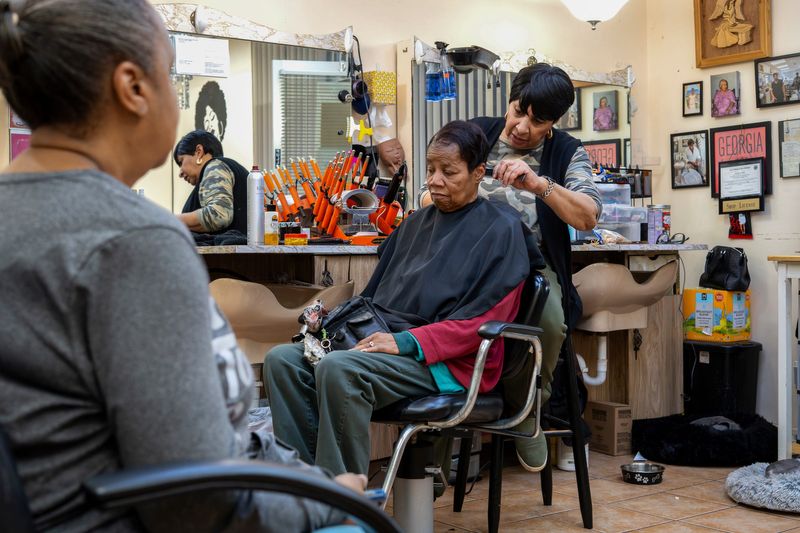
“I’ve been coming every week for 35 years,” said Beverly Lindsay, 66, as she walked into the salon for her weekly appointment. She took off her coat and eased into the styling chair. Grigsby gently leaned her back, washed her hair in the vintage shampoo bowl and slowly applied conditioner.
Now and then, Grigsby would stop what she was doing to tell a story, and Lindsay would sit patiently, just like everyone else in the chair does. Like any good barbershop or beauty salon, the conversation is half the reason for the appointment.
“It’s friendly,” Lindsay said. “It’s home. Here, we can all not talk to each other, and that’s OK. Or we can talk together, and we have a good time talking. Or if it doesn’t interest me, I just lay back — I hear you, but I don’t hear you. This is my little ‘Me’ time, my Zen time.”
“Most of them, like Beverly, are more like family than a client,” Grigsby said. “I’ve been knowing her so long, I’ve watched her kids grow up, I know her husband. I’ve been to their anniversary.”
Here was a workstation with a printer and a computer: “File your return here,” says a sign. Grigsby’s not just a cook and a hairdresser, she does people’s taxes, too. Mostly seniors.
“They want somebody they can trust,” Grigsby said. “They know me.”
Here, too, were Grigsby’s two little dogs, both Shih Tzus, about 15 years old. One’s blind and deaf, the other has but three legs. They follow her in every day, curl up on their beds by her feet and stay there. “They’re the sleepingest dogs I’ve ever seen,” Grigsby said.
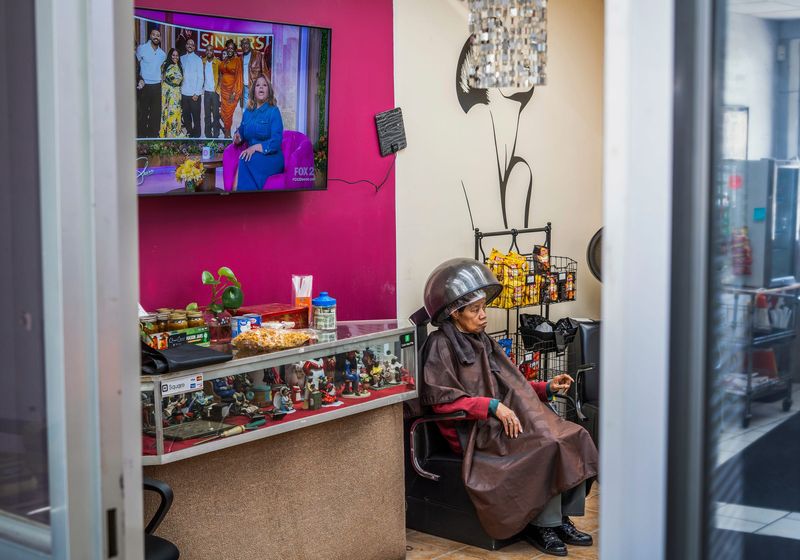
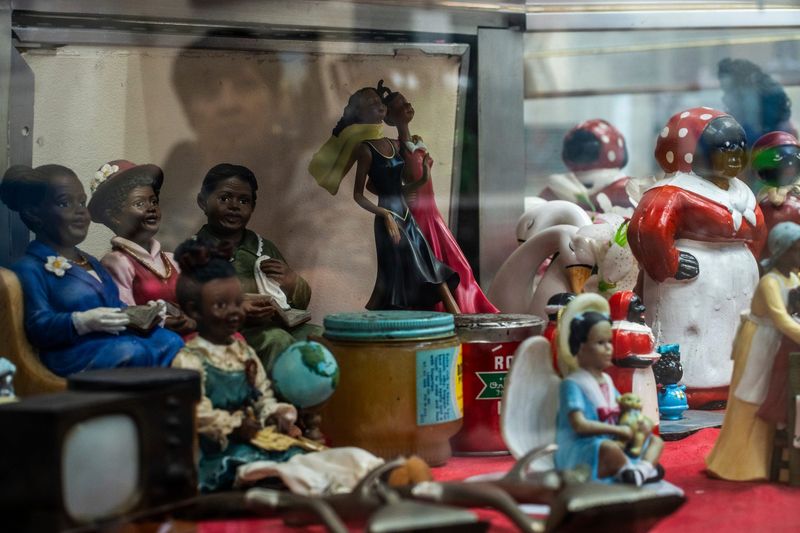
And here, of course, were fresh jars of chow chow, sitting on top of a glass case full of collectibles that serves as the barbershop’s unofficial museum.
It displays hair antiques such as hand-scissored hair clippers, ancient curling irons and jars of long-ago styling products. “And this big pair of shears here, that’s when the big Afro came out,” Grigsby said. “You had to have something big to get around all of that or you’d be cutting all day.”
They were arranged among authentic Jim Crow figurines and Aunt Jemima salt and pepper shakers, which stood in contrast alongside more modern Annie Lee statuettes showing everyday life, like the Mother’s Bench in church, a little girl writing in a school lesson book, a hairdresser brushing another woman’s hair. And Shep’s barber school diploma enabling him to open his own business.
“It’s my own collection,” Grigsby explained. “But there’s no particular reason for any of them.” They still told a story, though.
At the time, the barbershop up front was empty. “Terrance is taking a customer home,” his mom said. “We do shuttle service. If they don’t have a ride, we go get them. His customer had a fall in his house and he messed up one of his eyes and he can’t drive. I pick up some of my older women on my way and drop them off. If they’re waiting on a ride, I just take them home. It’s just things that you do when you know people a long time.”
“And that’s the difference between this new generation of hairdressers and seasoned people like us,” Lindsay said, speaking for the group. “We do care. The younger hairdressers, they wouldn’t dare do that.”
Grigsby was recently asked to give a talk to her church’s Sunday School classes about how her business has endured here for so long. The answer she gave was yet one more thing that’s been passed down from the old days at Shep’s.
“I told them what my uncle taught me: You stay because things are going to change,” she said. “They always change. If you hang in there and be there when they change, you can take advantage of it.”
Lindsay’s hair was done, right on time, same as it always had been. She stood up and put on her coat.
“All right Miss Dottie, I’m going to leave,” she said. “But I’ll be back next week.”
John Carlisle writes about Michigan. His stories can be found at freep.com/carlisle. Contact him: jcarlisle@freepress.com. Follow him on Twitter @_johncarlisle, Facebook at johncarlisle.freep or on Instagram at johncarlislefreep.
This article originally appeared on Detroit Free Press: Metro Detroit’s oldest barbershop endures by staying the same
Reporting by John Carlisle, Detroit Free Press / Detroit Free Press
USA TODAY Network via Reuters Connect