Clinton Township ― A years-long battle over extending a controversial high-voltage power line just feet from a Clinton Township condominium complex is raging on in court, where township officials vow to keep fighting, while the utility company praised a recent ruling as “an important step” to advance the project.
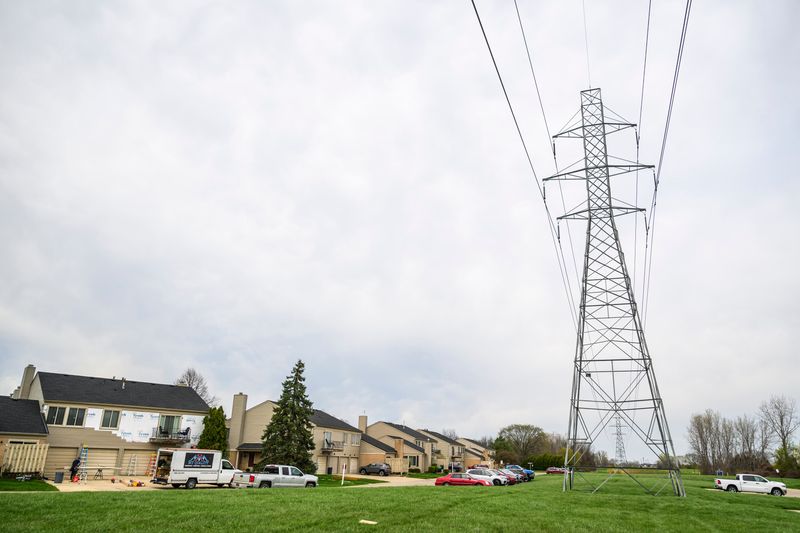
Novi-based ITC Transmission wants to build a transmission line along 19 Mile to deliver more power to Henry Ford Macomb Hospital after its new North Tower opened in the township in 2023. ITC, which is responsible for much of the region’s power grid, has proposed extending its Lenox-Stephens 120-kilovolt transmission line from just west of Hayes Road to the Shrine substation on Commons Drive.

The line, a high-voltage conduit that efficiently delivers energy over long distances, would run for less than a mile along the north side of 19 Mile.
But Clinton Township officials fiercely oppose ITC’s 19 Mile route, calling it “unconscionable” to put lines so close to residents’ homes. A Macomb County Circuit Court judge granted ITC the easement rights that would allow the firm to build and maintain the lines along 19 Mile earlier this month, and Clinton Township officials last week filed a motion for reconsideration.
Clinton Township Supervisor Paul Gieleghem said the township and ITC’s attorneys are finalizing the language of an agreement under which ITC can’t start construction without receiving other approvals. The township is willing to take many steps to fight the proposal because it believes that it’s here to “protect our residents and their property rights,” the supervisor said.
“And that this big corporation should not be trampling on these residents,” Gieleghem said.
But ITC called its proposal to extend the line down a portion of 19 Mile the best route. In addition to pursuing the easement rights, the utility firm is seeking another form of approval through the Michigan Public Service Commission after the Clinton Township Board of Trustees denied ITC’s proposed route last year.
“We fully support and believe that our best route, and we stand by that, is the 19 Mile Road route,” said Gary Kirsh, ITC’s senior area manager of local government and community affairs.
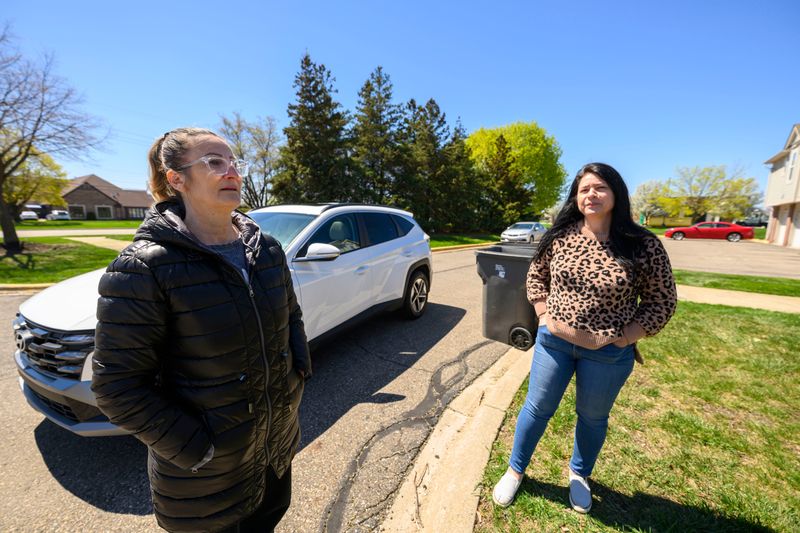
Cindy Ridky is a resident of the Westchester Village condominium complex, which is right near where the lines would be extended. A high-voltage line, which would be 50 feet from some units, would replace trees and flowers now starting to bloom again after a dormant winter.
“We want this corridor here at 19 Mile to look and stay residential and keep our residents, you know, safe. … We want them to stay healthy,” Ridky said.
Why are the transmission lines needed for the Henry Ford hospital?
Under ITC’s plan, DTE Energy power lines would bring power from the substation to Henry Ford Macomb Hospital on 19 Mile. ITC transmission lines carry energy at a level too high for the hospital to use, so the DTE lines would allow energy to be transmitted to the hospital at the right level.
Henry Ford Health said its ability to continue providing high-quality care is at risk until it has a “new, reliable power source.”
“We are committed to supporting any safe, expedient solution that allows us to invest in the power we need to deliver lifesaving services without disruption, maintain the trust our patients place in us, and sustain the continued growth of our services and facilities,” a Henry Ford Health spokesperson said in a statement.
Gieleghem said the township wants to ensure the hospital has the power, but wants an alternative route for the ITC line ― one along Dalcoma Drive. The township has gone so far as to file a Freedom of Information Act request and hire a helicopter expert to help make its case.
The expert studied how the route could affect Henry Ford Macomb Hospital’s helicopter operations and said the helipad’s proximity to the hospital building and parking lot light poles already necessitate a steep descent by helicopters, Gieleghem said. The expert asserted that the power lines would have less of an impact than the current impediments, he said.
Gieleghem said the township Board of Trustees in June 2025 denied ITC’s proposal under its Essential Services Ordinance, which evaluates all above-ground utilities that have an impact on residents. The township adopted the ordinance a few years ago because the city of Mount Clemens had considered building a water tower in a residential neighborhood, he said.
The township supervisor said there is a difference between people deciding to buy a house near existing power lines and putting power lines next to existing homeowners.
“If a developer comes in and builds a house adjacent to power lines and people decide to buy it, that is people making economic choices,” Gieleghem said. “But to have existing property owners own their home for many years, and then all of a sudden, a power line is forced less than 50 feet from their home is not appropriate.”
The township submitted a public records request to Macomb Community College and learned that Henry Ford Macomb Hospital lobbied the college in 2021 to place the transmission line along Dalcoma Drive, and ITC officials were included on those emails. Gieleghem said ITC has shown no willingness to compromise on the route “whatsoever.”
“We’re ready to negotiate, but we’re also actually going out to independently validate the claims that they’re making,” he said, “and we’ve found that their claims have been disingenuous at best.”
ITC calls 19 Mile plan ‘the right route’
But ITC’s Kirsh said the 19 Mile route is “the right route” because it can be built more quickly and would be less expensive than an underground route on Dalcoma Drive.
ITC held a series of community meetings earlier this spring to share details about the expansion with residents. ITC said it doesn’t have project costs on the expansion as “the design and construction plans are still being worked on.”
“ITC is working to make sure that we can get power to the hospital as soon as possible,” Kirsh said.
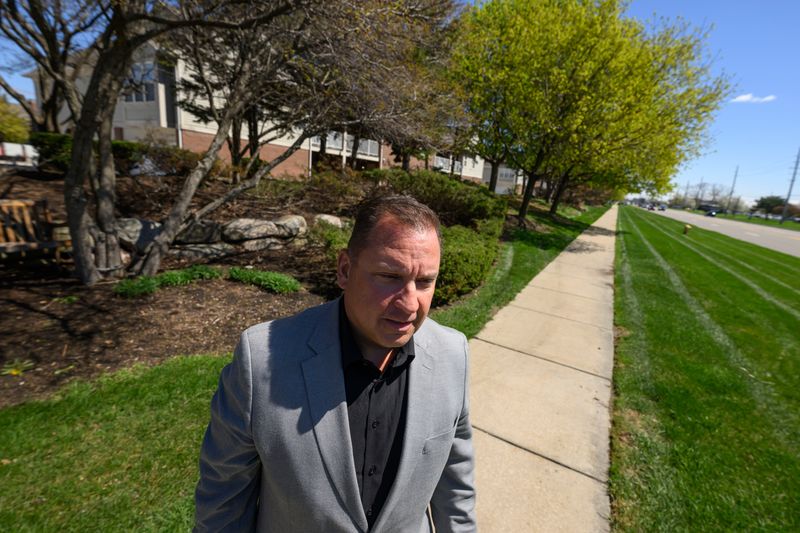
A natural area with blooming deciduous trees, bushes and pine trees separates the Westchester Village condominium complex from 19 Mile. A wooden bench sits under the trees.
Under ITC’s plan, the company will remove all of that vegetation, Ridky said, so it can extend the transmission line.
“All these trees are going to be gone,” she said, adding that the noise barrier that the trees provide will go away.
ITC said it will clear the right-of-way of vegetation for the project’s construction. Some vegetation that is compatible with transmission lines may be permitted to revegetate in the right-of-way, the utility firm said.
Ridky, a member of the condo association’s board, said an ITC employee told her that there aren’t any devices on the transmission line poles that monitor the electromagnetic radiation levels. ITC’s Kirsh confirmed that there are no devices on ITC’s lines or structures and noted that the company can come on-site to read electric and magnetic field levels for residents.
The Environmental Protection Agency says low-frequency electromagnetic radiation is “found in close proximity to electrical sources such as power lines.” Scientific studies have not consistently shown whether exposure to electric and magnetic fields raises cancer risk, according to the agency.
Kirsh said electric and magnetic fields from power lines, electrical appliances and home wiring are not strong enough to damage DNA.
Georgia Kontoudis, who has owned a condo in Westchester Village since 2003, said children would be waiting under the transmission line for the bus every school day. She also worries about how the lines would affect the condos’ property values.
“And a lot of us actually would want to move if the transmission lines were approved, because we wouldn’t want to live near them,” said Kontoudis, 51.
ITC pursues Public Service Commission approval
After the township’s rejection, Kirsh said ITC is pursuing another form of approval with an application to the Michigan Public Service Commission that resulted in three public meetings. About 45 people attended the March hearings organized by ITC, where the utility presented its proposed route and an alternate route ― an underground route on Dalcoma and University Drive.
ITC brought subject matter experts, Kirsh said, who could address “just about every question that they had.”
Ridky said she attended a few meetings, which she called “intense.”
“But there was a point where ITC basically kind of bullied us and basically said if the city doesn’t approve, that they’ll basically take it to court,” she said. “And that’s exactly what they’re doing.”
Before the Macomb Circuit Court ruling earlier this spring, Kirsh said ITC presented voluntary easement offers to the Westchester Village Condominiums Association, but was rejected. ITC then sought the construction easements through eminent domain, which allows private property to be seized for public use, such as building infrastructure.
Despite the court ruling that granted the easements, ITC will still need other approvals before construction can start.
“By confirming the easement has vested with ITC, the Court’s order does not provide ITC with the authority to commence construction without receiving any other approvals ITC may be legally required to obtain prior to doing so,” Kirsh said.
The Michigan Public Service Commission’s approval of ITC’s application would allow the 19 Mile route construction to move forward.
Gieleghem said the township is prepared to defend its denial of the ITC route in court and defend its Essential Services Ordinance. It is also prepared to argue for an alternative route before the Public Service Commission, he said.
“What we’re ultimately looking for is for public entities like the township and the college to come together and require ITC to develop a route that has the least amount of residential impact while still getting the power needs of the hospital” met, Gieleghem said.
Henry Ford’s stance
ITC has an ally in Henry Ford Health. In an April 2025 letter to Gieleghem and the Clinton Township Board of Trustees, four Henry Ford Health officials expressed their “strong support” for ITC’s application to connect the Shrine Substation to the Lenox-Hayes circuit.
Henry Ford Macomb Hospital has already invested more than $5 million in the Shrine Substation, according to the four officials, who included Shanna Johnson, then interim president of Henry Ford Health Macomb Hospital, and Michael Markel, the hospital’s chief nursing officer.
When the hospital’s new tower was built in 2023, it was anticipated that the substation would provide “the necessary additional power support,” they wrote.
“Because the Shrine Substation remains unconnected, the hospital currently is operating at a lower level of power service than needed, forcing us to switch to emergency generator backup power during energy interruptions,” said the letter, also signed by Henry Ford Health Chief Operating Officer Denise Brooks Williams and Marc Corriveau, chief government relations officer for Henry Ford Health. “This emergency backup generator only powers the most critical areas of the hospital, while much of the operations go without electricity.”
For its part, nearby Macomb Community College spokeswoman Jeanne Nicol said the college understands the importance of expanding “energy infrastructure” to support the expansion of Henry Ford Macomb and the college has no objection “as long as it does not require an easement from the college nor hinders the ability to develop, enhance or use the limited buildable property that remains on its Center Campus.”
ITC never officially requested to pursue a route along Dalcoma Drive on college land, Nicol said. Gieleghem requested the idea of putting “electric infrastructure along Dalcoma Drive” to University Drive and then east to Henry Ford Health’s facilities on the college Board of Trustees’ May 21, 2025, meeting agenda, she said.
The board rejected the item, she said.
“Macomb’s overarching position is that relinquishing college land for non-educational purposes limits the ability to fully and effectively employ college resources to respond to evolving student and community needs,” Nicol said, “and is not consistent with the longstanding trust the community has in Macomb Community College to appropriately use the assets and resources they have invested in the college.”
Kontoudis, the longtime Westchester Village condo owner, said the fight is shifting to the Michigan Public Service Commission, where she is encouraging residents and businesses to post comments about the proposed ITC project on the PSC website.
“We don’t want that (the extended transmission line) for our community,” Ridky said. “We don’t want the front of our complex to look like it’s a district, a manufacturing district. We want it to look like a residence.”
asnabes@detroitnews.com
This article originally appeared on The Detroit News: Macomb Co. township fights to keep high-voltage power line away from homes
Reporting by Anne Snabes, The Detroit News / The Detroit News
USA TODAY Network via Reuters Connect