Detroit — The decline of the perceived worth of a college degree is nothing new to Detroit, a city that has historically had low postsecondary attainment.
But over the last decade, the city and its partners have attempted to address this situation ― with the Detroit College Access Network’s annual Detroit Decision Day being a celebration of what has worked to bring Detroit’s students to their next step.

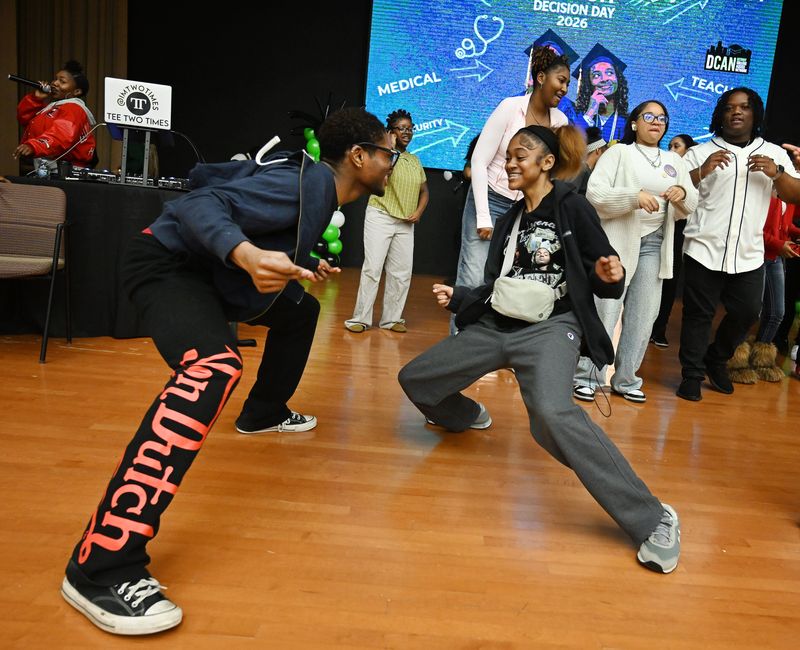
Hundreds of students from a handful of Detroit’s 54 high schools filled the auditorium of The Icon building along Detroit’s riverfront Thursday morning. The students danced, blew whistles and brimmed with excitement about what their futures held ― whether that be a traditional four-year college or university, a community college or a vocational school.
Crockett Midtown High School of Science and Medicine senior Geovonni Dickerson said that, for him, going to college was a way to make his family proud and learn the skills he needs to be an attorney.
Dickerson, who’s been accepted into roughly 100 schools and received over $3 million in potential scholarships, said he’d always felt his education was important and wanted to show his younger siblings what was possible. He said he wouldn’t have been able to pursue the scholarships and acceptances he earned without the support of his family, school principal and counselors.
“It was a little nerve-wracking at the beginning,” Dickerson said. “But I had people there to help me. … I think other students who are feeling nervous (about applying for college) should just go for it. You’ll be proud of yourself.”
Detroit Decision Day is held a day before “National College Decision Day,” where students traditionally declare where they plan to attend after high school graduation. Detroit College Access Network CEO Cyekeia Lee described the day as a celebration specific to Detroit students who’ve historically had less access to higher education.
“We’re still chipping away at it,” Lee said. “Detroit sits at around 19-20% for degree attainment, more work needs to be done. … The gap is pretty wide in Detroit right now.”
Educational attainment in Detroit
Decades ago, those living in Detroit could find high-paying, stable jobs without a college degree, said Detroit Regional Chamber Chief Education and Talent Officer Greg Handel.
That’s no longer the case, he said. By 2031, nearly 70% of jobs in Michigan and nearly all of the high-paying jobs will require postsecondary education, according to the chamber’s 2025 State of Education and Talent report.
“Education and income are closely aligned,” Handel said. “And we’ve seen, across the country, companies are going where the talent is instead of talent just going where the companies are.”
Detroit’s educational attainment levels lag behind peer cities like St. Louis and Atlanta. The percentage of Detroit students who enroll in college within six months has fallen roughly 13 percentage points over the last decade, data from 2024 from MISchoolData shows. The decline was exacerbated by the COVID pandemic and mostly affected community college enrollment, Handel said.
Detroit is making an incremental improvement, but compounding the issue of low educational attainment is racism and other barriers that have prevented Black city residents from having the same access to higher education historically, Detroit Promise Executive Director Onjila Odeneal said. The Detroit Promise is a last-dollar scholarship for students living in Detroit to access higher education tuition-free. About 2,600 students are currently enrolled in the program.
The residents who have historically seen the most barriers to higher education are the same ones who see the most fallout from changes at the national level that target specific programs aimed to boost their chances at succeeding in postsecondary education today, Odeneal added.
“When you’re looking at communities that are the target of a lot of what’s happening right now, they’re in a space of questioning the value, asking what makes sense and if (higher education) is worth it, especially with all the propaganda and all the messaging telling people college isn’t worth it,” Odeneal said.
Focusing on gaps in college supports
Students at Detroit Decision Day said they wouldn’t have been able to complete high school, apply to college and feel ready to attend without the help of teachers and counselors.
“It was kind of stressful, I didn’t know where to start,” said Zoe Davis, a Detroit Edison Public School Academy senior.
The college seminar at her school helped her with applications. And it was worth it, she said.
“I got lots of scholarships and offers, I was happy with that, and my parents were too,” she said.
Wayne State University Senior Director of Admissions Ericka Matthews-Jackson said that in addition to the in-school supports for students, it’s important that Detroit students have access to community-based institutions.
“Detroit students might need different supports than others,” Matthews-Jackson said. “High school counselor-to-student ratios are very high. One counselor might have hundreds of students they’re responsible for.”
Matthew-Jackson, who also sits on DCAN’s board, said the organization is planning summertime options for students to ensure they don’t lose out on any time or opportunities to prepare for what comes after high school.
“We’ll be opening new hubs for Detroit students in the summertime, where they can talk to their high school counselors, get support for any education needs,” she said. “And we know the counselors have a lot to handle. DCAN also supports them through professional development and other training and support.”
DCAN’s Lee said she didn’t think the loss of university programs specifically aimed towards Black students and federal pressures would prevent students from being successful.
“Programs on a lot of campuses are being eliminated, but Detroit partners have been showing up,” she said. “We fill in the gaps because we have to. Students need the supports. … We’re going to still be here despite any changes in the federal landscape, we have a lot of state support.”
Keeping students on track for college
Getting students to postsecondary education isn’t the end goal, Handel said. Of Detroit students who enrolled in postsecondary education in 2018, less than 40% of them earned a degree or certificate within six years, chamber data shows.
There are signs that state and institutional changes post-pandemic have made a difference. First-year college students are completing courses at the same rate they did before the pandemic, according to the chamber’s report.
Matthews-Jackson said Wayne State and other colleges and universities throughout the state have realigned how they retain students.
“Year one to year two is the most critical,” Matthews-Jackson said. “At Wayne State, we have college transition initiatives where we creating touchpoints with students. We’ve also really been very intentional and targeted with our academic advising.”
Matthews-Jackson said the goal was for students to know where to go when they’re struggling before it happens. This includes “slightly intrusive” messaging, including texts to remind students throughout the academic year what was coming up.
“We need to be making outreach to students and not just waiting for them to come to us,” she said.
Odeneal said the Detroit Promise was also pushing for “standards of care” institutions enrolling Detroit students would follow to improve the experience for all students.
“How do we show up for students?” she said. “How are we collectively creating systems that show up for students? And the beauty of that is the supports we place around Detroit students actually helps all students that are on campus because (institutions) are consciously thinking about how do we make this experience easier for students to navigate?”
satwood@detroitnews.com
This article originally appeared on The Detroit News: Detroit students celebrate college plans amid fall in participation
Reporting by Sarah Atwood, The Detroit News / The Detroit News
USA TODAY Network via Reuters Connect