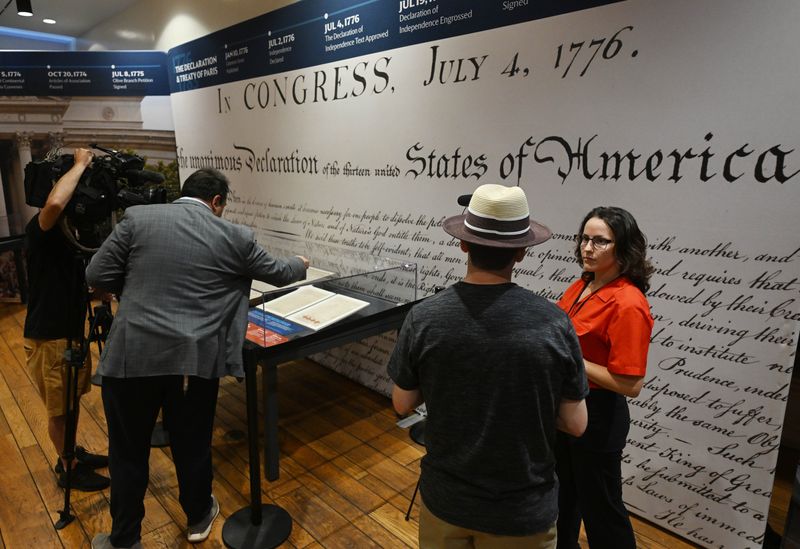
Dearborn — Centuries-old documents rested beneath glass in a dimly lit gallery at The Henry Ford on Wednesday, where visitors will soon have the chance to examine the pages, signatures and words that helped shape the nation’s history.
While the Fourth of July may have passed, Michigan’s celebration of America’s 250th anniversary marches forward with a new exhibit at the Dearborn museum.

Nine founding documents, traveling aboard a Boeing 737 specially decorated for the occasion, touched down Monday on Michigan soil. The traveling exhibit, called “Freedom Plane National Tour: Documents That Forged America,” opens to the public on Thursday at The Henry Ford Museum of American Innovation in Dearborn. It runs through July 26.
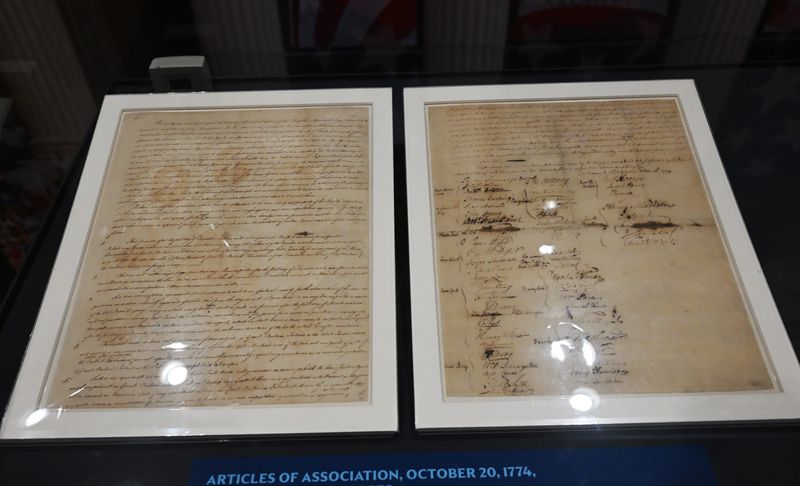
Tickets are sold out, but those who have secured a chance to see the exhibit will get to view a range of treasured pieces of history. They include the 1783 Treaty of Paris; George Washington’s, Alexander Hamilton’s and Aaron Burr’s oaths of allegiance to the revolution; a rare draft printing of the U.S. Constitution; a Senate markup of the soon-to-be Bill of Rights; and an original 1823 engraved copy of the Declaration of Independence.
The rare parchments are arranged in a rotunda-style display, beginning with pre-war documents, followed by Revolution-related records and ending with post-war nation-building documents.
The Henry Ford in Dearborn is one of only eight cities where these documents will be exhibited. The exhibit was inspired by the 1976 Bicentennial Freedom Train.
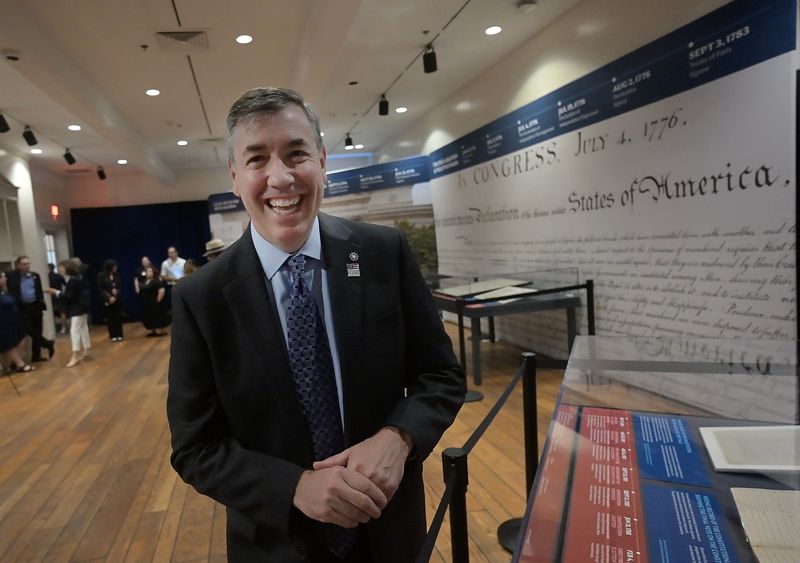
Patrick Madden, CEO of the National Archives Foundation, explained to The Detroit News that the foundation selected a few, special cities in areas that do not often get to experience founding history.
“It’s a chance for us to get founding documents out of Washington and share them with the American public for the 250th,” Madden said. “So intentionally, there’s no sites in the original 13 colonies. There’s already a lot of old documents and stuff around the founding there. So, how can we get out to major markets where it has as much reach as possible and then have people experience these things that honestly, even if you came to Washington, you wouldn’t see this.”
Detroit specifically offered both a rich history and large market, Madden said.
“Detroit to me is one of those major markets,” he said. “It’s iconic with its history of entrepreneurship, innovation and obviously international component to it as well. I’ll be curious afterwards to see if there’s folks are from Canada come over and see it.”
Patricia Mooradian, The Henry Ford’s president and CEO, said she was honored to receive the email from the National Archives Foundation in December 2025.
“We were delighted to be selected,” Mooradian said. “We really felt like it was an important thing to do for our community, the community of Detroit and the greater region, to bring these documents, which don’t travel together to the city. It was a really important decision for us to make, and it was not a hard one to make. We said yes immediately.”
Mooradian said seeing the documents in real life provides a deeper connection than seeing them online.
“When you see these documents you understand the courage that it took for these founding fathers to do what they did to create this new country,” she said. “It’s pretty incredible, and it makes you understand how deeply they believed in freedom and democracy. They risked a lot to do it, and they persevered, and these are qualities that I think we all need to have in our everyday lives.”
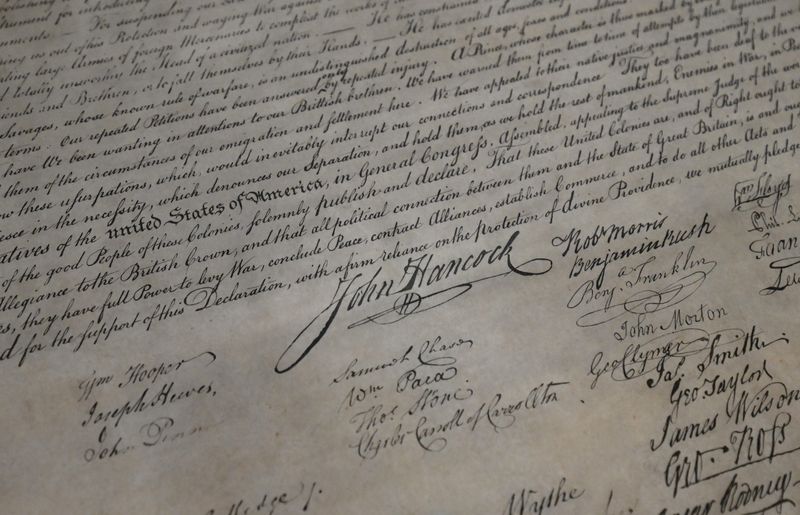
All of these parchments have rich stories associated. One famous example: John Hancock’s signature on the Declaration of Independence. While legend has it that Hancock signed so large to ensure the King could see it even without his glasses, Maureen MacDonald, special assistant to the archivist at the National Archives, said that story is likely false.
“That’s sort of a fabled story,” MacDonald said. “So most likely he signed it first. He was president of the Continental Congress, and so I think he assumed people would sign it as large, but again they were considered traitors, so why would you want really big signatures that the king could read.”
While the original copy of the Declaration of Independence remains in Washington, the engraved copy, a part of the tour, is also incredibly valuable and less faded.
“In the 1820s the original is already starting to fade because it was traveled around and displayed in the sun,” Madden said. “So, John Quincy Adams decides, with the technology at the time, to do a wet transfer. They basically wet a piece of paper on the original declaration, they peel a layer of ink off of it and they put it on a copper plate. It takes one stonemason three years to engrave it in reverse from that copper plate. They made 200 copies, and this is one of them. There are only 50 that are known to still exist.”
While some fading from the past was inevitable in this case, today, archivists do a lot of work to keep the documents in top condition. For instance, one of the reasons only eight cities were chosen for the traveling exhibit was to reduce light damage to the documents.
There are also measures that need to be taken at each stop of the tour.
“It’s a lot of work and it’s a lot of people involved,” McDonald said. “It’s conservators, there’s archivists, security people. Then we work with local venues to make sure that they have the right facility to hold the documents securely, have the right temperature and humidity control.”
Hillary Rose, a frequent museum-goer and a history teacher at Stride Inc. from Carleton, said she was disappointed, but not surprised to see that tickets were already gone, before opening.
“As a history teacher, these are the documents that I’m reading with my students, so to see the actual pages, and… take a selfie with it to show my students would be very cool,” she said. “It just evokes some emotion. This is really a piece of history, it’s not just a scan or a digital copy.”
That’s not to say the situation is hopeless for those who want to go.
“We’re monitoring very carefully whether or not we will be able to offer other opportunities for people to see this,” Mooradian said. “So, I would say to pay attention to the Henry Ford website.”
Organizers were pleased to see such demand. Documents like the oaths of allegiance were selected in part to generate interest, featuring names such as George Washington, Aaron Burr and Alexander Hamilton — figures who are not only central to American history but also familiar to many through the hit musical “Hamilton.”
“The oaths are really interesting,” McDonald said. “All of those oaths were held by those founding fathers. They were signed over the horrible winter in Valley Forge in 1778. They didn’t have food, clothing, housing, it was terrible conditions. So George Washington sort of slow-rolled them because he knew the morale was really low, and he probably wouldn’t get many people to sign them.”
Another document Madden found interesting was the marked-up draft of the Bill of Rights.
“It’s a really interesting historic piece literally capturing a moment in time when they were debating what ends up being the First Amendment,” he said. “Which for us is very iconic, but you can see that there was a lot of debate.”
“Freedom Plane National Tour: Documents That Forged America” will be open daily from 9:30 a.m. to 5 p.m. at The Henry Ford, with special extended hours until 8 p.m. on July 23, before closing July 26. Tickets are sold out, but officials may add viewing opportunities.
atisch@detroitnews.com
This article originally appeared on The Detroit News: History takes flight: Rare founding documents arrive at The Henry Ford
Reporting by Alyssa Tisch, The Detroit News / The Detroit News
USA TODAY Network via Reuters Connect
By Alyssa Tisch, The Detroit News | USA TODAY Network