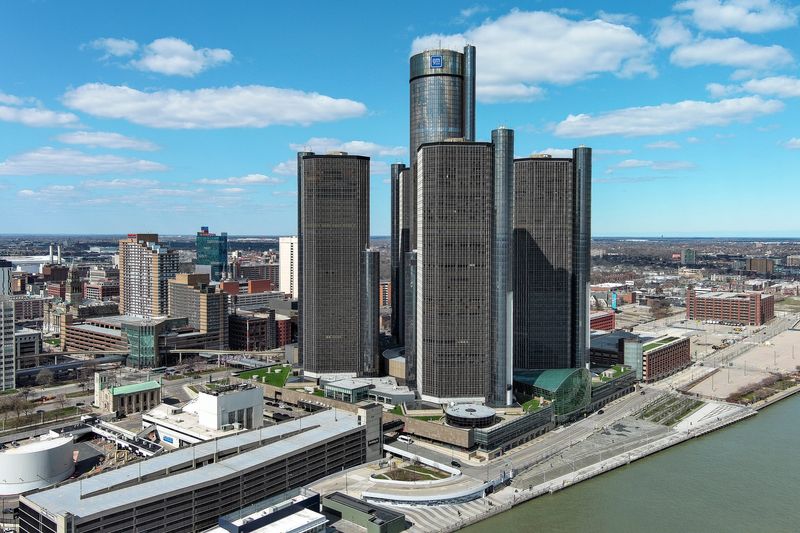
For the ambitious $1.6 billion-plus Renaissance Center redevelopment plan, the big holdup is finally over.
General Motors and its development partner, Dan Gilbert’s Bedrock firm, say they are ready to move forward with their plan — and quickly — now that the state Legislature has lifted the financial cap on a key incentive program that the RenCen redevelopment hinges on.

The House voted July 3 to raise the cap on the Transformational Brownfield program to $3.2 billion, doubling the total amount available for large-scale development projects statewide.
GM’s and Bedrock’s RenCen project, first unveiled in late 2024, had been in a holding pattern for more than a year until the Legislature acted, as there was hardly any money left for new projects under the previous cap. (The Senate approved a cap-lifting bill last December, and Gov. Gretchen Whitmer is expected to sign the revised House-approved bill soon.)
“We’re grateful that the state has taken this step,” David Massaron, vice president of infrastructure and corporate citizenship for GM, told the Free Press in a July 16 interview.
They are now ready to step on the gas and get the downtown Detroit project moving.
What the RenCen redevelopment plan calls for
In a Free Press interview, GM’s Massaron and Bedrock CEO Jared Fleisher laid out the next steps for the RenCen plan.
The development team is aiming to have demolition of the two towers underway by summer 2027. However, multiple must-have approvals from local and state officials need to happen before then.
They aren’t yet ready to give a timeline for when the project would be completely done, but do expect it to take years from start to finish.
“The faster we can start, the faster we’ll be done,” Massaron said. “So we’re going to work as hard as we can to start as soon as we can, and work as hard as we can to finish.”
Who is paying, and for what
Bedrock would contribute about $1 billion toward the $1.6 billion cost of the RenCen redevelopment, with GM contributing $250 million and the remainder coming for public financing, according to a Bedrock spokesperson. (The quasi-public Detroit Downtown Development Authority last fall approved a $75 million cash grant to help with the cost of demolishing the podium and developing the outdoor civic space.)
The full cost of developing the new riverfront park and attraction, however, would be an additional expense on top of the $1.6 billion.
“The Renaissance Center itself is arguably the most complex adaptive reuse project in the country,” Fleisher said. “And the riverfront next to it is, we believe, the most ambitious community-driven riverfront redevelopment in the country.”
Gathering ideas and community support
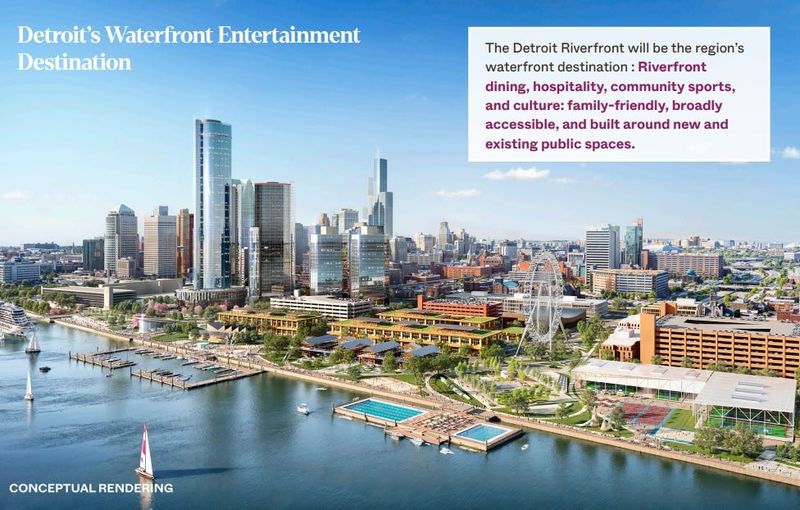
As soon as next month, the development team could begin a community engagement process for the project with public meetings aimed at gathering ideas for what residents would like to see at the new RenCen — especially in the future riverfront park and public space.
There are all sorts of possibilities for that space, Fleisher said, anything from a waterpark to a go-kart track to a movie theater. He said they are eager to hear what ideas emerge from those meetings.
“The aspiration is making it the best family-friendly, broadly accessible waterfront district in the country,” Fleisher said, “designed by Detroiters for Detroiters, with what they want to see there.”
Yet one specific RenCen riverfront amenity the development team would like to see is a marina, which could potentially attract boaters from all over to come and visit downtown.
“Instead of the water just being something to look at, it becomes something to experience,” Fleisher said. “Boat here, dock here and spend money in our city — that drives our economy.”
The community engagement process would be followed by the project’s formal Community Benefits process, perhaps by this fall. That process typically involves a series of public meetings and hearings that end with developers agreeing to a package of concessions and gifts for residents and groups situated near the project, such as promises to hire locals for certain jobs or spruce up parks just outside the development zone.
The Community Benefits process is required in Detroit for large developments seeking significant incentives or tax breaks.
Later, there would come another set of public meetings for the formal process of approving the project’s Transformational Brownfield. That incentive allows developers to capture multiple streams of future local and state tax revenues that get generated at development sites for up to 30 years.
Because there is no up-front money in the program, if a project doesn’t get built, there is no revenue for the developer to capture. However, developers can use the anticipated future revenues from the tax capture to borrow money from the capital markets that is needed to get a project built.
The monetary value of the RenCen’s potential Transformational Brownfield has not yet been established.
New program rules related to public money
The new Transformational Brownfield legislation, along with lifting the cap on the program, also added new tax capture rules and disclosure requirements.
One of those new rules could potentially cost the RenCen development millions of dollars in future subsidies that it might have otherwise gotten.
The rule, which applies only to new and not previously established Transformational Brownfield developments, prohibits developers from capturing the state income taxes of permanent workers at their development who aren’t working in a newly created job, or whose employers already have more than 50 people on payroll.
The rule does not apply to workers in the retail or hospitality business.
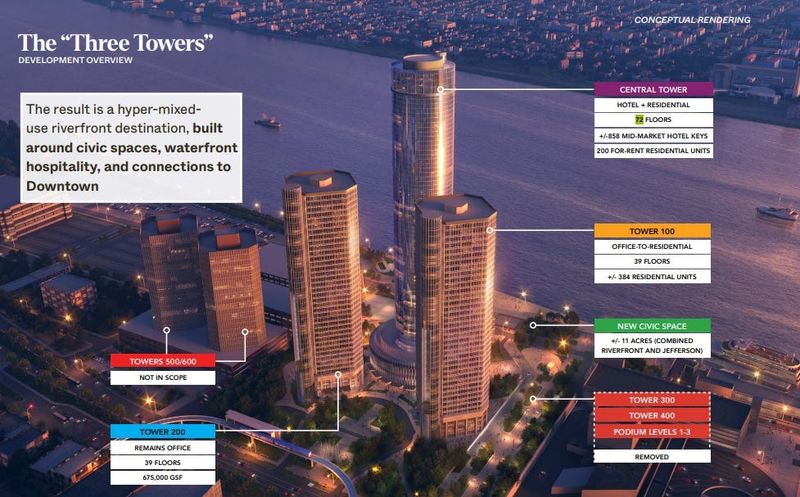
The rule could add to the financial difficulty of rehabbing RenCen Tower 200, which is the sole tower that would remain office space under the current redevelopment plan.
“That arguably creates a challenge for the project,” Fleisher said.
The rule appears to be a response to some past criticism of the Transformational Brownfield program for potentially awarding incentives for the presence of office jobs at new developments that weren’t necessarily new jobs, but rather existing jobs at existing local employers whose location moved to a newly developed building.
Nevertheless, Fleisher said the development team supports the new set of rules, and noted how the Transformational Brownfield program originated a few years before the COVID-19 pandemic that permanently upended the office space market.
The program has evolved away from centering office jobs as the primary driver of transformation in cities, he said.
“So we have no problem with it, we support it, and we think it’s the rightful evolution of the program,” Fleisher said, “recognizing that investing in housing and entertainment and hospitality and commerce is actually how you invest in the foundation of a thriving city.”
Minimizing disruption that can come with demolition
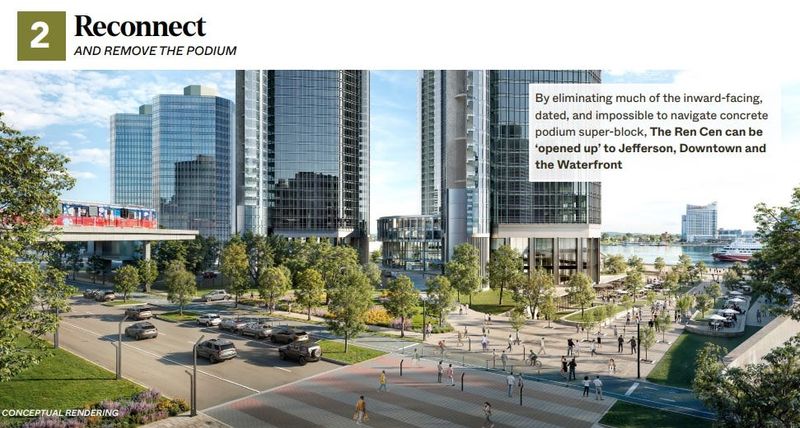
The development team plans to demolish RenCen Tower 300 and Tower 400 through a careful piece-by-piece process, aimed at minimizing dust and debris.
Massaron said they intend to have the popular Detroit RiverWalk segment in front of the RenCen stay open during the demolition.
“I’m sure there will be some disruption on some days, but we’re going to do everything we can to avoid it,” he said.
The Renaissance Center was designed by architect John Portman and built between 1973 and 1977. A pair of smaller 21-story towers were later added to the east of the complex and opened in 1981 as the development’s second phase.
One of those smaller towers is occupied by Blue Cross Blue Shield of Michigan. The owner of the other smaller tower recently unveiled plans to convert it from all office space into a mix of office, residential and commercial.
Contact JC Reindl: 313-378-5460 or jcreindl@freepress.com. Follow him on X @jcreindl
This article originally appeared on Detroit Free Press: Here are the next steps for redeveloping Detroit’s Renaissance Center
Reporting by JC Reindl, Detroit Free Press / Detroit Free Press
USA TODAY Network via Reuters Connect
By JC Reindl, Detroit Free Press | USA TODAY Network