Still holding onto hope that those sky-high credit card rates and other exorbitant interest rates are set to tumble in 2026? And, maybe, prices for groceries and other goods will fall sometime soon?
Not likely. We’re looking at a hot expensive summer with borrowers burdened by costly credit card debt, car loans and more.

On Wednesday, June 17, the Federal Reserve Open Market Committee unanimously left short term interest rates unchanged in 2026.
The Fed has held rates steady for each of the first four meetings of 2026 in January, March, April and now June. Economists say the Fed needed to keep rates at higher levels to try to stabilize prices and maintain a close eye on the latest surge in inflation.
No one expected a rate cut at the June meeting.
The target range for the federal funds rate remains at 3.5% to 3.75%.
The Fed noted in its statement: “Economic activity is expanding at a solid pace despite elevated uncertainty that owes, in part, to the conflict in the Middle East. Productivity growth and capital investment are strong. Job gains have kept pace with the workforce, and the unemployment rate has changed little.”
The statement did not offer a clue as to whether a rate cut could be ahead sometime. The Fed indicated that “inflation remains elevated” relative to the Fed’s 2% goal. And indicated that the higher inflation in part reflects “supply shocks that have driven price increases in certain sectors, including energy.”
When will we see an interest rate drop
Diane Swonk, KPMG chief economist, maintains that after more than five years, we’re seeing signs that inflation is becoming entrenched — which in her view means it could be more than a year before the Fed moves to cut interest rates.
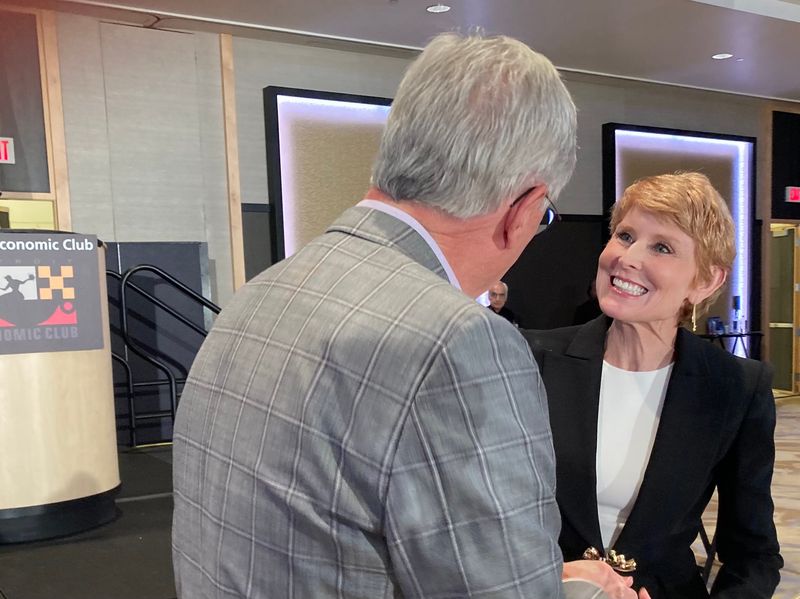
Swonk told the Detroit Economic Club that she’s forecasting that the Federal Reserve will move to raise short term interest rates — not cut them — twice in late 2026.
Swonk, who spoke Tuesday, June 16, at the MotorCity Casino Hotel, said she would expect that the Fed will likely need to hold interest rates higher for longer well into 2027. But she holds open the possibility of rate cuts sometime late next year.
The Chicago-based economist says inflation has been driven higher by factors that go beyond the war in Iran, which sent oil prices skyrocketing this year. Inflation in the service sector, she said, rose significantly in late 2025 before the war, likely reflecting demand for services from higher income households.
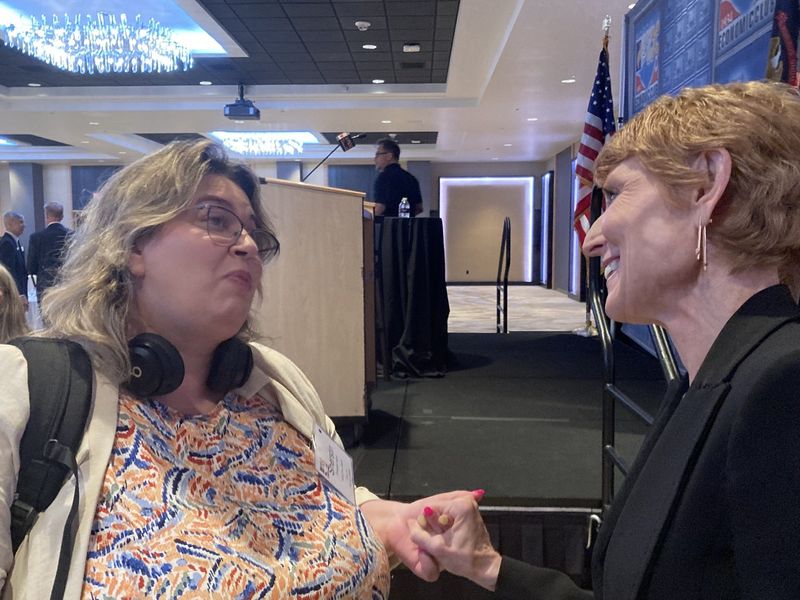
“It suggests that inflation is starting to get a mind of its own,” Swonk said after her remarks before the Detroit Economic Club.
Swonk also suggested that global oil markets will take time to recover after a deal between the United States and Iran to stop fighting. Some inflation will still be felt, she predicted, in food prices in the months ahead due to higher costs for fertilizer and diesel fuel.
And she expects that drivers could even see another bump in gas prices at some point along the way. Much work will need to be done to return to normal, including allowing oil producers more time to ramp up output.
Economy has two different faces in 2026
Inflation overall has created a drag on growth, Swonk said, as wage gains for most workers ended up being eroded by higher prices.
“Even if you have a job, it feels like you’re losing ground,” Swonk told the Detroit Economic Club.
The top 20% of households are buying and they’re buoying the economy, Swonk noted. High income earners accounted for a record breaking 57% of total spending in the first half of 2025. The statistic is based on research by the Federal Reserve Bank of Dallas.
Higher earners saw their incomes grow significantly enough to outpace inflation, Swonk said, while the majority of consumers didn’t see such a boost.
The bottom 80%, Swonk maintains, have struggled to make ends meet.
“Inflation intensifies inequality,” Swonk said in Detroit.
The economy has not fallen into a recession because the highest earning U.S. households kept spending.
Swonk wrote earlier in 2026 that the AI boom and the wealth it generated have powered the overall economy forward but failed to deliver on other investments and job gains. She noted then that 2025 was the second worst year for job gains since the global financial crisis in 2009.
Companies held back on hiring and shed jobs as uncertainty spiked.
“Inequality intensified with the fate of the economy concentrated in fewer firms and households,” Swonk wrote in January 2026.
Overall U.S. economic growth would be a lot stronger than it is, Swonk told the Detroit Economic Club, if more consumers weren’t so heavily burdened by higher inflation.
Many lower-income and middle-income households feel that the economy is not doing well, she said, because they’re not able to buy as much as they had in the past, due to limited wage gains and higher prices. Some are truly facing more financial challenges now when they might have been more able to get by in the past.
“Food banks are slammed,” Swonk told the Detroit Economic Club.
Why the Fed isn’t likely to cut interest rates soon
Even so, Swonk noted in a report issued Friday, June 12, that the acceleration in growth of inflation is upping the risks that the current fed funds rate is too low at a range of 3.5% to 3.75%. Rate hikes, she said, will be needed to derail underlying inflation.
“The conflict in the Middle East is only one factor,” Swonk wrote. “The Fed may not have caused all of the inflation we are enduring; it is the only institution tasked with derailing it.”
The three-month annualized inflation rate, which better tracks momentum, climbed to 8.2% in May from 7.3% in April. “That is the hottest three-month pace since September 2022,” according to Swonk.
The Consumer Price Index for All Urban Consumers increased 4.2% over the last 12 months. It was the third consecutive year-over-year increase since the start of the Iran war in late February.
Higher inflation led most economists to forecast early on that the Federal Reserve would not cut interest rates at the the Federal Open Market Committee meeting on Wednesday, June 17.
And now many who had expected rate cuts in 2026 are saying that interest rates aren’t likely to head lower.
Michele Raneri, vice president and head of U.S. research and consulting at TransUnion, said in a statement that the latest expectation is that the Fed will likely remain on hold rather than pursue additional rate hikes or cuts in the near term in 2026.
Ted Rossman, principal analyst for Bankrate.com, said on Tuesday, June 16, that he too does not envision any rate cuts in 2026.
“The spike in inflation caused by the war in Iran, plus a solid job market, could actually mean the Fed’s next move is up rather than down. That’s an idea that wasn’t in the conversation at the start of the year,” Rossman said.
Before the Iran war, he said, it looked like inflation was coming down and the Fed would cut two or three times in 2026.
Currently, the average interest rate on credit cards is 19.56%, down from 20.12% a year ago, according to Bankrate.com data.
The average rate for a five-year new car loan is 6.92%, down from 7.24% a year ago, according to Bankrate.com data. And the average rate on a home equity line of credit is 7.45% now, down from 8.22% a year ago.
A CME FedWatch tool, a measure of investor expectations, currently shows a 57% chance of at least one rate hike by the end of 2026, Rossman said, with the other 43% chance indicating that rates stay the same.
Mark Zandi, chief economist for Moody’s Analytics, acknowledged in late April that the war in Iran dashed previous expectations for three interest rate cuts in early 2026.
“I don’t expect any rate cuts from the Fed this year,” Zandi told the Detroit Free Press in June.
“The fallout from the Iran war has pushed inflation to near 4%, about double the Fed’s inflation target,” he said.
Inflation expectations are high, as well, Zandi said. And if the concern is that inflation is heating up, the Fed would be more likely to raise rates to calm inflation than cut rates.
“But I don’t think the Fed will raise rates as the job market and economy remain soft, and the inflation should recede once the Iran war winds down, which appears more or less at hand,” Zandi said.
Zandi put the odds of a recession starting at some point in 2026 at an estimated 30%, close to double the recession odds in a typical economy.
“The uncomfortably high odds of a downturn go to the still considerable possibility that the Iran War continues on, causing energy prices and inflation to jump,” Zandi said.
The soft economy is “vulnerable to a downturn if anything else doesn’t stick to script,” Zandi said.
“And it isn’t hard to imagine that.”
Contact personal finance columnist Susan Tompor: stompor@freepress.com. Follow her on X @tompor.
This article originally appeared on Detroit Free Press: Fed keeps rates unchanged as inflation remains elevated
Reporting by Susan Tompor, Detroit Free Press / Detroit Free Press
USA TODAY Network via Reuters Connect
By Susan Tompor, Detroit Free Press | USA TODAY Network