Michigan and the U.S. Environmental Protection Agency announced a new $10 million partnership Monday that will accelerate pollution cleanup work on the Detroit River, a waterway loaded with toxic compounds left behind by factories, coal plants and sewage overflows that dominated the river’s shoreline for a century.
Under the partnership, staff from the Michigan Department of Environment, Great Lakes and Energy and EPA will develop a plan for cleaning approximately 800,000 cubic yards of polluted sediment from the stretch of the river along Belle Isle, areas they call Harbortown and Harbortown-Upstream.

They also will develop preliminary cleanup goals for removing polluted sediment from the rest of the river. EPA put $6.5 million and EGLE put $3.5 million toward the project.
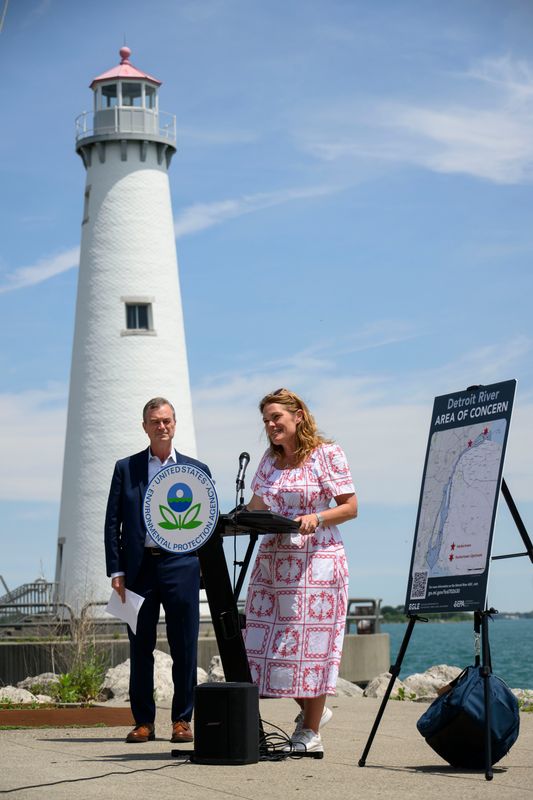
“You all know the legacy of industrial use of this river, the contamination that results,” EPA Region 5 Administrator Ann Vogel said at a press conference at William G. Milliken State Park and Harbor in Detroit. “We’re talking about dredging, we’re talking about removing that contaminated sediment.”
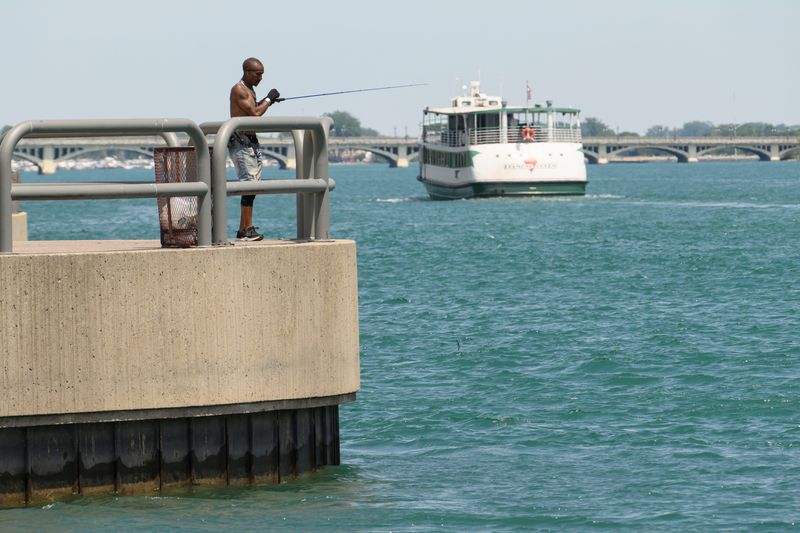
Detroit River fish carry consumption warnings
The Detroit River was polluted by sewage overflows and discharges from coal plants and factories that lined its shore for well over a century. Both the Canadian and U.S. governments considered it polluted enough to designate it as one of 34 Great Lakes “areas of concern” in 1987. There are 23 remaining areas of concern in the Great Lakes, including these five in southeast Michigan: the St. Clair, Clinton, Detroit, Rouge and Raisin rivers.
The Detroit River area of concern is 700 square miles, Vogel said Monday. Its sediment still carries dangerous pollutants, including polychlorinated biphenyls, or PCBs, polycyclic aromatic hydrocarbons, or PAHs, as well as metals, oils and greases.
The pollution continues to cause problems such as restrictions on how many fish are safe to eat from the river; beach closings; loss of fish and wildlife habitat; and animal health problems, such as deformities and reproductive problems. The Michigan Department of Health and Human Services warns people against eating certain species from the Detroit River as well as other Michigan water bodies because of the pollution they carry in their bodies.
EPA, EGLE and other partner organizations have removed or capped roughly 400,000 cubic yards of contaminated sediment in the Detroit River as well as 100,000 cubic yards in the Rouge River.
Despite decades of cleanup work, there were an estimated 5 million cubic yards of polluted sediment remaining in the Detroit and Rouge rivers as of 2023. At the time, the estimated price tag for cleaning those rivers was close to $1 billion.
In addition to removing polluted sediment, EGLE, EPA and the environmental nonprofit Friends of the Detroit River have taken on major habitat improvement projects, such as Friends of the Detroit River’s $18.6 million Sugar Island restoration project. EPA, EGLE and other partners have restored more than 320 acres of habitat in the Detroit River and 200 acres in the Rouge River.
Detroit, Rouge river dredging update
Dredging crews will be removing polluted sediment from the Monguagon Creek and Upper Trenton Channel between Bridge Road and the Gross Ile Toll Bridge in Riverview this summer. It’s a two-year project that involves dredging out the contamination and installing a sand cover. It was funded by EPA and Bridgestone America Tires Operation with construction led by the U.S. Army Corps of Engineers Detroit District.
Dredging at the Harbortown and Harbortown-Upstream sites will take at least five years to start, EGLE aquatic biologist Sam Noffke said.
Dredging work finished in the old channel of the lower Rouge River, the EPA said Monday. EPA and Honeywell International, Inc. partnered to fund that $84 million project, which removed more than 100,000 cubic yards of polluted sediment from the area.
Two other sediment cleanup projects have been finished on the Detroit River — the Black Lagoon project in Trenton and the Detroit Riverwalk project.
“The Detroit River is an invaluable natural resource, not just for the City of Detroit, but for the region as a source of water, as well as for recreation and commerce,” Detroit Mayor Mary Sheffield said in a press release. “I am deeply appreciative to the EPA and EGLE for prioritizing these cleanup efforts to ensure the Detroit and Rouge rivers are safe and clean for generations to come.”
ckthompson@detroitnews.com
This article originally appeared on The Detroit News: Detroit River pollution projects advance with state, EPA agreement
Reporting by Carol Thompson, The Detroit News / The Detroit News
USA TODAY Network via Reuters Connect
By Carol Thompson, The Detroit News | USA TODAY Network