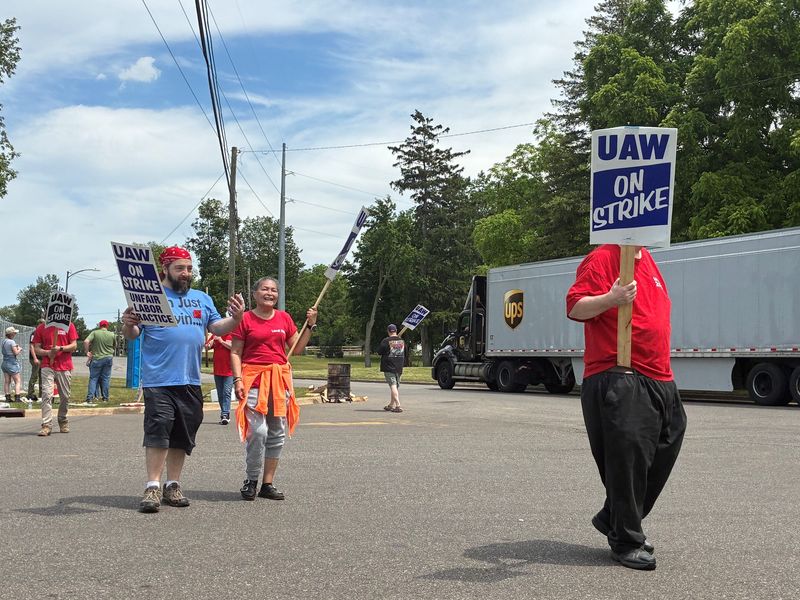
Autoworkers for the Detroit Three and other major carmakers hold some of the best-paying manufacturing jobs in the United States, but that often doesn’t hold true for their colleagues at parts suppliers — including those in unionized shops.
Consider the nearly 1,000 American Axle/Dauch Corp. workers who went on strike Monday at the supplier’s plant in Three Rivers in the southwest corner of the state. United Auto Workers-represented production workers there make at most $22 per hour after a five-year progression, following major pay concessions during the 2008 Great Recession to help save the plant.

The factory is a critical axle supplier for General Motors Co. pickups — yet the Dauch production workers make roughly half the wages their GM union peers earn. They also make less than most nonunionized employees in the motor vehicle and parts sector at large, said Marick Masters, a retired Wayne State University labor professor. He said average pay in the motor vehicle and parts industry is about $31 an hour for non-union shops and more than $40 an hour in unionized workplaces.
“They had to make concessions during the really tough time period for the economy as a whole and the auto industry, and they haven’t been able to catch up since then,” Masters said. “And now under the current leadership of the UAW, they’re moving more aggressively to catch up.”
Workers at the Three Rivers plant have proposed growing their wages to $30 an hour by 2030, without any out-of-pocket cost increases for health insurance, said Josh Jager, bargaining chairman for UAW Local 2093. Even that pay hike wouldn’t bring employees back to where they were in 2008, when they made $29 per hour, which would equal about $44 per hour today when adjusted for inflation.
UAW members at several other prominent suppliers are making a similar push to bring their wages and benefits closer to auto assembly. Workers at Nexteer Automotive in Saginaw and Allison Off-Highway in Lafayette, Indiana, both recently took strike authorization votes as they pushed for better deals, though they have not walked off the job.
UAW President Shawn Fain recently criticized independent auto parts suppliers in general for not paying enough, given how critical their workers are to the supply chain. He said during a livestream Sunday that the union’s leadership was ready to help other smaller parts shops fight for better wages.
“Auto parts workers everywhere are fighting for their fair share,” he said. “They’re not asking to be millionaires, they’re asking for dignity.”
Parts workers paid less than Detroit Three peers
Wages for auto parts manufacturing workers — both in Michigan and nationally — fall somewhere in the middle of other notable blue-collar professions. They make more, on average, than those in the warehousing and fulfillment sector. But the compensation is significantly worse than that of vehicle assembly personnel employed directly by the likes of GM and other major automakers.
Nationally, vehicle assembly workers on average earned about $101,000 in 2024, according to federal data. That includes overtime payments but excludes profit-sharing checks, which can be sizable for UAW employees at the Detroit Three. By contrast, auto parts manufacturing workers averaged about $73,000 in wages that year. The gap is less pronounced in more heavily unionized Michigan ($104,000 vs. $86,500), but workers at suppliers are still at a clear disadvantage to their assembly counterparts.
In Three Rivers, union officials and workers said the goal is to secure a contract with a fair, livable wage. Jager said the company’s most recent proposal — to bring top wages up to $25.75 an hour by the end of the contract — isn’t enough considering rising gas prices, grocery prices and rent.
The union’s argument is that Dauch has the money, given that it brought in about $8.4 billion in profits over the last decade.
Jager said multiple workers have had to live out of their cars after they could no longer afford their rising rent, and others have racked up credit card debt. Scott Zuckschwerdt, the union’s assistant director for Region 1D, said some workers walk or ride their bikes to work because they can’t afford car repairs.
“We actually had a member whose car broke down because the car is like 18 years old, and they had to ride their bike to work, got pulled over, got ticketed because they didn’t have a light on their bicycle, and that member didn’t even have enough money to pay the freaking ticket,” he said.
The lower pay, physical difficulty of the job and often long hours has led to frequent turnover in the plant, said Robert Cooper, 68, who has worked there 13 years in shipping and receiving. He started out making just $10 an hour, but said it’s been worthwhile due to the health care benefits.
Jager said the union struggled to make headway during the most recent rounds of contract negotiations in 2016 and 2021. The general philosophy was: Be thankful you still have a job. Now, he said, the international leadership of the union, including Fain, is engaged and backing the local to take a more aggressive approach.
“We’re here, we’re ready to bargain,” Jager said. “They wanted a battle; they got the war.”
The state of negotiations
Jager said the union is waiting for the company to respond to its most recent full proposal, which it submitted on Sunday. That included the $30-per-hour wages, maintaining current health benefits, as well as stronger work-life balance protections.
“The company really doesn’t care about our personal time, or family, or anything like that,” said David Scott Broker, 44, who has worked at the plant for 12 years. “It’s all about the numbers. They got to get their parts out, and that’s all that matters to them.”
Dauch spokesperson Chris Son said he didn’t have any updates Tuesday on the Three Rivers strike, but said the company remains “committed and available to negotiate with the union in good faith and hope to promptly reach a fair agreement.”
The Three Rivers facility primarily supplies axles and axle parts to GM’s highly profitable pickup line. Much of its axle output goes into Chevrolet Silverado and GMC Sierra heavy-duty pickups that are assembled in Flint, as well as the GMC Canyon and Chevy Colorado midsize trucks made in Wentzville, Missouri. Axle tubes made at the plant also go toward light-duty Silverados and Sierras, with some steering linkage components routed to a different supplier, Nexteer. The plant also makes an actuator that goes into Chrysler Pacifica minivans.
The strikers may have increased leverage if GM’s truck axle supply dwindles; UAW officials and workers said they understood there was an existing supply large enough to last about two to three weeks. GM said earlier it is closely monitoring the situation and “assessing any potential impact.” But Dauch was also trying to keep at least some production going at the plant without its unionized employees, workers said.
Auto supplier jobs become scarcer
Auto suppliers in general have long threatened to move more production to Mexico or other lower-cost countries to save on labor costs.
U.S. auto parts employment previously far exceeded the economy-wide total of jobs in warehousing for companies like Walmart Inc. and Amazon.com Inc., but that changed in the lead-up to the Great Recession in 2009.
There are now almost four times as many jobs in warehousing as there are in auto parts manufacturing. Even coffee shop jobs, including baristas, are twice as common as auto parts jobs.
Michigan has withstood that trend as the state economy remains heavily reliant on manufacturing.
As the Local 2093 workers at Dauch seek a better contract, they do so amid headwinds for the auto supplier field more broadly. Jobs in auto supply manufacturing still outnumber the better-compensated roles in vehicle assembly, but employment in the sector has been mostly declining for decades.
The peak of auto parts jobs in the last 35 years was in 2000. There were about 835,000 jobs nationally and 222,000 in Michigan. As of last summer, those numbers were roughly 515,000 and 112,000 — declines of 38% and 50%, respectively.
In 2008, American Axle successfully argued it needed the concessions from its striking workers to stay competitive and keep the plant open.
But the current Three Rivers UAW strike comes in a different environment, with President Donald Trump’s tariffs pushing more suppliers and automakers to increase U.S. production. And the company has recently shown its commitment to the plant with a $133 million investment in 2025, following a nearly $41 million investment and hiring push in 2021.
The Dauch strike, Masters said, “is a test of the economic leverage of the UAW.” Winning major wage gains “will be viewed as a victory for the union,” he said, while a drawn-out, painful strike for workers would “signal that the companies are willing to resist the union and that the industry is in for a difficult set of negotiations going forward.”
Staff Writer Breana Noble contributed.
This article originally appeared on The Detroit News: Auto supplier workers play catch-up amid American Axle/Dauch strike
Reporting by Luke Ramseth, Grant Schwab and Summer Ballentine, The Detroit News / The Detroit News
USA TODAY Network via Reuters Connect