Just go, SEC. That clear enough? Just go. Break away, form your super-conference and destroy what’s left of college sports, not to mention the futures of all those young people whose only path to college – an athletic scholarship in a sport other than football – is gone, a relic from the good old days before the SEC ruined it for everyone.
Do that, SEC. Go.

Or shaddup.
U.S. senators Ted Cruz (R-Texas) and Maria Cantwell (D-Washington), the ranking members behind the Protect College Sports Act of 2026, are trying to make the SEC stand down. So are 17 Senate Commerce Committee colleagues who signed the bill, an act of defiance in the face of SEC fearmongering and warmongering and greedmongering.
Name your mongering, and the SEC is doing it. This means people like SEC Commissioner Greg Sankey, Georgia football coach Kirby Smart and Georgia president Jere Morehead. It means coaches and athletic directors and presidents at other SEC schools, people just as selfish as Sankey, Smart and Morehead if not as comfortable to put their name on it.
It means the SEC. All of them. All of you.
Nothing’s enough for the SEC, a conference whose slogan – “It just means more” – drips of arrogance and hubris and entitlement.
Why did the SEC become the dominant football conference? The same reason the Los Angeles Lakers have been the flagship NBA franchise, and the New York Yankees in MLB, and the Dallas Cowboys in the NFL:
Location, location, location.
Location isn’t something you earn, by the way. The Georgia Bulldogs didn’t just wake up one day and decide to move to the Southeast, where the weather is good and the athletes are great and the recruiting – the winning – comes easier than it does for, say, IU football or Purdue. Or Minnesota or Colorado or Syracuse or Kansas.
Georgia was born in Georgia, meaning it was born with the same manifest football destiny as Alabama and Auburn and Florida and LSU, and similar to that of Texas and Oklahoma, who jumped ship from the Big 12 to the SEC in 2024 because Texas and Oklahoma, like the rest of the SEC, were thrilled to get farther ahead by burning down everything around them.
Which brings us to the dumpster fire that is college sports, and the SEC’s increasing threats to pour gasoline onto the smoldering mess and light a match.
SEC football, Big Ten are the bad guys
The SEC understands that it has dominated college football forever, and after the hiccup of the last year or two, will do it again. It’s not brilliance, it’s location. The only thing more remarkable than winning big at Georgia and Alabama (and other schools in the SEC) is not winning big at Georgia and Alabama (and other schools in the SEC). Takes some doing, to be born on third base and fail to score.
The Big Ten has risen as well, meeting the SEC at the point of attack – the ATM machine – and even beating the SEC without some of the SEC’s inherent advantages. Indiana won the 2025 national title, for crying out loud, not a function of location or finances but of #iufb coach Curt Cignetti’s tactical, developmental and motivational brilliance. Michigan and Ohio State have great football traditions as well, SEC-worthy schools in almost every area (including arrogance, if we’re being honest) but location, location, location.
The Big Ten has become the SEC’s partner in crime along the way, it should be noted. Just five years ago Big Ten formed an alliance with the ACC and Pac-12, created specifically to stop the SEC, then, from what the SEC is trying to do now: Rewrite the rules in favor of the SEC, and threatening to leave the NCAA if the rest of the country won’t comply.
The Big Ten lost its way within 10 months from that August 2021 alliance, stealing Pac-12 lynchpins UCLA, USC, Oregon and Washington in June 2022, and now has formed an alliance with the SEC, the only conference that can derail its own rise to superpower. Two days after commissioners of the ACC, Big 12 and American conferences expressed support for the Protect College Sports Act – which proposes limits on roster spending and transfer portal chaos, among other things – the Big Ten and SEC issued a joint statement against the act.
Doyel in 2021: ACC, Big Ten, Pac 12 alliance an honorable reaction to SEC treachery
Doyel 10 months later: Oops, the Big 10 lied to us and just destroyed the Pac-12
The Big Ten and SEC went for nobility, mentioning things the bill didn’t do, like clearing up “the patchwork of state laws” impacting college sports inconsistently, and things like this: “Rather than reducing (the threat of future) litigation, the bill likely expands it without offering clear alternatives for dispute resolution.”
Sounds good, but what the SEC and Big Ten really meant was this:
We don’t want this much cooperation between major conferences because we’re richer than they are. Plus, we want to retain the option of cutting sports, stealing other schools or breaking away from the NCAA – all three, eventually – thank you very much.
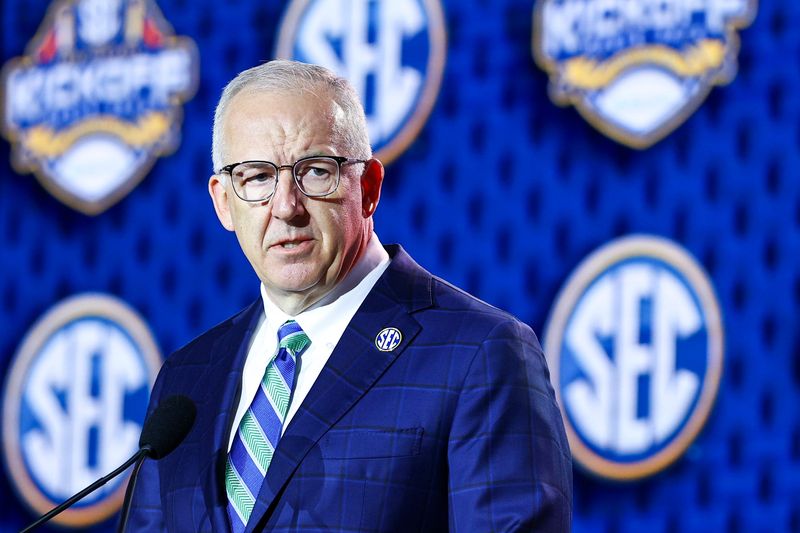
At SEC meetings this week, Sankey has made it clear that the talk of his league breaking away from the rest of the NCAA – including leaving behind the Big Ten, in theory – is “real” and not “a leverage point.”
Here’s how that would look.
SEC speaks: Greg Sankey says SEC threats on CFP, breakaway are “real,” not “leverage”
(Can anyone) Save College Sports Act?????
OK, say the SEC leaves. What then? Everyone else reacts.
The Big Ten, if it doesn’t simply join the SEC from the outset, will do so eventually. Big Ten football didn’t grow this big, this good, to compare itself to the likes of Duke and Kansas State. Nope, the Big Ten would cave to the pressure as fast as it can. Remember how fast the Big Ten stole USC, UCLA, Washington and Oregon from an alliance partner?
Ten months.
Remember what happened to the Pac-12? It’s gone. The Big Ten did that, and the Big Ten would do the same to the Big 12, ACC and American if the alternative is letting the SEC run up the score on us.
The Big Ten considers itself a leader, and when everything is going just right, sure, the Big Ten is a leader. But at the first sign of trouble the Big Ten follows the SEC, as it did shortly after forming that alliance with the Big 12 and Pac-12 – that was cute – and as it did again earlier this month. How long did it take the Big Ten to join the SEC in defiance of the Protect College Sports Act after the ACC, Big 12 and American had advocated for it?
Two days.
By leaving behind the rest of the country, see, the SEC (and Big Ten) are pretty sure they can avoid anti-trust lawsuits because let’s be honest: College athletes don’t have to play in the SEC (or Big Ten). They could play for – What’s the name of that place? Right, Washington State – if they’d rather.
Locally: Why Indiana’s Todd Young voted in Big Ten favor of Protect College Sports Act
IndyStar on your phone: Get a personalized reading experience in the IndyStar app
Football being the king that it is, and TV contracts being the golden goose that they are, schools would keep paying more and more for players until the best athletes would be taking a pay cut after being selected in, say, the second round of the NFL Draft. That being reality, schools would start – sorry, continue – cutting sports, meaning eliminating college opportunities for those hard-working young folks who excel at track or wrestling or those other sports that don’t move the SEC’s needle.
This is where we’re heading, unless the SEC is stopped. Does anyone have the will to stop the SEC? Does anyone have the will to save college sports? The sponsors of the Protect College Sports Act are trying to get a full Senate floor vote soon, and then it would have to get past Congress before landing on President Trump’s desk – but the SEC (and Big Ten) are in the way.
Is it perfect, the Protect College Sports Act? Of course not. But it’s all we’ve got, and the clock is ticking.
Is the SEC bluffing? Seems unlikely. Can college sports be saved if the SEC refuses to sacrifice for the common good? Seems unlikely. There is no good option here. The SEC is willing to destroy college sports, one way or another. It’s saying, essentially:
We can do this the fast way, or the hard way.
Do it fast, I say. Just go. Show us just how much it means, just how far you’re willing to go.
More: Join the text conversation with sports columnist Gregg Doyel for insights, reader questions and Doyel’s peeks behind the curtain.
Find IndyStar columnist Gregg Doyel on Threads, or on BlueSky and Twitter at @GreggDoyelStar, or at www.facebook.com/greggdoyelstar. Subscribe to the free weekly Doyel on Demand newsletter.
This article originally appeared on Indianapolis Star: Doyel: Is SEC football willing to destroy college sports? And would Big Ten join them?
Reporting by Gregg Doyel, Indianapolis Star / Indianapolis Star
USA TODAY Network via Reuters Connect
By Gregg Doyel, Indianapolis Star | USA TODAY Network