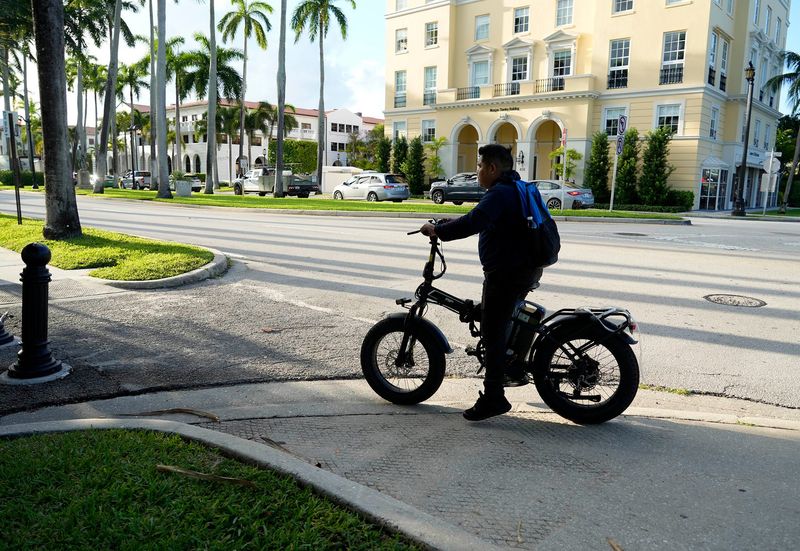
Palm Beach has adopted sweeping restrictions on e-bikes and other electric mobility devices, limiting where they can be used and who can operate them.
The move reflects a broader effort by state and local governments to regulate the rapidly growing use of e-bikes and similar devices, which can reach speeds of up to 28 mph.

The issue gained new attention after Gov. Ron DeSantis vetoed statewide legislation June 25 that would have imposed new restrictions on e-bikes, including a requirement that riders slow to 10 mph when within 50 feet of a pedestrian.
In vetoing the bill, DeSantis said the provision would be difficult to enforce and could require increased surveillance or speed-monitoring technology.
“They did a bill on e-bike regulation, and I don’t know these things, maybe there’s problems,” DeSantis said June 26 during a news conference, according to the News Service of Florida. “But do we really want to have policing of e-bikes?”
The state Legislature could override the veto with two-thirds votes in both the House and Senate. But since lawmakers have adjourned for the session, they would have to reconvene before any override could be considered.
Palm Beach moved ahead with its own regulations last fall after state lawmakers granted municipalities broader authority to regulate micromobility devices, which are small, lightweight vehicles typically used for short-distance transportation. These include electric scooters, electric bikes, electric skateboards, hoverboards and Segways.
Last October, the Town Council unanimously approved a series of ordinances tightening rules for bicycles, e-bikes and e-scooters on public roads and pathways, including the Lake Trail.
The measures ban most electric mobility devices from sidewalks, trails and the Lake Trail, require riders to carry government-issued identification and prohibit anyone under 15 from operating the devices in public areas.
A state law requiring riders younger than 16 to wear helmets while riding e-bikes continues to apply.
Town officials said the changes were aimed at improving safety in response to growing use of the devices and concerns about speeding in pedestrian-heavy areas.
Police Chief Nick Caristo told the council last August that the devices have become an increasing concern for enforcement and safety, particularly in areas shared with pedestrians.
“Talking with other municipalities, it’s a big concern for safety reasons,” he said, noting fatalities in Miami and Jupiter and a crash involving a juvenile in Palm Beach Gardens. “In 2023 in Palm Beach County alone, there were like 27 trauma cases in the hospital regarding e-bikes.”
Palm Beach police said the town’s approach has been well received since the rules took effect.
“Our community has been receptive and responsive to our e-bike ordinance,” Palm Beach Police spokesperson Sgt. Michael Ogrodnick told the Palm Beach Daily News. “Our continued education of the community has led to safer sidewalks, walkways and pedestrian pathways.”
He declined to comment on the governor’s veto of the statewide legislation.
Town officials previously cited additional safety concerns, including crashes involving micromobility devices in Palm Beach County and elsewhere.
In one incident in November 2023, a 14-year-old boy riding a motorized scooter on the Lake Trail was knocked unconscious after falling and striking his head. In October 2022, a woman was injured after falling from a scooter while swerving to avoid a collision with her child.
Jodie Wagner is a journalist at the Palm Beach Daily News, part of the USA TODAY Florida Network. You can reach her at jwagner@pbdailynews.com. Help support our journalism. Subscribe today.
This article originally appeared on Palm Beach Daily News: Palm Beach’s strict e-bike rules preceded DeSantis’ veto of state bill
Reporting by Jodie Wagner, Palm Beach Daily News / Palm Beach Daily News
USA TODAY Network via Reuters Connect
By Jodie Wagner, Palm Beach Daily News | USA TODAY Network