

Detroit — A fight for the future of the Democratic Party is playing out inside community gatherings, on debate stages and at doorsteps across Michigan this summer, as progressive candidates pursue a wave of victories in the Aug. 4 primary election.
Longtime Democratic officials in the swing state said they’re concerned that voter frustration with the economy and the increasing cost of groceries and energy might produce far-left nominees who can’t win against Republicans in November.

But the outsider faction — often backed by the Democratic Socialists of America — is calling on Democratic leaders to oppose data center projects, reject corporate political money and be bolder in pursuing big policy reforms and more aggressive in their opposition to the GOP.
On Tuesday, state Rep. Donavan McKinney, who’s hoping to unseat two-term incumbent U.S. Rep. Shri Thanedar of Detroit in the upcoming primary, spoke to a crowd of about 50 people at a Detroit venue. Red and blue campaign signs in front of McKinney carried messages such as “Free Palestine,” “Medicare for all” and “childcare for all.”
Asked if he’s sensing anger from voters as he meets with them this summer, McKinney paused. Then, he nodded and said, “Absolutely.”
“We’re not meeting the moment, the urgency of the moment,” McKinney said, referring to the nation’s leaders. “And people are fed up with status quo politicians.
“They don’t care if you’re Democrat or Republican. They’re fed up with the status quo. And they want people who are going to deliver for them.”
McKinney has been endorsed by the Metro Detroit Democratic Socialists of America. He worked for a health care union and won a seat in the state House in 2022. As a state lawmaker, he introduced a bill to ban Michigan’s dominant electric utilities from giving money to political leaders. Over the years, those contributions have flowed to Michigan Democratic Party accounts and funds tied to the party’s top elected leader, Gov. Gretchen Whitmer.
In response to McKinney’s remarks, Thanedar said he has supported expanding Medicare coverage to all Americans and introduced legislation to abolish the Immigration and Customs Enforcement agency.
“My record shows that I am not in Congress to defend the status quo,” said Thanedar, who last year introduced a resolution to impeach President Donald Trump. “I am in Congress to challenge it, stand up to powerful interests and deliver for the people of Michigan’s 13th District.”
More than a dozen primary races in Michigan this summer feature progressive candidates or candidates linked to democratic socialism, like McKinney, running against incumbents, like Thanedar, or others who have ties to the party’s establishment wing.
Lon Johnson, former chairman of the Michigan Democratic Party, blasted the efforts of democratic socialists in the state, saying they were attempting to “hijack the Democratic Party by drafting behind legitimate anger at our party.”
“Michigan Democratic primary voters are pragmatic and realize change takes time and work,” Johnson said. “The DSA are filled with privileged and ideological candidates who make false promises to get votes and won’t pay a price like working people will when they fail.”
How Michigan Democrats got here
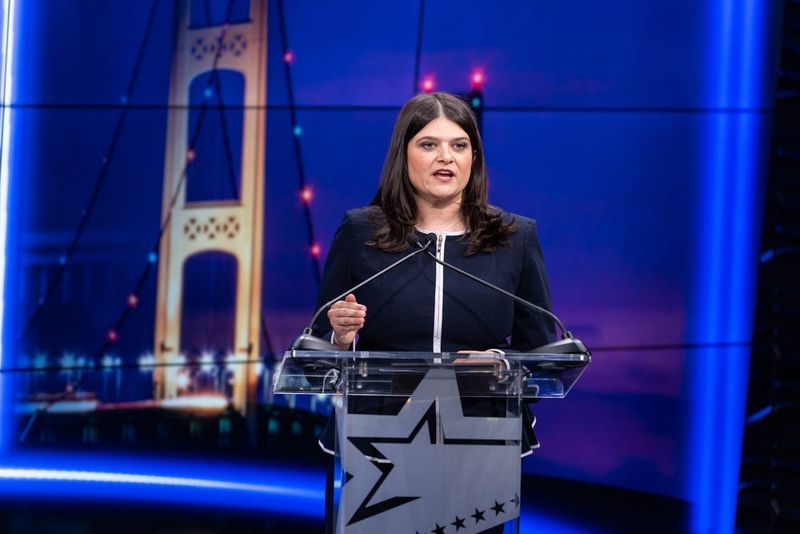
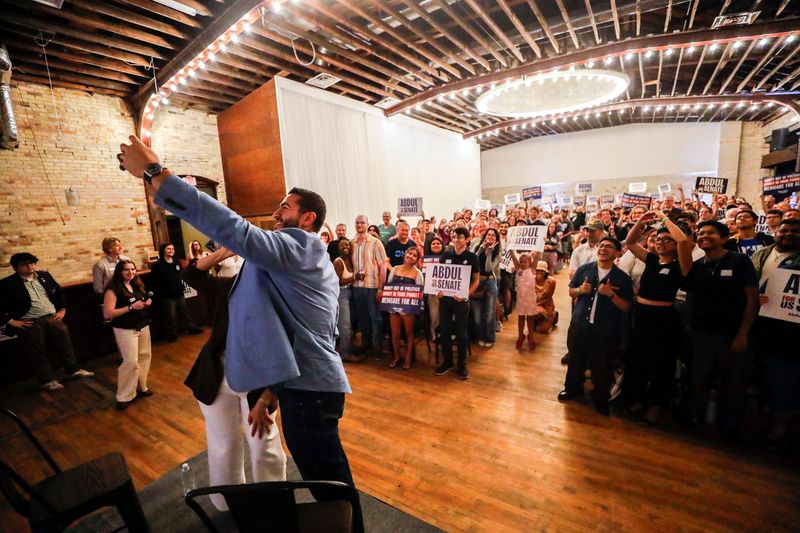
At the center of the internal battle among Michigan Democrats this year has been the U.S. Senate primary between four-term U.S. Rep. Haley Stevens of Birmingham and progressive firebrand Abdul El-Sayed, a former Wayne County health official from Ann Arbor.
Over the last 30 years, nine of Michigan’s 10 U.S. Senate Democratic primaries have been uncontested, meaning the party has largely avoided heated contests in those races.
That’s not the case this year, after U.S. Sen. Gary Peters, D-Bloomfield Township, decided against seeking reelection amid disagreements about how Michigan Democrats should respond to Republican Trump’s victory here in the 2024 presidential election.
“This is an ideological battle as much as it is a candidate battle,” Johnson said of what’s unfolding in Michigan. “It’s one faced by the Democrats every time we don’t have the White House.
Stevens and El-Sayed have been presenting opposing visions for the future, including their stances on Israel, health care and campaign finance.
El-Sayed, who rejects the socialist label, has admonished corporate political spending and is vowing on the campaign trail to get money out of politics, while Stevens has defended contributions from committees tied to corporations and is being backed by tens of millions of dollars in outside spending to promote her campaign.
Stevens has touted herself as a workhorse on policy and criticized El-Sayed for having a podcast and writing a book.
“My head is down doing the work for the people of Michigan, who need the work to be done,” Stevens said last week.
Bernie Sanders, AOC are coming to Michigan
However, it’s El-Sayed who has been drawing larger crowds on the campaign trail, and some Democrats contended the energy and ground game behind El-Sayed’s progressive bid could make the difference.
Eight years ago, El-Sayed made a similar effort to win a statewide Democratic nomination, running for governor against Whitmer and Thanedar. El-Sayed finished second with 30% of the vote behind Whitmer at 52%. Thanedar received 17%.
The Senate primary is expected to be much closer in 2026.
This weekend, U.S. Sen. Bernie Sanders of Vermont and U.S. Rep. Alexandria Ocasio-Cortez of New York, two stars of the national democratic socialist movement, will hold a series of events in Detroit, Grand Rapids and Lansing with El-Sayed.
In June, El-Sayed told a group of his supporters in Dearborn Heights that if he can win Michigan’s U.S. Senate seat, it will have broader implications, changing the nature of the debate in the 2028 presidential race because the state is “the heart of the political universe.”
“If I get elected with my foreign name and my politics, what does it say about Michigan and who can win it?” El-Sayed asked.
But former Michigan Gov. Jim Blanchard, a former congressman who remains an influential Democrat in the state, labeled El-Sayed a “poster boy for the left-wing establishment.”
“They’re not interested in Michigan, in my opinion,” Blanchard said of national figures backing El-Sayed’s campaign. “They’re interested in having a victory for the far left.”
“This is the left-wing Washington establishment versus Michigan Democrats,” he added.
Some Michigan races to watch
On top of the U.S. Senate race, other U.S. House, state legislative and local primary contests will test the strength of the progressive movement in Michigan.
In the Lansing-area 7th U.S. House District, community activist William Lawrence is attempting to beat two other Democratic candidates with heavier establishment support, former Navy SEAL Matt Maasdam and former U.S. ambassador to Ukraine Bridget Brink. The winner will take on Republican U.S. Rep. Tom Barrett of Charlotte in the general election.
Lawrence’s main TV ad opposes data centers. He’s previously labeled former Vice President Kamala Harris and U.S. Sen. Elissa Slotkin, D-Holly, “warmongers.”
Maasdam has been endorsed by Slotkin, who won a close U.S. Senate race in Michigan in 2024. Brink has been endorsed by the Michigan Education Association, Blanchard and former Gov. Jennifer Granholm.
In northern Michigan’s 1st U.S. House District, three Democrats are competing for their party’s nomination to challenge U.S. Rep. Jack Bergman, R-Watersmeet.
Democrat Callie Barr of Traverse City, who lost to Bergman in 2024, has the backing of former U.S. Rep. Bart Stupak and a bevy of union groups, including the MEA. However, Democrat Kyle Blomquist of Iron Mountain has the support of the local chapter of the Democratic Socialists of America.
In Ann Arbor, former state Rep. Yousef Rabhi has been endorsed by El-Sayed and Sanders, according to his campaign website, as he attempts to unseat Ann Arbor Mayor Christopher Taylor, who’s been endorsed by Whitmer and Slotkin.
About 40 miles away in Detroit, Chris Gilmer-Hill, who’s been the policy manager for the Michigan Environmental Justice Coalition, is attempting to unseat three-term state Rep. Helena Scott in a primary in the 8th District.
Gilmer-Hill has been endorsed by the Metro Detroit Democratic Socialists of America. Volunteers with the Democratic Socialists of America have helped Gilmer-Hill’s campaign knock on 28,000 doors, he said.
The organization’s membership has grown because of other democratic socialist victories, like Zohran Mamdani’s win in becoming mayor of New York City, and frustration with Trump returning to the White House, he said.
“That confluence has led to a lot of people recognizing that something big needs to change,” Gilmer-Hill said Wednesday.
Two of the top issues in his race against Scott, a former House Energy Committee chairwoman, have been the influence of the Detroit-based electric utility DTE Energy and political corruption, Gilmer-Hill added.
Scott recently appeared in a campaign video with Stevens.
“She is an excellent candidate,” Scott said of Stevens in the video.
Democratic socialists expand campaigns
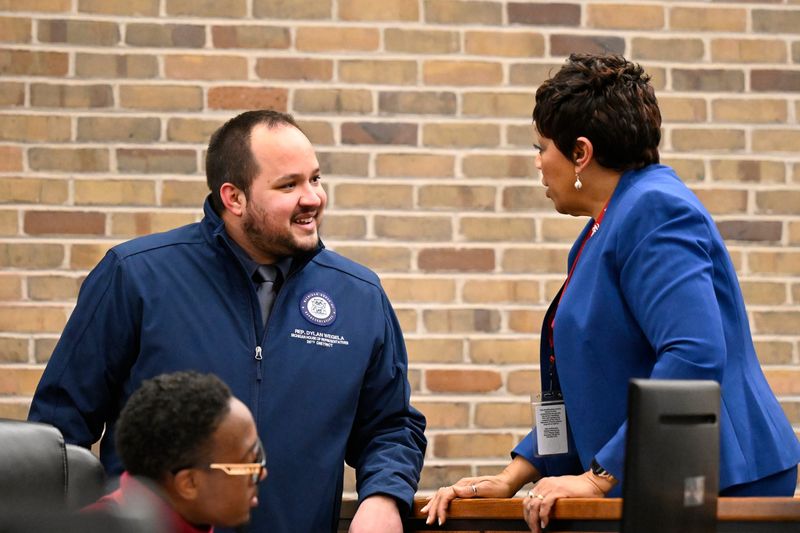
State Rep. Dylan Wegela, D-Garden City, who labels himself a democratic socialist, said he believes there’s a record number of Democratic Socialists of America-backed candidates seeking office this year in Michigan.
The movement wants to provide universal access to health care, combat data centers and reform campaign finance laws, Wegela said.
“Do we want a future that’s controlled by the oligarchy, by big tech, by data centers?” Wegela asked. “Or do we want a future controlled by working class people?”
In a July 8-11 poll of 500 likely Democratic primary voters in Michigan, commissioned by The Detroit News and WDIV-TV, 58% said they had a favorable view of Democratic Socialists of America, while 28% were neutral or had no view at all, and 15% had an unfavorable view.
The survey, conducted by the Glengariff Group, had a margin of error of plus or minus 4.4 percentage points.
Detroiter Teron Haynes Jr. identifies as a democratic socialist and attended McKinney’s campaign event on Tuesday on the city’s west side.
“I see a lot of the changes in very small, minute portions of the Democratic Party,” Haynes said. “They’re recognizing that leaning further left is inevitable. I do think that it’s going to take some more electoral victories for it to happen.”
Socialism means a lot of different things to different people, contended Blanchard, who was Michigan’s governor for most of the 1980s.
“I think the mood right now is more anti-incumbent and change,” Blanchard said of feelings of primary voters in the battleground state.
But the reasons for the trend are more complicated, argued Pennsylvania state Rep. Chris Rabb, who was endorsed by the Philadelphia Democratic Socialists of America on his way to winning a primary race for the U.S. House in his state in May.
Rabb visited Michigan this week to campaign for McKinney. Rabb said voters are seeking candidates to run who would otherwise not be deemed viable.
“Who would think that a democratic socialist, reparationist, anti-establishment Democrat could win in one of the oldest cities in the nation that has been dominated by the same political machine for 40 years?” Rabb asked, referring to his primary victory in Philadelphia.
Rabb has endorsed El-Sayed and Lawrence. Asked if those two candidates could win over independent voters in a general election in swing areas of Michigan, Rabb argued that independents want candidates who stand up to what he described as the “corporate duopoly.”
“For those people who don’t trust money in politics and the billionaire class, they don’t have to be lefties to support these folks in purple districts or purple states,” Rabb said. “Because there’s something that motivates them beyond traditional partisanship.”
cmauger@detroitnews.com
This article originally appeared on The Detroit News: Progressive uprising divides Democrats up and down Michigan’s ballot
Reporting by Craig Mauger, The Detroit News / The Detroit News
USA TODAY Network via Reuters Connect
By Craig Mauger, The Detroit News | USA TODAY Network
