(This article was updated to correct inaccuracies.)
Two of Artemisia Gentileschi’s extraordinary paintings are on view in “Artemisia Gentileschi: Naples to Beirut,” an exhibition currently on view at the Columbus Museum of Art (CMA).

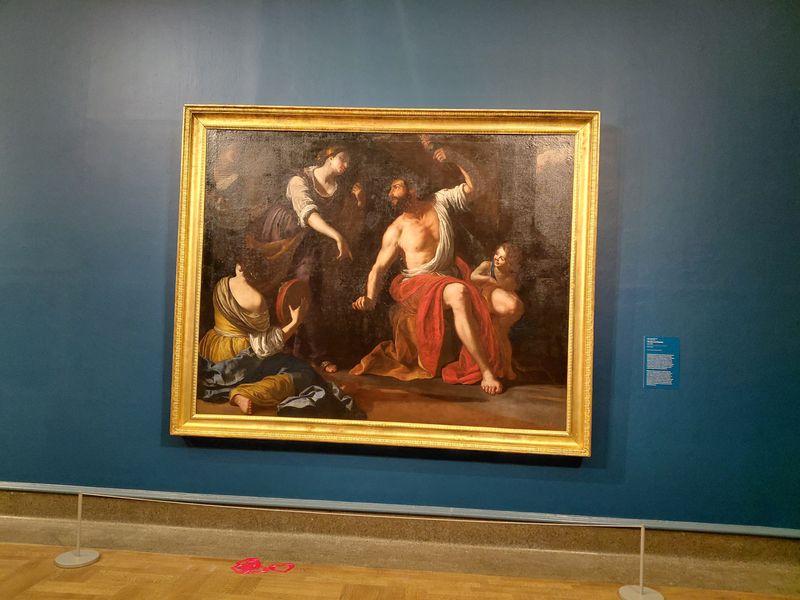
The centerpiece of this gallery exhibition is Gentileschi’s “Hercules and Omphale” (about 1635-1637). Near “Hercules and Omphale” hangs Gentileschi’s “Bathsheba” (about 1636-1637) from CMA’s permanent collection.
Based on Greek mythology, the subject of “Hercules and Omphale” is Hercules’ servitude to the Lydian princess Omphale as the punishment for murder. This painting, on loan from the Sursock Palace collections, was painstakingly restored by the Getty Museum after it was nearly destroyed in a 2020 explosion in Beirut.
A film depicting the restoration effort is running near the piece; fragments of glass removed from the canvas are enclosed in a glass case for context. I was in awe of the exemplary conservation restoring this work, showing no evidence of damage. A screen shows backlit details of the damage with notes by Lebanese artist and art historian Gregory Buchakjian, who discovered the painting among the rubble.
Gentileschi (1593-1654) was an Italian Baroque painter of the 17th century, notable because she was the first woman admitted to Florence’s Accademia delle Arti del Disegno and for her Caravaggio-influenced works.
She is also remembered as one of the few recognized female artists of the period. She was also a victim of rape. In 1611, her abuser was brought to trial. Gentileschi was made to give testimony under torture.
Remarkably, Agostino Tassi, the accused and a friend of her father’s, was found guilty and sentenced to exile, but the sentence was never carried out. This violent act may have shaped Gentileschi’s depiction of strong female figures in her works, such as the bloody “Judith Beheading Holofernes” (1620).
Gentileschi’s paintings show the uniquely female perspective of gender struggle during an era in which women were rarely recognized for their intellect or talent. According to Tom Gurney’s assessment of the painting “Bathsheba on thehistoryofart.org, this work was a collaboration between Gentileschi, Viviano Codazzi and Domenico Gargiulo, each creating a section of the painting.
As with many of Gentileschi’s other works, the female subject, Bathsheba, is the innocent target of male lust, supplied by King David on the balcony. We are fortunate to be able to view Gentileschi’s fabulous works here in Columbus. This exhibition is on view through May 31.
Art to excite visitors
Fast forward to “New Encounters: Reframing the Contemporary Collection of the Columbus Museum of Art,” an exhibition of intriguing works. We will examine a few of the pieces on view.
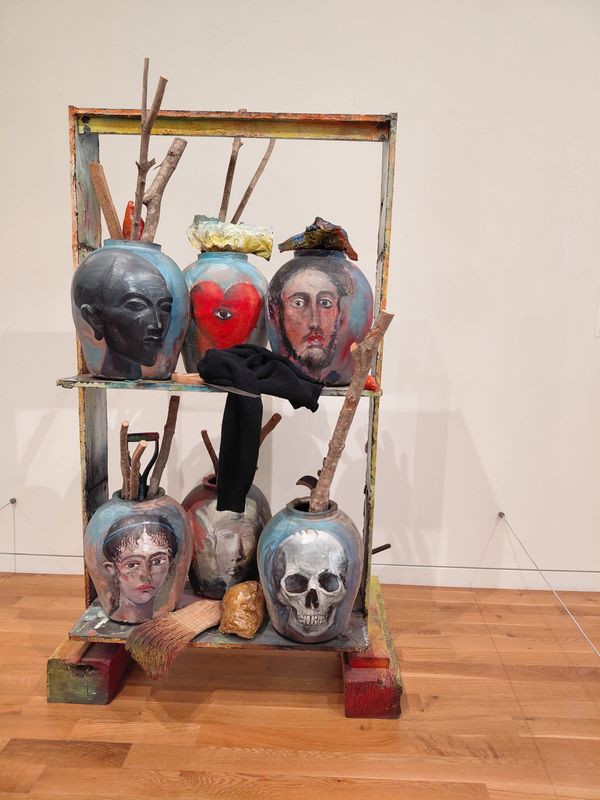
Jim Dine, who is best-known for his hearts and bathrobes, created a series of six bronze jars representing funerary urns painted in the style of ancient Egyptian and Greek portraits, a skull and a heart with an eye at the center for the mixed-media work, “The Storage Jars” (1991). The jars are filled with found objects representing ideas stored within.
On loan from the Pizzuti Collection is Nick Cave’s “Sound Suit” (2010).
A figure − draped in crochet, knits and patchwork from the torso down, with a lace doily on the middle – sprouts small musical horns and other noise-making devices on the head and shoulders.
This piece is taken from a series of “Sound Suits,” which appear “whimsical and joyful” but are intended as disguises of racial and gender identity created in response to racial profiling and race-based violence.
Ohio visual artist Ann Hamilton’s “(suitably positioned) (1984/2014)” is literally a felt pantsuit adorned with toothpicks. Sometimes referred to as the “toothpick suit,” this piece examines identity and the body. Up close, the suit is reminiscent of the spines of a porcupine. Hamilton earned a Master of Fine Arts degree in sculpture from Yale University.
Columbus artist Aminah Brenda Lynn Robinson’s “My Lord What a Morning” (1994) consists of nine towering figures made from organ pipes painted with expressions and human appendages.
They represent the choirs singing gospel music and spirituals, sung to lift the spirit from the bonds of enslavement and connect one generation to the next. Although Robinson (1940-2015) was formally trained as an artist, she was inspired by self-taught artists such as Elijah Pierce.
Amy Drake, M.A., M.S. MCM, is a Telly Award-winning filmmaker, playwright and actor. She can be reached at draketheatrical@gmail.com.
This article originally appeared on The Columbus Dispatch: Artemisia Gentileschi’s restored masterpieces lead new CMA exhibitions
Reporting by Amy Drake, Special to The Columbus Dispatch / The Columbus Dispatch
USA TODAY Network via Reuters Connect
By Amy Drake, Special to The Columbus Dispatch | USA TODAY Network