INDIANAPOLIS — The outfit choice was bold and the message crystal clear. Eric Shanks, the mastermind behind Fox Sports’ award-winning, sometimes out-of-the-box reputation, and the might of Rupert Murdoch’s sports broadcasting arm had arrived.
Shanks did it sporting a custom T-shirt: “Fastest racing on earth” it read on the front. The back, above the list of IndyCar’s 17 races on its maiden tour with Fox in 2025, read, “Kickstart My Heart.”

Could there be a more fitting, albeit bold, lyric – spun from Motley Crue’s bassist dying and being brought back to life by a shot of adrenaline to the chest – for a sport that battled Formula 1 on the international stage in ’90s, only to languish for three decades after being overtaken in the U.S. by the freight train that was Jeff Gordon and Dale Earnhardt’s NASCAR?
The paddock was about to find out.
Shanks sat on the stool inside the Grand Prix of St. Petersburg media center, looking every bit an atypical CEO. The born-and-bred Hoosier – who spent his teen years reveling in the pageantry of the Month of May in Speedway, whose work ethic forced him out of Bloomington without a degree and, in 2010 at 38 years old, he became the youngest sports network head in history – was there to deliver a simple message.
Unafraid to deliver a dig at Fox’s predecessor – “I saw some (audience) numbers last year on Peacock that were pretty bad…” – the Fox Sports CEO had a laundry list of ideas that made the men he shared the stage with, Penske Entertainment president and CEO Mark Miles and newly minted IndyCar (and IMS) President Doug Boles, grin as wide as their cheek bones allowed.
Fox wasn’t here to continue the years-long incremental growth IndyCar had seen during its years with NBC. After Fox swooped back in with a final offer just under the buzzer the previous May to buy IndyCar’s domestic broadcast rights – timed ever so curiously with losing rights to NASCAR’s Coke 600 and the decision to ax its daily NASCAR news show “Race Hub” – Shanks swayed Penske Entertainment with the promise of an all-network race schedule, cable broadcasts of practice and qualifying, and some audacious bells and whistles.
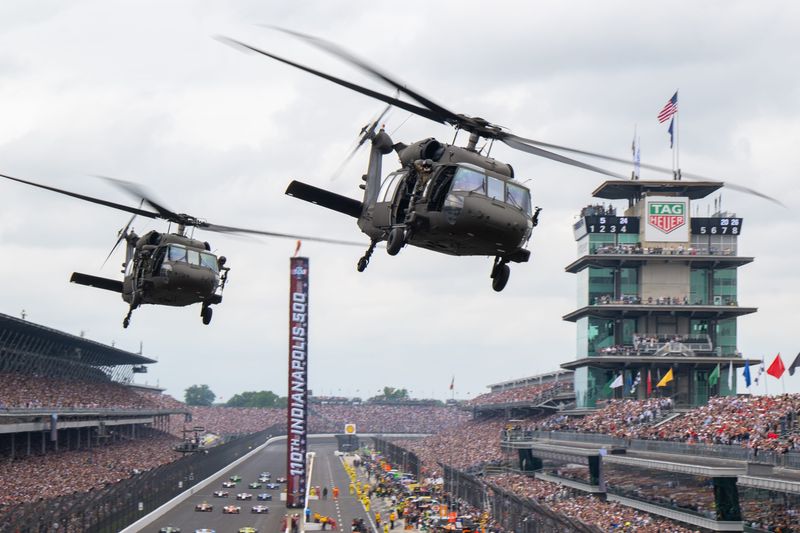
Three Super Bowl commercials – costing Fox eight figures in potential sales, not to mention the production costs – and the ask for Blackhawk helicopters to shadow the Indy 500 field during the parade laps in May were unlike anything the sport had seen in years. In NBC, IndyCar had a broadcast partner who couldn’t carve out an all-network schedule because it was so rich in elite, championship-level sports programming. But with Fox? Between Super Bowl Sunday and the first college football broadcast of the year, IndyCar was no longer the small fish in a big pond. Fox’s full-throated promotion of the sport reportedly had some in NASCAR circles miffed.
With nearly nine months of lead-up time between the mid-June announcement the summer prior and that March 1 presser, the paddock was as eager as Shanks to see the results of all the potential promise.
Cautious, anxious, frustrated, too.
In Part 2 of this series, IndyStar looks at why Fox’s entry as a broadcaster and owner of IndyCar provided the hope and (at least some) of the results the series needed at this key point in its history.
Will Fox deliver? Will it happen quickly enough?
Twelve months earlier, Michael Andretti, a now-ex-IndyCar team owner, had brashly called for Roger Penske to sell the sport he’d helped keep alive through the pandemic if he wasn’t willing to invest enough to launch it into orbit.
Penske Entertainment had spent more than $60 million on the Indianapolis Motor Speedway’s latest facelift, while propping up IndyCar’s almost never-ending hybrid project, saving the Long Beach Grand Prix and helping races in Iowa, Milwaukee and Nashville get rolling. To say Penske had pinched pennies since purchasing the sport and IMS for approximately $300 million from the Hulman-George family would be inaccurate.
But to say those expenditures had merely helped keep the series afloat while F1 and NASCAR rolled out new cars, new race markets and new licensing deals, wouldn’t be far off.
“I’m very bullish on what the series can and should be, but I don’t think we’re moving fast enough,” McLaren Racing CEO Zak Brown told reporters in September 2024. “Formula E is losing money, while IndyCar is a very famous brand with one of the most iconic races in the world, so one has to ask themselves, why is Formula E worth $750 million, while IndyCar (and IMS) is worth $250 million or $300 million?”
And then Brown backed Andretti up.
“If you put $100 million into it, the goal would be to make it worth $2 billion,” he continued. “The sport needs money not just to raise the bar and upgrade IMS. Your instinct should be, if Formula E is worth $750 million, shouldn’t IndyCar be worth a billion and a half, or two billion?”
Six months later, nearly 130 million sports fans had seen IndyCar’s Super Bowl ads. Driver Graham Rahal felt Fox was finally taking the lead – mentioning the sport during NFL games, featuring it multiple times during its “Big Noon Kickoff” college football show and producing movie-quality commercials.
“The reality is,” he said, “there’s been a helluva lot of people talking about (us). … I think we should all feel very blessed that Fox came in and took the leap of faith on the sport.”
Team owners largely agreed but was Fox really going to deliver? Would it come quickly enough? Becoming one of two racing series in the U.S. – and the only major one – to air all its races on network TV needed to increase IndyCar’s week-to-week audience. And those audience numbers needed to lead to more consumer-facing sponsors. And those sponsors needed to be willing to pay more for the stickers on the car and activate around those deals.
That offseason, teams – some begrudgingly – signed a charter agreement that gave them something tangible to own outside the cars, trucks and parts. But it came with no revenue sharing program beyond the already established Leaders Circle program that isn’t guaranteed to all 25 full-time cars and, for most teams, didn’t provide even 20% of the annual budget. Looming on the horizon was a new car that team owners knew very little about and had several doubting if it was needed. Team owners said that winter their budgets had risen roughly 25% the last couple years – a trend expected to continue. TWG Motorsports CEO Dan Towriss stated plainly that revenue hadn’t kept up with expenses.
Added an executive from another team: “I’m personally concerned we’ve got a ‘moment’ right now, and we’re not equipped to capture it. … If we ever want to grow as a business and challenge our competitors, we’ve got to get our heads out of the 1950s.”
“We’ve got a lot of positive things going on right now, and we have a ton of hope, but hope doesn’t pay the bills,” Mike Shank told IndyStar race morning of the 2025 St. Pete Grand Prix. “We think we’re going to be good, but when you’re making a living on this and nothing else, it’s scary at times.”
How Fox made an instant impact on IndyCar’s growth
IndyCar had landed double-digit network windows for 2022 (14) and 2023 (13) in its final deal with NBC — which was worth $20 million to $30 million a year — but was losing ground to F1 and the Xfinity series.
With fewer than 25% of the season’s race broadcasts landing on network TV (4 of 22), F1’s average audience in 2022 (1.21 million viewers) was quickly encroaching on IndyCar’s mark (1.3 million). New for 2025. the Xfinity series, NASCAR’s second-level circuit, would hold its entire schedule on The CW, far and away the least popular broadcast network behind the traditional big four, and it’s season-long average audience, too, surpassed the 1 million mark (1.034 million). Though IndyCar remained ahead of both, neither F1 nor Xfinity holds a race near the level of the Indy 500 — and without the boost of the 500, IndyCar’s season-long TV audience average in 2025 fell near 850,000.
In short, outside one race a year, IndyCar’s non-500 interest had clearly fallen below that of F1 and Xfinity — all while Formula 1 held a cable-heavy broadcast rights deal in the U.S. worth as much as $90 million per year, and Xfinity had landed $115 million per year to take a chance with The CW.
“The headline for us is ‘Taking Off,’” Miles told IndyStar in an exclusive sit-down the morning of the 2025 St. Pete race. “We have an opportunity to move IndyCar up in the sports food chain, at least in North America, in a big way, and I think Fox is the most important development in that regard.
“Fox helps us get in front of more fans. Now, how do we get them more deeply engaged?”
Fox’s first run with IndyCar – that 2025 St. Pete race broadcast – was a success. Aided by the run-up to NASCAR’s third Cup series race that immediately followed on the network, IndyCar saw its average TV audience eclipse 1.4 million for just the second time for a non-500 race in nearly 15 years. This came after a sizable dip in audience from 2023 (1.32 million average) to 2024 (1.072 million) – largely due to the series’ contract with NBC that allowed for 13 network races in ’23 but just 10 in ’24. Fox’s first 500 averaged an audience of 7.088 million people – an astounding figure for a race whose audience (outside the pandemic) hadn’t surpassed the 6 million mark since the historic 100th running in 2016.
Unfortunately for the sport, however, those gains would not be realized the rest of the summer. Fox and IndyCar would have 11 races fail to hit the 800,000 average TV audience mark in 2025. On one notable Sunday in July, IndyCar’s race broadcast from Toronto (average audience of 734,000) failed to outdraw NBC’s live event coverage of the Pro Motocross Championships (926,000). During IndyCar’s six-year exclusive broadcast relationship with NBC, it failed to reach 800,000 viewers only 10 times outside the pandemic, and six of those ran against NFL games.
IndyCar’s 2025 audience finished 27% up on the year prior – the highest TV audience growth rate for sports with an average audience of at least 1 million. With close to double the network windows of 2024, though, its non-500 network average was down nearly 100,000 viewers.
While acknowledging the virtual certainty that the season-long average was set to increase simply by the configuration of the TV schedule, Miles and other Fox and Penske Entertainment executives trumpeted the spike as a historic success, even as the bulk of the figures produced questionable results.
“You can’t do these things in a year,” Miles said on Rossi and James Hinchcliffe’s podcast “Off Track with Hinch and Rossi” in August. “We’re rebuilding – or building – an American sports franchise. We never had any doubt that this deal with Fox would produce an important increase in our TV audience, and I understand how it’s kind of a slam dunk because everything’s on network.
“But in short order, they’ve gained the trust of Roger Penske and all of us as great partners.”
Fox takes greater stake in IndyCar for needed promotion boost
The morning of July 31, Murdoch’s Wall Street Journal reported that Fox Corp. had bought a 33% stake in Penske Entertainment, with Fox purchasing shares of the privately held company from Penske Corp. Financial details were not disclosed, though the Journal reported the deal to be worth between $125 million and $135 million. Along with the minority ownership stake ceded to its media rights holder, Penske Entertainment also struck a multi-year extension of its domestic broadcast rights to the end of the decade.
On the “Off Track” podcast, Miles described an almost sheepish Shanks who had approached Penske Entertainment executives months prior to test the water.
“I remember Shanks saying a couple times right when we were beginning the broadcast relationship that, ‘Hey, the Murdoch companies have a pretty hefty balance sheet. They have a lot of cash because they want to be opportunistic at looking at acquisitions,’” Miles said. “To be frank, it didn’t cross my mind that that would be a conversation starter for us, and then several weeks ago, it became that.”
Penske told the Journal: “It was a pretty easy question to say ‘Yes’ to.”
Though it wasn’t explicitly stated, the short-term goal – given that Fox had not become the outright IndyCar broadcast rights owner, just the holder of them over the life of the latest deal – seemed to be this: Fox, over the course of the next five years, could help inject a much-needed energy and know-how into the promotion, advancement and growth of the sport before the two sides would again take IndyCar’s rights to market. If done right, and with the recent Xfnity series and F1 deals as important data points, IndyCar could expect to multiply its rights fee, turning into return-on-investment for Fox, additional funds to power the sport for Penske Entertainment and, depending on the decisionmakers, more revenue to funnel down to the teams via the Leaders Circle.
Chip Ganassi told IndyStar, “It opens doors that were previously closed. It’s an on-ramp to momentum. You know what it does? It brings ‘entertainment’ to Penske Entertainment.”
How IndyCar’s Arlington Grand Prix turned a corner on scheduling
Months after IndyCar announced its initial agreement with Fox, Penske Entertainment unveiled perhaps its most aggressive project to date. After completing American open-wheel racing’s first season without a race in the Dallas/Fort Worth area since Texas Motor Speedway opened in 1997, Penske Entertainment announced its replacement.
Since F1’s Miami Grand Prix debuted in 2022, racing around the Miami Dolphins’ Hard Rock Stadium while creating a fan extravaganza featuring painted ocean scenes with real yachts and sand to match, it had become abundantly clear what the new-age version of street racing should be. Grand prix on the city streets of Long Beach and St. Petersburg will forever be staples in IndyCar, but proven by the long list of similar projects that lasted for just a few years (Baltimore and Nashville, among others) or never even got off the ground (Boston and Nashville Part 2), successful street events with longevity are difficult to launch.
Miami, though, showed what success can look like if you stray from a city center and find the right combination of partners and infrastructure to build a world-class track with off-track entertainment and amenities to match.
“I hope (Arlington) is the best of Miami and more,” Miles said in March 2025 of IndyCar’s future Grand Prix of Arlington. Miles went as far as to tell Inside Indiana Business that IndyCar’s newest event “rivaled anything F1 does in this country.”
Beyond the eye rolls elicited in the IndyCar paddock by that line – F1 literally races up and down the Las Vegas Strip, parks yachts on concrete in Miami and has had Taylor Swift, The Weeknd, Bruno Mars, Green Day and Ed Sheeran headline concerts for the U.S. Grand Prix at COTA – it was undeniable Arlington raised the bar for IndyCar races.
“I think this is the new standard,” Scott Dixon told reporters shortly after arriving on site early in the race weekend in March.
That formula included one of the longest tracks on the calendar – a 2.73-mile, 14-turn course around AT&T Stadium and Globe Life Field, featuring speeds reaching 180 mph, a far cry from the prototypical IndyCar street course that rarely reaches two miles long.
The race promoters sold out their grandstand seats for race day. All 73 suites – including some where guests could actually watch the cars race underneath them – were purchased. Patrons came from all 50 states and 20 countries, and the race weekend sold more IndyCar merchandise than any non-Indy 500 race in recent memory.
Hype around the event featured a months-long lead-up as Fox name-dropped it frequently on Cowboys broadcasts. Add a special extended pre-race show that included a live sit-down with Cowboys owner Jerry Jones and the Grand Prix of Arlington averaged 1.336 million viewers. It was IndyCar’s third consecutive broadcast audience of more than 1 million to kickoff the 2026 campaign – the first time the sport has achieved that since at least 2008.
“It was the closest thing we’ve ever had to an F1-level event, from the way the track was prepared, the signage, the quality build of the track, the access, the scale of the track. This wasn’t a po-dunk 50-second lap track,” Rossi told IndyStar of the Arlington event in May. “You had the classic IndyCar experience around the paddock, but if you wanted to have an upscale experience with fine dining and good wine and cocktails, you could have that as well at a tenth of the cost (of F1).
“It appealed to so many demos, and that’s what IndyCar racing should be. Execs wanted to bring their clients, but also, families wanted to bring their kids. If you want to grow the sport and want more money to come into the sport, you have to create an environment where those people want to come, too.”
Rossi was perhaps most amazed at an experience he had arriving at his hotel 25 minutes away from the track.
“That was the first time in my IndyCar career outside the 500 where I stayed 25 minutes away from the track, in a different zip code, and I checked into my hotel, and they asked, ‘Are you here for work or pleasure?’” Rossi said. “And I said, ‘Oh, I’m here for work. Here for the race,’ and they said, ‘Oh, the IndyCar race in Arlington?’ I’ve never once had someone know about a race we’re having in the same city we’re even in.
“There were no billboards in that part of Dallas. It was a golf-and-spa resort – definitely not where people were staying for the race, and they somehow knew about us.”
Drivers across the paddock have widespread ideas of what should come next. Denver has long been rumored as the next target for Penske Entertainment, with two big-name team sponsors (Team Penske’s Sonsio and Arrow McLaren’s Arrow Electronics) headquartered just outside the city, but it’s unclear how the Broncos’ vision for a new stadium site in the next five years could alter those plans.
Series officials have held varying levels of talks in recent years to return to Brazil after more than a decade away, and Penske Entertainment hosted officials from Colombia in May and have also discussed the possibility in recent months of a return to Japan. Only slim hopes for a deal to return to Mexico City remain.
Shanks – notably before Fox purchased an ownership stake in Penske Entertainment – first proposed racing in the nation’s capital to series stakeholders in May of 2025 and is understood to have been the catalyst that propelled IndyCar to race in D.C. in August as part of a year-long celebration across U.S. pro sports to celebrate the nation’s 250th birthday. The idea was deemed “not ever feasible” for 2026 and “never in the cards” by Miles in September, but it somehow caught steam over the winter following persistent meetings with various government officials and groups from Penske Entertainment.
The promotion of Arlington and Fox’s believed role in pushing the longshot D.C. race to President Donald Trump’s desk is seen around the paddock as more examples of what the network brings to the mix.
“The main thing in this sport has been, do people know we exist? And I don’t think they did,” Tony Kanaan told IndyStar in May. “We have hardcore fans, and everybody knows (IMS) exists, and it’s the most popular place we go, and so the broadcaster puts 10 times more effort into this race. That works, so why don’t we do that at any other place? We have to go to the big markets, and I think that’s what the difference (with Arlington) was. It’s an event. They say, ‘Well, you can’t have an Indy 500 every weekend.’ Well, F1 does!”
Fox helps lock in Honda as engine manufacturer for new deal
Perhaps the biggest win secured in the 18 months since Fox’s arrival came in what didn’t happen. Two-and-a-half years ago, American Honda Motorsports manager Chuck Schifsky gave one of the most scathing pre-Michael Andretti-at-St. Pete reviews of the state of the sport. After a decorated three decades entrenched in American open-wheel racing, Honda had begun questioning the value of competing in IndyCar.
“We have great concerns over the costs,” Schifsky said to Racer in December 2023. “If we were to choose not to renew (our manufacturer contract), that would be the reason why. And it’s easy to see. We don’t have a third manufacturer, and there’s a reason for that – it has to do with the cost. If the return on investment matched up with the investment, we’d have a number of other manufacturers involved.”
IndyCar considered adopting a spec engine built by Ilmor for the series’ next package, with freedom for other manufacturers to compete with the hybrid unit. Outsiders like Toyota and Lamborghini expressed varying levels of interest in that project according to a series source. Penske was bracing for the OEM’s exit until Boles smoothed things over.
Honda, Chevy and IndyCar announced a multi-year deal through at least the end of the decade ahead of the rollout of a new engine formula and new car in 2028 earlier this year.
“We not only saw a boost in ratings but we’ve seen Fox really leaning in on the promotion of the sport – and then they bought in,” Schifsky told IndyStar in May of Honda’s decision to sign an extension. “Equal credit goes to Roger for selling 33% as much as for Fox buying 33%, because that sent a big message within Honda that, ‘Oh, this isn’t just 16th and Georgetown trying to run this series and compete with other stick-and-ball sports and NASCAR and F1 and IMSA.’
“This is Fox saying, ‘We’re going to put our money where our mouths are and jumping in and getting some board seats and really grabbing ahold of it.”
How drivers factor into IndyCar’s brand
There’s an internal debate across the paddock as to the proper way for the series to create superstar drivers.
Few of IndyCar’s drivers move the needle. It’s not without effort. They’ve become staples at NBA, NHL and MLB games via fan events, race-specific promotions or meticulously planned opportunities meant to reach a new segment of sports fans. From men’s health magazines, fashion shoots and UFC fights to panels at SXSW and the White House’s annual Easter Egg Roll, drivers have frequently been seen outside the 465 corridor where so much of IndyCar’s fanbase lives.
Years ago, the series had attempted to make its drivers feel more relatable. But some industry marketing professionals argue that’s the wrong direction to swing.
“I think if you look at celebrities, nothing’s relatable. The most famous people on earth, they’re the most unrelatable people, and none of what these drivers do for a job is relatable,” one longtime marketing professional told IndyStar earlier this year. “We need to put up a velvet rope and don’t make it seem like they’re human and make it seem like they’re superheroes and they’re a bigger deal.
“These are aspirational athletes. You don’t say, ‘Boy, I sure do love Tom Brady because he was a sixth-round pick.’ Athletes become superstars because they’re not like the rest of us.”
Conor Daly thinks more drivers need to be willing to fully open up, whether that be on social media, in race weekend interviews or through viral confrontations on pitlane – an opportunity NASCAR, in particular, takes advantage of.
“You can’t change who people are and tell them to go out and be more exciting but I’ve got to say, F1 drivers, they do sit down and do those (‘Drive to Survive’) interviews and say some things on-camera,” Daly told IndyStar. “And a lot of our guys still aren’t willing to be out there much or have much of a social media profile.
“But also, I think we’re more grassroots guys. We don’t have yachts in Monaco. A lot of us live in moderately sized homes and are just out there grinding.”
It leaves a question around just what exactly IndyCar’s identity moving forward is and how it can best stand out in a crowded marketplace.
Daly’s argument that the sport provides the “purest form of open-wheel racing out there” is almost inarguable but F1 didn’t become popular overnight because the quality of the racing drastically improved. IndyCar’s continued use of on-track passing statistics and lead changes may increase interest among current fans but seems unlikely to generate significant growth in popularity.
“I went back to Austin for the F1 race last fall, and the question I got asked often was how are IndyCar and F1 different,” Fox IndyCar play-by-play lead Will Buxton told IndyStar in May. “And I said, ‘When I first went to university my first week there, I went to see a band. I’d heard though the grapevine they’d be pretty good and went to see them in a pub, and there were 20 people there. Sticky floors, low ceilings, all for this band to play this tiny gig to play all the songs they had, which were nine or 10.
“Months later, they released ‘Yellow,’ and Coldplay was suddenly the biggest band in the world, and 30 years later, they’re playing in 100,000-seat stadiums. Coldplay in a stadium with 100,000 people is Formula 1. Coldplay in a pub with 20 people, low ceilings, sticky floors and where you have a beer with the band afterwards, that’s IndyCar. One is a little more distant, a little more about the show. It’s a big event, and the other is raw, and it’s pure and there’s almost something untouched about it. That’s IndyCar.”
That, however, shouldn’t be IndyCar’s goal.
“However big IndyCar gets, the one thing it won’t and shouldn’t forget is the experience a fan has at a place like the Indy 500, where for $100 you can walk the paddock and meet your heroes and feel part of it.” Buxton said. “That becomes exponentially harder the bigger you become, but if IndyCar can find a way to maintain that element of relatability, of feeling part of something, while also growing to be as big and as popular as it hopes to become, then I think it’ll be on a very good path.”
Can that happen if the series upsets a segment of your female fanbase by partnering with Barstool or appall others who perceive the series to be diving into the political fray by racing through D.C. city streets for President Trump? Is holding a Wieniemobile race 48 hours before the Indy 500 at the Racing Capital of the World too outlandish? Rahal and others argue those are risks Penske Entertainment has to be willing to take.
“Ultimately, we have to find that next level of fan. We’ve got to find ones who’ve never seen it before. We’ve got to step outside our comfort zone,” he said. “I know some people don’t like D.C., and I get it from a political standpoint … but D.C. is going to be a helluva opportunity for our sport.
“Roger provided us with a good foundation but it’s like building a house. You can provided the sticks and concrete base, but you need someone to do all the furnishings and take it over the top, and that’s what Fox does. Anything Fox does is pretty bold and electric. I think Penske needed a partner like that to be a little more outside the typical Penske that we’re all used to.”
It’s a question Boles grapples with every day. He remembers the endless phone calls and emails from longtime Indy 500 ticketholders after IMS launched the modern-day Snake Pit. Old-timers were appalled at the idea of hosting a raucous concert in the infield simultaneous with the Indy 500. But there are young people who may not watch a single lap.
With that, though, Boles has watched the 500 evolve from some of its leanest years and into grandstand sellouts back-to-back years.
“The hardest thing to do is to stay true to your core DNA and history and tradition and what makes this place special, while at the same time, trying to find a way to bring in a new fan, because if we never do anything different, eventually we’re just going to get older and decline,” Boles said. “All (the) things (that) are central to our DNA, they’ll never change. But as you get further from the core, sometimes you have to give up on things to allow us to bring new folks in.”
Get IndyStar’s motor sports coverage sent directly to your inbox with our Motor Sports newsletter. Subscribe to the YouTube channel IndyStar TV: IndyCar for a behind-the-scenes look at IndyCar and expert analysis.
This article originally appeared on Indianapolis Star: Why IndyCar needed to be transformed, Part II: Be raw, be relatable… or be larger than life?
Reporting by Nathan Brown, Indianapolis Star / Indianapolis Star
USA TODAY Network via Reuters Connect
By Nathan Brown, Indianapolis Star | USA TODAY Network