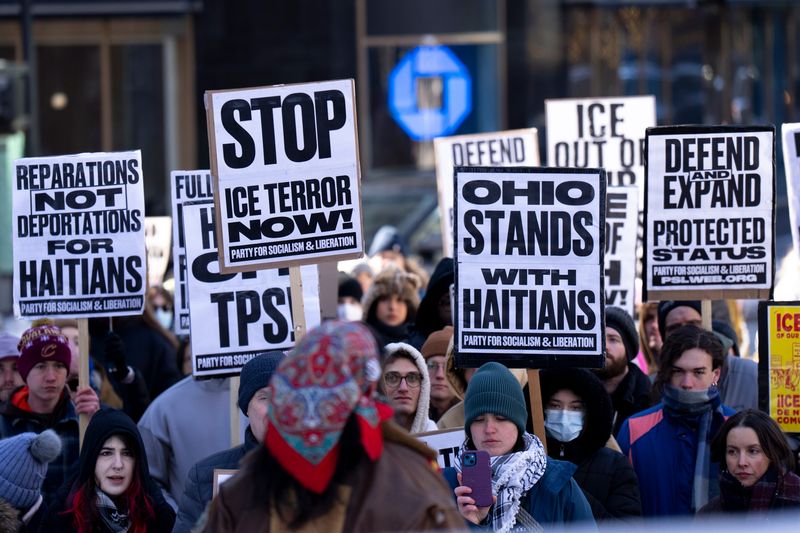
Ending Temporary Protected Status for Haitians is a mistake − not only for Springfield, but for Ohio’s working communities, including Cincinnati and Southwest Ohio.
The U.S. Supreme Court’s recent decision in Mullin v. Doe allows the Trump administration to move forward with ending Temporary Protected Status for more than 330,000 Haitians and about 6,000 Syrians. For many people, that may sound like another faraway immigration fight in Washington. But the consequences will be felt in Cincinnati, Dayton, Springfield, Hamilton, Middletown and communities along the I-75 corridor.

TPS is not citizenship. It is not a green card. It is temporary humanitarian protection for people already in the United States when conditions in their home country make return unsafe due to war, disaster, or extraordinary instability.
And in Haiti, unsafe is not a legal technicality. Haiti has faced earthquakes, political collapse, gang violence, kidnappings, hunger and a humanitarian crisis that has made ordinary life dangerous for millions of people.
Many Haitian TPS holders did exactly what we say we want immigrants to do. They came forward. They registered with the government. They passed background checks. They paid fees. They received work permits. They went to work.
They did not hide. They followed the rules the United States gave them.
The ripple effect across our communities
That is why Gov. DeWine’s response to the Supreme Court ruling matters. He did not talk about this like an abstract culture-war issue. He talked about it as a governor considering the real-world consequences for Ohio.
DeWine said more than 10,000 Haitians who had been living legally in Ohio, mostly in the Springfield area, could now be treated as unlawfully present and subject to deportation. He also made the practical point that people who were working and contributing to Ohio communities yesterday may now be illegal for employers to hire today.
That is not a small legal adjustment. That is a shock to families, employers and local economies.
The Ohio Capital Journal reported that about 30,000 Haitians with temporary status live in Central Ohio and that an estimated 12,000 to 15,000 Haitians live in Springfield, with a mix of TPS, citizenship and other legal statuses. Springfield city officials say Haitian immigrants there are legally present, many through humanitarian parole and later eligibility for TPS.
Those numbers should not be used to scare people. They should be used to plan.
Cincinnati should pay attention because Springfield is not some distant place. It is part of the same regional economy that connects Cincinnati, Dayton, Columbus and communities along I-75. Workers, employers, families, churches, hospitals, warehouses, restaurants, staffing agencies and supply chains do not stop at city limits.
The Cincinnati region depends on workers who show up in health care, logistics, manufacturing, construction, food service, hospitality, elder care, small business and transportation. According to USAFacts, immigrants made up 7.6% of employed workers in the Cincinnati metro area in 2024. Policy Matters Ohio has reported that immigrants made up 6% of Ohio workers and 10% of Ohio business owners in 2022.
Springfield has shown what happens when rapid population growth brings real strain: housing pressure, school pressure, language barriers, clinic demand, employers needing workers and local officials trying to catch up.
Those are serious problems. They deserve serious help.
But ending TPS will not fix them. It will make them worse.
According to FWD.us, Haitian TPS holders contribute an estimated $5.9 billion to the U.S. economy each year and pay about $805 million in federal and payroll taxes and $755 million in state and local taxes. FWD.us also estimates that Haitian TPS holders in Ohio contribute about $160 million annually to the state economy, including $18 million in federal and payroll taxes and $21 million in state and local taxes.
That is rent, groceries, car payments, church donations, school supplies, payroll taxes, customers for local stores and workers on the schedule.
Ending TPS does not make people vanish. It does not make Haiti safe. It does not magically create new workers for Ohio employers. It simply takes people who were working legally and pushes them into crisis.
Employers lose workers. Families lose income. Children lose stability. Churches and nonprofits get asked to do more. Local governments face more confusion. Taxpayers help pay for arrests, detention, immigration court, deportation flights and emergency social strain. At the same time, the government loses tax revenue from people it pushed out of the legal workforce.
A better path forward
Some supporters of ending TPS say the program was meant to be temporary. They are right about the word. But temporary should not mean disposable.
Congress should create an earned path to stability for long-term TPS holders who passed background checks, paid taxes, obeyed the law and built their lives here. Not automatic citizenship. Not a blank check. A serious, lawful process for people who have already shown they are contributing.
Cincinnati needs workers. Ohio employers need stability. Local governments need planning. Haitian families need safety. None of that is served by stripping legal status from people who came forward, followed the rules and went to work.
The Supreme Court may have answered a legal question in Mullin v. Doe. It did not answer the practical one: What does Ohio gain by taking workers out of hospitals, restaurants, warehouses, construction sites, nursing homes, factories and small businesses, and then asking taxpayers to pay for the fallout?
Gov. DeWine understands the answer.
Ohio gains nothing.
Richard T. Herman is the founder of Herman Legal Group, an Ohio-based immigration law firm that has represented international students, researchers, physicians, entrepreneurs, universities, employers, and families for more than 30 years.
This article originally appeared on Cincinnati Enquirer: Ending Haitian TPS creates more problems than it solves | Opinion
Reporting by Richard T. Herman, Opinion contributor / Cincinnati Enquirer
USA TODAY Network via Reuters Connect



By Richard T. Herman, Opinion contributor | USA TODAY Network