Editor’s Note: Jack Becker is the editor of Caprock Chronicles and is a Librarian Emeritus from Texas Tech University. He can be reached at jack.becker@ttu.edu. Today’s article is the sixth of an extended monthly series about Route 66 by Lubbock attorney Chuck Lanehart and Lubbock photographer Mark Umstot.
The road didn’t cut through the land like that interstate. It moved with the land, it rose, it fell, it curved. Cars didn’t drive on it to make great time. They drove on it to have a great time. –Sally Carrera (“Cars” character)

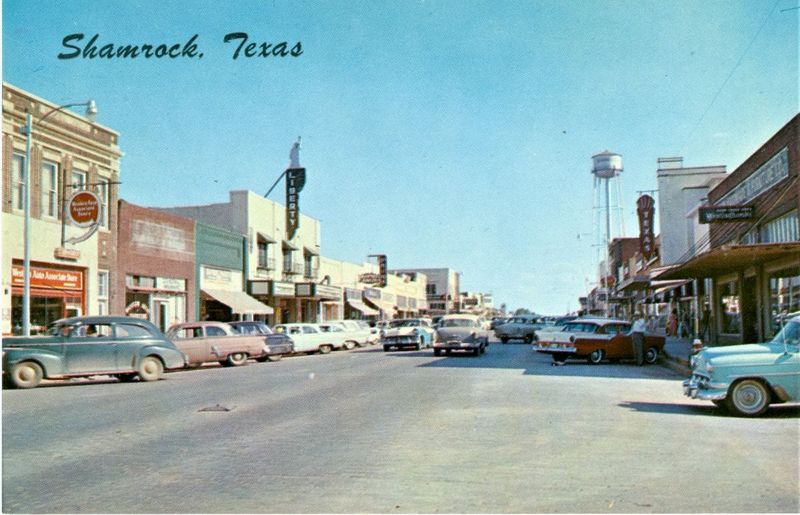
For motorists traveling west on Route 66, the first Texas stop was the city of Shamrock, Wheeler County, just 15 miles past the Oklahoma border.
The lucky name was suggested in 1890 by a sheep rancher of Irish heritage, George Nickel, when he applied to open a post office at his dugout home.
Nickel’s post office never materialized, but with the arrival of the railroad six miles south in 1902, the village of Shamrock was born.
The little hamlet prospered, surpassing 1,000 residents by 1920. Then Route 66 arrived, and combined with nearby oil and natural gas discoveries, the town’s population exploded to more than 3,000 within a decade.
The Mother Road stretched across 16 blocks in north Shamrock, quickly attracting tourist courts, cafés, garages, filling stations, and gift shops.
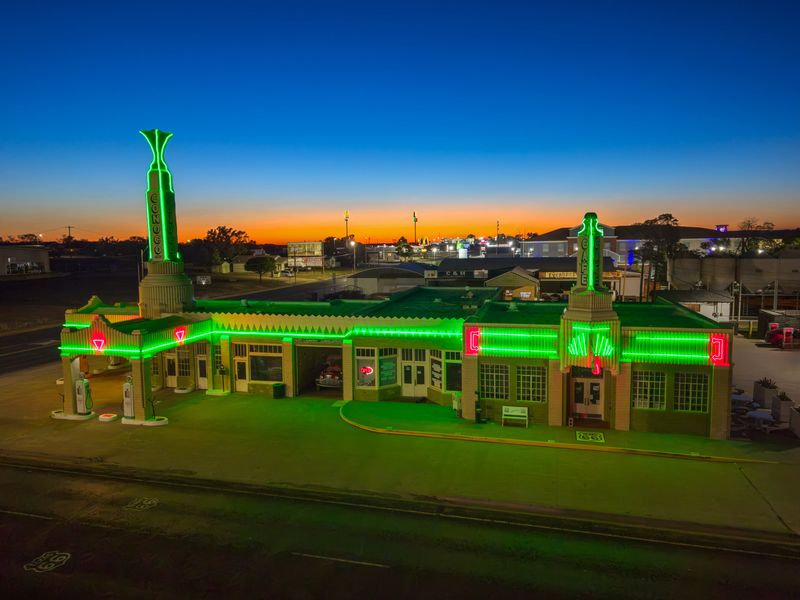
On the west side of town, Shamrock’s most famous landmark rises like a neon beacon: the magnificent Tower Station and U-Drop-Inn Café. According to legend, John Nunn stood across the highway in the parking lot of the Crossroads Motor Court and used a rusty nail to scratch out the design of the building.
Developers John Tindall and R.C. Lewis hired Pampa architect R.C. Barry to complete Nunn’s plan. The resulting Art Deco-style building featured two flared towers with geometric detailing, curvilinear massing, glazed ceramic tile walls, and neon light accents.
In 1936, the $29,000 Tower Station opened for business as a service station. The adjacent café needed a name, and a local boy won a $50 prize for suggesting the “U-Drop-Inn.”
The complex was promoted as “the most up-to-date edifice of its kind on US Highway 66 between Oklahoma City and Amarillo,” and the local newspaper dubbed the café, “the swankiest of swank places to eat.”
The Tower Station was the inspiration for the fictional Ramone’s House of Body Art in the 2006 animated Disney film, “Cars.”
Places like Shamrock weren’t simply stops along the highway. For many travelers, they became part of the memory of the trip itself.
The Tower Station/U-Drop-Inn enterprise shuffled through several operators over the years and suffered a decline after Interstate 40 bypassed Shamrock, but the building has been preserved, maintaining its iconic status.
The service station is now the Shamrock Chamber of Commerce and Visitor Center. Antique inoperable gas pumps still stand outside.
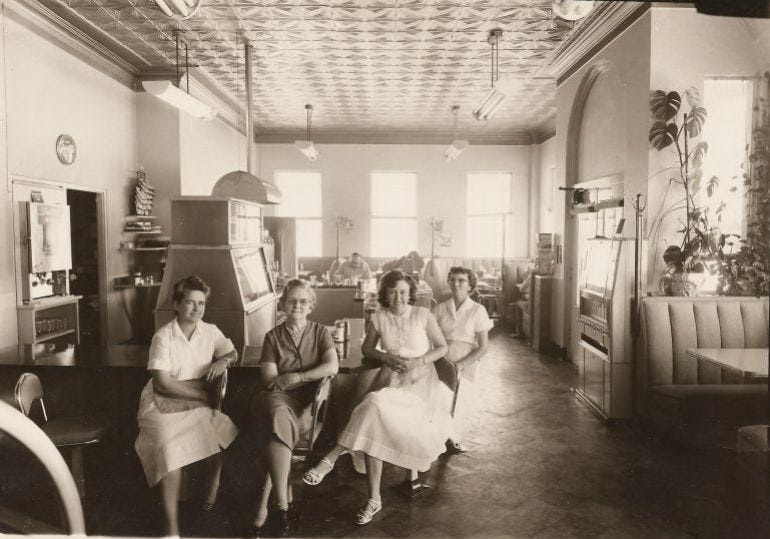
Next door, the café—featuring charming midcentury décor—offers soft drinks, shakes and floats, pastries and sandwiches.
In 1997, Tower Station was included in the National Register of Historic Places. The Texas Historical Commission called the structure “one of the most impressive examples” of Route 66 architecture.
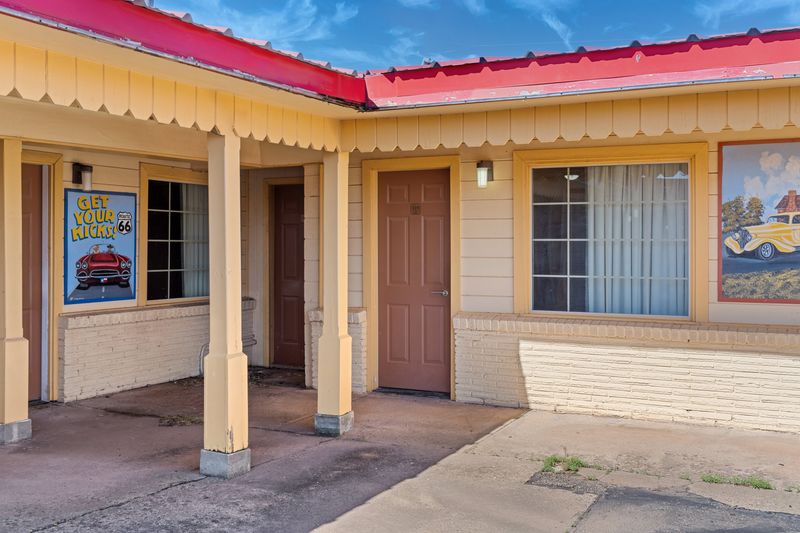
Shamrock’s Motel Row along Route 66 once featured a dozen big neon signs, and many other Shamrock businesses were established to accommodate Route 66 travelers, according to the 2013 book “Route 66 in Texas,” by Joe Sonderman. Among them:
Many Shamrock businesses spawned by Route 66 closed or moved when Interstate 40 bypassed Shamrock to the north in 1973, and the population has declined to about 1700 residents.
Six miles west of Shamrock, Route 66 travelers reached a village established in 1902 as Story.
The Wheeler County community became known as Lela, named after the postmaster’s sister-in-law. Lela served as a station for the Chicago, Rock Island and Gulf Railway, supported the surrounding farming and ranching region, and soon boasted a newspaper and a school.
When Route 66 was established through Lela in 1926, a couple of gas station/general stores were built, and the area found renewed prosperity with the discovery of natural gas nearby.
By 1947, only 50 residents populated Lela, a town with an elementary school, a church and four businesses. In the 1970s, the post office closed, and in the 1990s, the Lela school closed. The place is now a virtual ghost town.
The last and final “Reptile Ranch” was once located in a service station at Lela. It was one of several similar attractions operated by Mike Allred, a carnival-like character who once displayed snake attractions all along Route 66.
Part seven of this extended series, “McLean, the Friendly Uplift Town, and Alanreed” will be published next month.
This article originally appeared on Lubbock Avalanche-Journal: Caprock Chronicles Kicks on Route 66, Texas Panhandle highlights
Reporting by By Chuck Lanehart and Mark Umstot , special for the Avalanche-Journal / Lubbock Avalanche-Journal
USA TODAY Network via Reuters Connect
By Chuck Lanehart and Mark Umstot , special for the Avalanche-Journal | USA TODAY Network