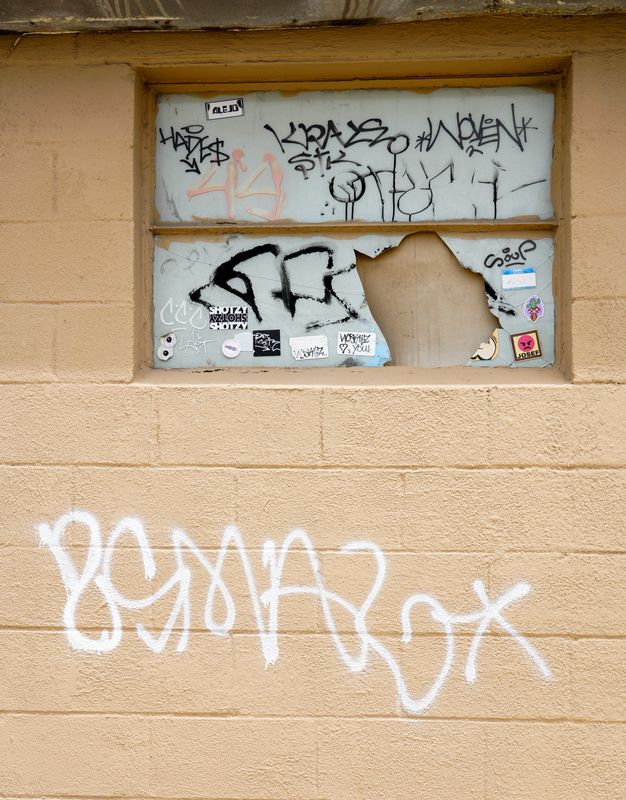
Mike Unger says he’s painted over the graffiti on his Cincinnati warehouse 100 times in the last five years.

Rory Benson says a contractor quoted him $18,000 to cover the graffiti on his five-story building in a different part of town.
Both were surprised to learn the city expects them – private property owners hit by graffiti taggers – to cover the costs along with the graffiti.
That’s been policy since 2024, when the city stopped removing graffiti from privately owned buildings – and began sending people like Unger and Benson violation notices ordering them to do that themselves in 30 days or absorb the city’s cost to handle it.
Now the city’s approach to graffiti could change again, with Cincinnati City Council giving victims of graffiti a break and considering ways take taggers to task.
Clean up a costly, constant effort
Unger, president of a distribution business in Cincinnati’s Northside neighborhood, wrote every City Council member along with Mayor Aftab Pureval when his latest “notice of graffiti violation” arrived in April.
Covering graffiti “has become a constant clean-up effort,” he told them, noting that repainted surfaces just provide “a new canvas” for taggers and cost him “$$$$.”
“It’s not people expressing art,” he said when The Enquirer visited. “It’s vandals.”
Council member Mark Jeffreys visited, too – and left with three ideas to seed what he hopes will be a comprehensive solution to graffiti.
His motion, passed by the full council June 17, provided “victim amnesty” for property owners hit by graffiti, pausing enforcement of violations.
Two other ideas will require further action by the city. One called for a “taggers restore it” law to make graffiti artists remove their own work. The other suggested policing options like cameras or drones to catch taggers in action.
The city didn’t get it right in 2024, Jeffreys said.
“We are essentially victimizing the victim,” he said. “It’s just not fair.”
‘You spray, you pay’ among possible solutions
Benson, whose building sits in Cincinnati’s West End neighborhood, likes the idea of taggers removing their own graffiti. He’d like that to happen quickly, he said, so they don’t get the thrill of seeing their work on buildings in high-traffic areas, like his along Interstate 75 at York Street and Winchell Avenue.
But taggers would need training and supervision to use equipment like power washers and boom lifts to remove their work, Benson said. “The city has to have some level of involvement,” he said.
He’s a bit more skeptical about employing cameras or drones to catch taggers. They mostly work in the dark of night and dress to avoid detection, he said.
Unger, the Northside business owner, favors a “you spray, you pay” approach, holding taggers responsible financially and under the law.
Then, he’d like the city to publicize that approach so would-be taggers know “you are going to jail and you are going to pay.”
Under city code, tagging a building without consent is a first-degree misdemeanor, punishable with a fine of up to $1,000 and jail time of 180 days.
At the state level, taggers can be charged under vandalism, criminal damaging or criminal mischief laws. If found guilty at the felony level, the maximum punishment is a fine as high as $10,000 with three years in jail.
Elsewhere, some less bothered by graffiti
Not everyone is as irked about Cincinnati’s graffiti.
Down the block from Unger, Matthew Strausbaugh, owner of Northside’s Strausbaugh Construction Services, said his building hasn’t been tagged in about a decade.
Taggers gave up, he said, because he painted over their work. “Spray paint’s not cheap,” he said. “If you paint over it, you win the battle.”
At the nearby Northside Yacht Club, taggers have left their mark on the restaurant’s exterior just a couple of times in Molly Bee’s six years on staff. “We’ve never really had a tagging problem,” the manager said.
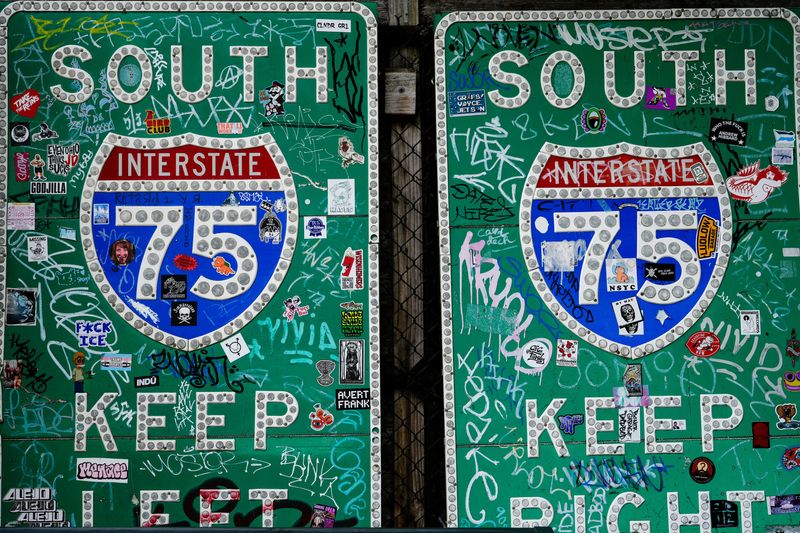
That might be because taggers add their work to bathrooms and three highway signs near an entrance instead. “We just don’t bother people about it,” Bee said.
In Cincinnati’s CUF neighborhoods – Clifton Heights, University Heights and Fairview – about 80 homeowners removed graffiti after the 2024 change in city policy, Nathan Hess, president of the CUF Neighborhood Association, told City Council members. “Having homeowners or property owners responsible for cleaning up was very effective for us,” he said.
In some neighborhoods, tags get attention as art. “Color coordinated,” a Facebook post of last fall proclaimed about an expanse of graffiti near downtown.
Can graffiti be embraced as public art?
Cities across the country have long grappled with graffiti.
From Philadelphia to Los Angeles, a number have adopted “you tag it, you clean it” programs. Some sentence taggers with other community service work.
Cincinnati could leverage its reputation for public art – like the large mural projects installed by 1001 Colors, formerly known as ArtWorks – to create sanctioned areas for taggers, said Heidi McAuliffe, senior vice president of government affairs for the American Coatings Association, a trade group for paint makers.
The city of Covington created a designated area for graffiti on a floodwall along the Licking River in 2014. Covington community liaison Chris Brown said the project reduced tagging in other areas of the city, but that the site is currently out of commission due to construction of a new Licking River Bridge. When construction is complete, the area will reopen to the public.
“It really helps to cut down on graffiti when a community embraces a piece of public art like that,” McAuliffe said.
Some cities have taken that approach on buildings that are frequently tagged. Some invite local artists to participate or hold contests to pick painters.
Most cities consider illegal graffiti as negative social behavior that needs to be removed, McAuliffe said. “Leaving it there is a bad idea because it kind of generates and sort of promotes additional negative social behaviors. And that’s never a good thing.”
Cincinnati’s current “graffiti abatement program,” in addition to requiring building owners to cover the cost of graffiti removal, advises them to use lighting, fencing and security cameras to discourage tagging. The city also encourages residents to report graffiti by calling 311, its service line.
City asked to identify more solutions by fall
Mark Jeffreys has four children. If any tagged a building, he said, he’d tell them “You scrub it off.”
Other City Council members endorsed his plan to attack graffiti.
During a meeting of council’s Public Safety & Quality of Life Committee, Scotty Johnson said graffiti disrespects building owners. Jan-Michele Lemon Kearney said the current policy is “a lot to ask” of them. Evan Nolan floated the idea of legal tagging zones.
Jeff Cramerding supported the measure, too, but said owners who neglect their buildings should not be eligible for amnesty on violation notices.
As part of his motion, Jeffreys asked city administrators, within the next 60 days, to identify solutions to graffiti that “do not penalize the victim.”
That will be in late August, after council returns from its summer break.
This article originally appeared on Cincinnati Enquirer: Legal graffiti zones? Jail? Cincinnati ponders how to fight graffiti
Reporting by Patricia Gallagher Newberry and Mia Hilkowitz, Cincinnati Enquirer / Cincinnati Enquirer
USA TODAY Network via Reuters Connect




By Patricia Gallagher Newberry and Mia Hilkowitz, Cincinnati Enquirer | USA TODAY Network