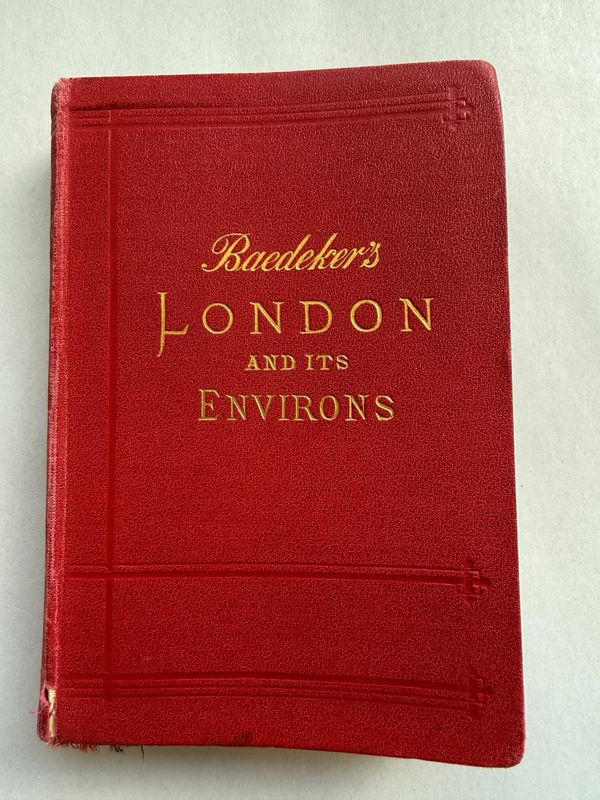
As retirement looms these days, I’m getting asked a lot what I’m going to do thereafter. Beyond what I hope will be a quiet summer, I’m not entirely sure. What do people do when they retire? Play golf? Nah. Chase the grandkids around? Unappealing … and besides, we don’t have grandkids. Travel? That used to sound good, but in these days of long lines, high prices and global hostility, it might be better just to stay home and watch the Travel Channel. All the same, we recently received at the gallery several antique Baedeker’s travel guides, and those are great reminders of what travel used to be. Let’s open one up.
To start with, Baedeker guides go back a lot longer than I knew. The Baedeker clan had already been publishers for generations when Karl Baedeker (1801-1859) broke away from the family business in 1827 to start his own firm. In that era, travel was slow, often hazardous and nearly impossible to plan in advance. Printed guides to foreign ports were few and largely bereft of detail, thus requiring travelers to hire a local to show them around.

In the early 1830s, Karl took an existing guide to the Rhineland and substantially enlarged it with everything he thought a foreign traveler should know, including hospitality options, sights to see and even pricing tips. He patterned his initial volume on the famous Murray Handbooks, first published in London in 1836 and designed for those intent on undertaking the Grand Tour. Some 75 different Murray Handbooks were eventually published, covering much of Europe, Asia and the Middle East. Murray was a contemporary of Baedeker, and the two were in direct competition for decades.
Over the ensuing 20 years, the popularity of Baedeker’s travel guide grew along with his firm. He was the first to introduce the “star system” of marking must-see sites with an asterisk, and he traveled widely to see for himself what sites were worthy of highlighting.
When Baedeker died in 1851, his son Ernst took over the business and added several new titles, including an English translation of his original guide and another about Italy. Ten years later when Ernst passed away, another son (Karl II) stepped in and added an additional 14 titles in three different languages. When a third son (Fritz) joined the firm in 1869, its growth increased exponentially. Fritz moved the firm from Koblenz to Leipzig, Germany’s publishing center at that time, and engaged the firm of Wagner and Debes to create the highly ornamented maps that became Baedeker hallmarks. During his 50 years at the helm, Fritz released 73 new travel guides in three languages. It was during the Fritz era that the Baedeker name became synonymous with travel guides.
Unfortunately, the 20th century was not so kind to the Baedeker firm as was the one before. Now run by Karl’s grandson Hans, the company’s fortunes declined as a result of poor investments, rising inflation and a lingering hostility to anything German following World War I. The Great Depression didn’t help either, nor did the rise of Nazi Germany and the advent of World War II.
In December of 1943, the company’s headquarters building with more than a century of archives was completely destroyed in a RAF bombing raid. Following the war, a few more Baedeker’s guides were published but the firm was now in the East German zone and the authorities there were concerned about the degree of detail the guides were providing. At least 90% of one book was confiscated by Russian officials following its review.
Today, Baedeker guidebooks are the stuff of historical interest and collector enthusiasm. Most volumes like the ones you’ll find at our gallery and elsewhere are small and covered in red leather. They all include a variety of maps and plans, and some even feature a street index. Their detail is truly remarkable; the London guide alone is more than 460 pages. There are sections on hotels, restaurants, libraries, shops, various modes of transportation, telegraph offices, topography, history, clubs, embassies and even a bibliography of other books. Our volume is the 14th edition dated 1905, and it provides a fascinating window to London life at the turn of the 20th century.
Other than a few rare or politically significant titles — e.g., the book on Russia just before the Russian Revolution — nearly all volumes can be bought for $100 or less. For bibliophiles, travel buffs and those with European roots, they make for great fireside reading.
Mike Rivkin and his wife, Linda, are long-time residents of Rancho Mirage. For many years, he was an award-winning catalogue publisher and has authored seven books, along with countless articles. Now, he’s the owner of Antique Galleries of Palm Springs. His antiques column appears Sundays in The Desert Sun. Want to send Mike a question about antiques? Drop him a line at silverfishpress@gmail.com.
This article originally appeared on Palm Springs Desert Sun: Baedeker’s guides show the world as it was
Reporting by Mike Rivkin, Special to The Desert Sun / Palm Springs Desert Sun
USA TODAY Network via Reuters Connect
By Mike Rivkin, Special to The Desert Sun | USA TODAY Network