There’s a banner inside The Alamo in downtown Springfield that reads, “Temporarily an Irish bar,” for its proximity to the annual St. Patrick’s Day parade path.
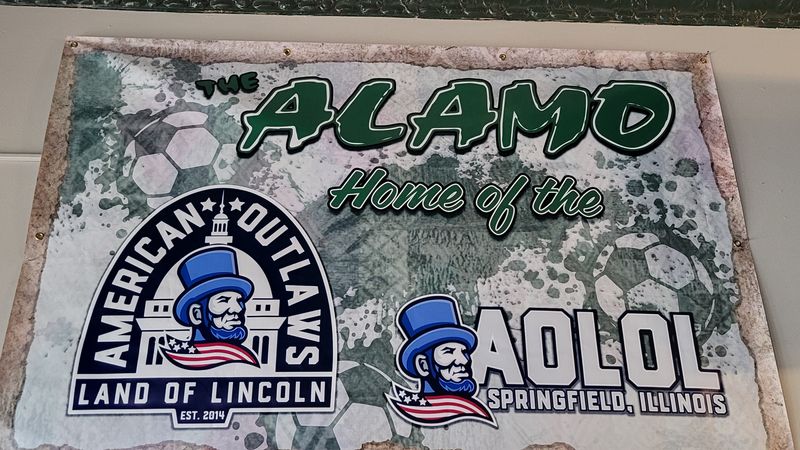
But when the U.S. soccer teams are playing, it’s the permanent home of the American Outlaws’ Land of Lincoln chapter’s watch parties since 2014.

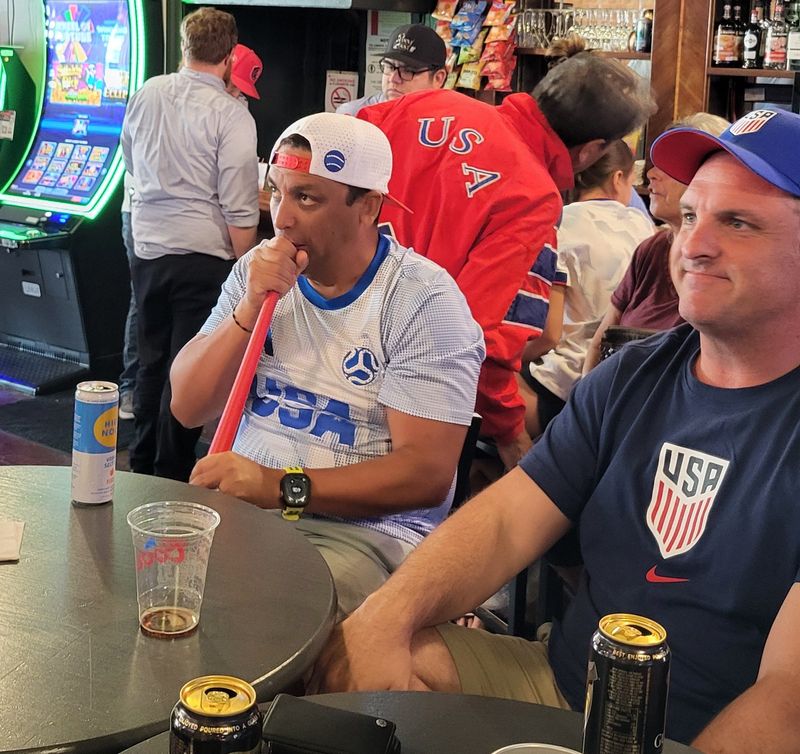
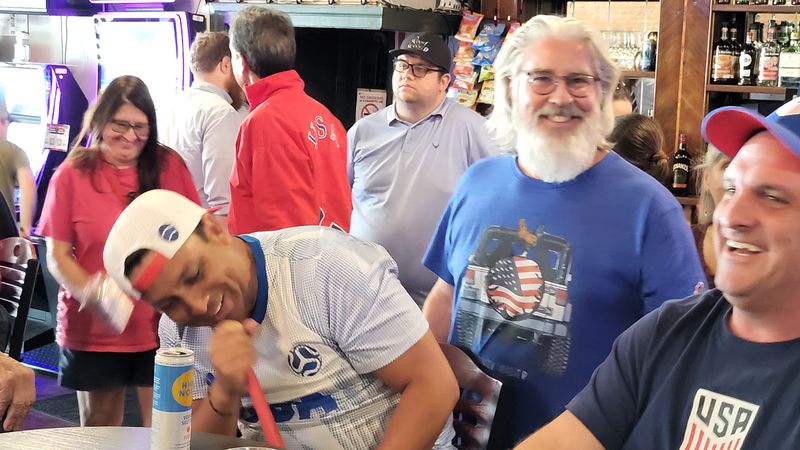
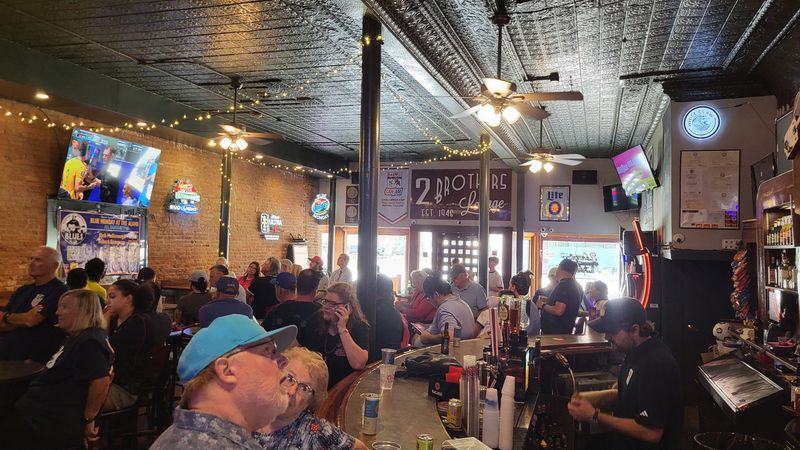
Inside the high-ceilinged, venerable bar on Friday, June 19, soccer fans young and old packed every seat with others standing for the entire match as the U.S. Men beat Australia 2-0 in group play of the 2026 World Cup. Jose Jimenez, 43, blew into his vuvuzela — a holdover relic from the 2010 World Cup in South Africa — while Tom Bundy beat his bass drum to stir the crowd into “U-S-A” chants.
Even outside, it was difficult to maneuver through the throngs of fans in the beer garden. Owner Barry Friedman purchased a second TV for the outside customers, and even though the game began in the early afternoon, the four bartenders working often had their hands full.
Friedman said the idea to become the official watch party host of U.S. soccer — both men and women, he added — came out of talks with himself, his nephew Zach Rambach and former Illinois House representative Tim Butler in advance of the 2014 World Cup.
“This year it’s crazy,” Friedman said. “Every bar’s got a watch party, everybody’s got a watch party. Back then (in 2014), it was just hardcore soccer fans who really watched it.
“It just kept building and building and building. And then we joined the American Outlaws. We’re the only chapter in Springfield.”
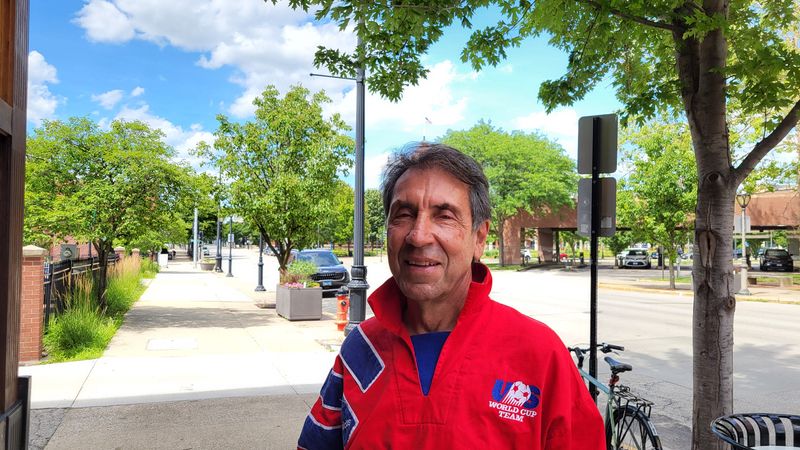
Bundy, who still plays soccer at 70 and will be traveling to an over-70 tournament in Burlington, Vermont, next month, said he’s seen American soccer slowly, but steadily, grow in popularity. When asked if the U.S. team needed to get to the semifinals or beyond to help the sport reach a fever pitch in America, Bundy said he wasn’t sure about that, but that he’s confident it has plenty of room to keep growing.
“That’s the one everybody wants the answer to,” Bundy said. “When Pelé came (in 1975), that was the big influx, biggest star in the world coming to play for our New York Cosmos. Has there been a wave since that? Being the optimist, I would say yes; but has it crested? By no means.”
‘We actually have talent’
Chicago’s Dirk Klemm, on the day before his 59th birthday, was traveling to Kansas City for Saturday’s World Cup match between Ecuador and Curacao. He stopped in Springfield to watch the US victory. Klemm is a lifelong soccer fan and an American Outlaws member in Chicago. Klemm, born to German parents, said he came by his soccer fandom from an early age.
The last time the U.S. Men’s National Team played in the World Cup on home soil was 1994. The team went 1-1-1 in group play and advanced to the knockout rounds before a loss to eventual champion Brazil in the first round.
Klemm said the difference between U.S. soccer now and then is vast.
“Oh, the team’s completely different,” Klemm said. “We actually possess the ball. We actually play like we deserve to be there, as opposed to in ‘94 where we were defending and counter; (back then) we were playing like Australia (did Friday), right? Trying to counter. We won on hustle.
“We’re actually winning (now) because we actually have talent.”
Jimenez said the culture around soccer in America has drastically changed since he moved here from Bolivia in 1999. In the 22 years that have passed between North American hosting the World Cup, American excitement around soccer has swelled, Jimenez thinks.
“This year, it’s different,” Jimenez said. “When you see Boston, like the Scottish are going over there, it’s more than the game: it’s the atmosphere, what happens before, what happens after the game.”
Klemm, who played soccer at Northwestern University, said he’s seen the demographics of the fans change as well.
“After ‘94 and everything with the MLS, there’s absolutely much more of a culture of soccer within the States. It’s still not No. 1, but it definitely exists whereas in the ‘80s, it didn’t exist. It was basically all the foreigners.
“My parents are first-generation German. I was born here, spoke German first because my parents didn’t speak English. It was basically all immigrants that rooted for the U.S. in the ‘94. Now it’s actually homegrown fans that are rooting for the U.S.”
Soccer can unify
It’s also a unifying experience, Friedman said. When baseball fans gather to watch a Cubs vs. Cardinals game at The Alamo, Friedman can expect about half the crowd to root for one team and half the crowd to root for the other. There can be playful banter and maybe even some rivalrous taunting, but U.S. soccer fans are there to root on the home country.
Friedman noticed that when the U.S. men’s hockey team beat Canada 2-1 in overtime to win the Winter Olympics gold medal in February and he’s seeing the same fervor again.
“When the United States beat Canada in the Olympics, it was 7 a.m., and we had a huge crowd in here chanting. And when they won, it was the most explosive thing.
“And I see that with this crowd: you see when they score, or almost score, or get a shot on goal, people are going crazy. And it’s fun when they’re all cheering for the same thing because nobody’s fighting over, ‘The Cubs are better; the Cardinals are better’ and all that. It’s kind of awesome.”
Jimenez added that gathering for these soccer matches is a politics-free zone where everyone wants one thing: a United States victory.
“I think it unifies people,,” Jimenez said. “… You just come watch a game, have fun (and) relax.”
Jimenez said it’s also been an experience for people coming to visit America for the first time.
“You’re watching other countries do their own thing; everybody’s very proud of where they come from. That’s the main thing: it’s more than the game. Obviously, winning helps, but it’s more than that.
“A lot of people from the U.K. are coming, and Europe, and they’re like, ‘Oh, the U.S. is amazing; I’m trying barbecue for the first time,’ they went to Bass Pro (Shops). That’s for them coming here, and for us, it’s like all these people are just having a good time, relaxing, drinking, enjoying people. That’s what the World Cup is all about.”
Contact Ryan Mahan: 788-1546, ryan.mahan@sj-r.com, Twitter.com/RyanMahanSJR.
This article originally appeared on State Journal-Register: Outlaws in a bar? It’s OK: they’re just watching US soccer at The Alamo
Reporting by Ryan Mahan, Springfield State Journal-Register / State Journal-Register
USA TODAY Network via Reuters Connect
By Ryan Mahan, Springfield State Journal-Register | USA TODAY Network