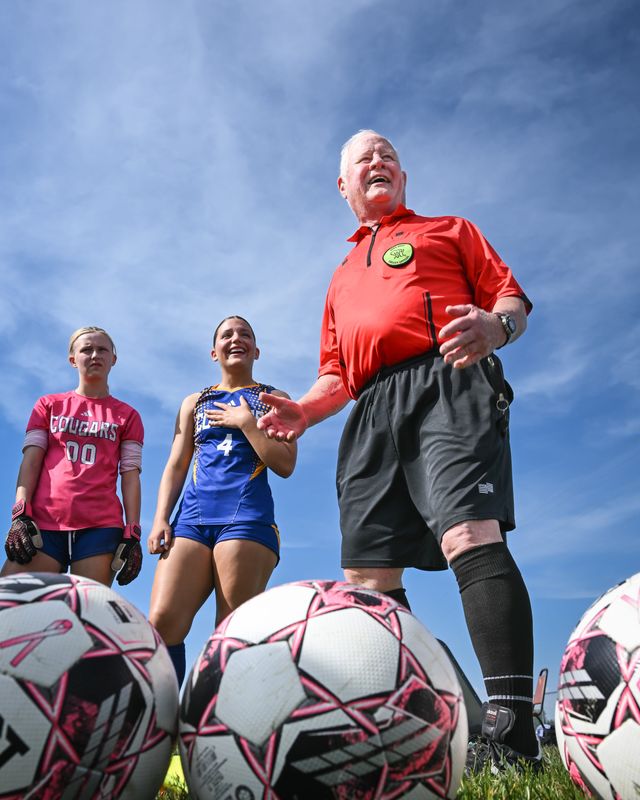
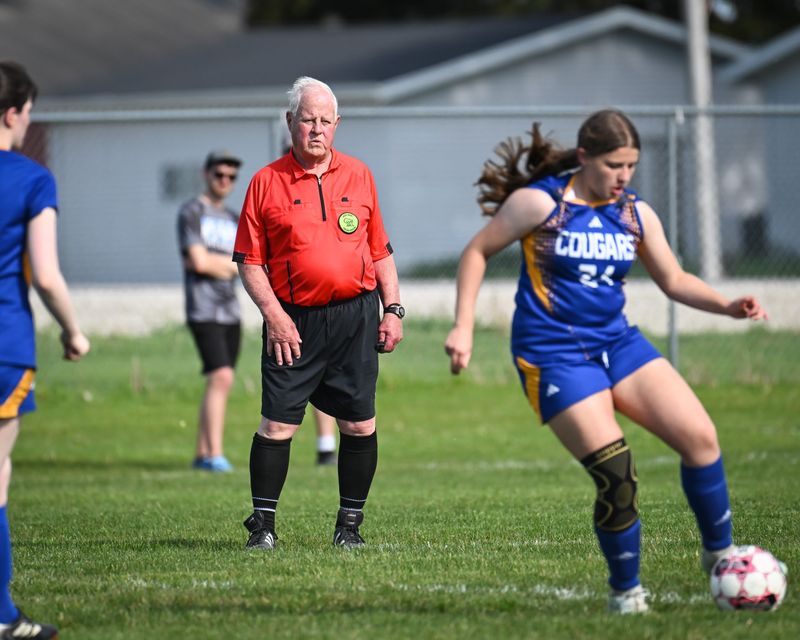
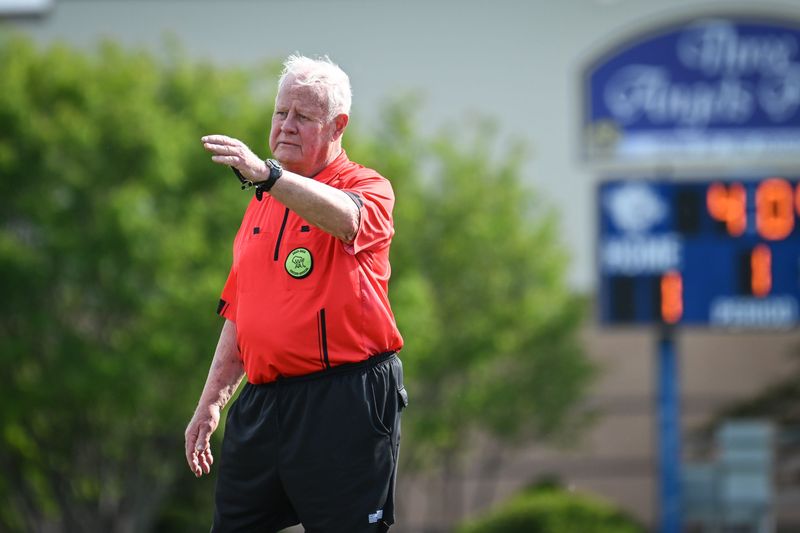
When John Roever stepped onto the Breese Stevens Field pitch in Madison, he felt as though he’d arrived.
A curious soccer dad drafted into officiating by necessity, he would be reffing a WIAA state tournament match for the first time.

Roever would love to tell you exactly when that was. He’d also like to be able to run the way he did back then.
But at 80, the details of what happened four decades ago aren’t as sharp as they once were, and his legs aren’t as strong.
The long-retired high school principal from Slinger will retire once more May 28, hanging up his whistle – except in case of an emergency next season – after working the Port Washington vs. Ozaukee/Random Lake girls match.
Thousands of high school games, endless miles of travel and post-match dinners with longtime partners – not to mention the players, coaches and fans – all touched Roever’s spirit over the years.
They’ve left him with innumerable stories and in one case with a scar over his right eye.
“Hartford High School, back in the late ‘80s, I think it was, we used to play on their back field,” Roever recalled before a match May 26. “They had two big soccer pitches in the back, but there were always golf balls around because the neighbors would come and that’s where they would do their practice.
“Well, some kid who was disgruntled because he had gotten disciplined and couldn’t play that night picked up a golf ball towards the end of the game and threw it high into the air, hoping to hit the coach. But it got me.”
That’s probably the low moment among the many highs for Roever, who got pulled into officiating while asking questions as his children played in the late 1970s. He became a WIAA official in 1983 and also spent some time as an assistant coach for youth teams at a time when the sport was beginning its upward trajectory in Wisconsin.
“When high school soccer really got started, it needed an awful lot of people refereeing who saw more than just the game, who saw sportsmanship should be part of it,” Roever said. “Winning’s important. But sportsmanship is equally important. And it took a while to help get that through.
“That’s what I was doing. You had to teach the kids, you had to teach the coaches. You had to teach the fans.”
Other than the stray golf ball, Roever said he didn’t recall significant issues with players over the years. He learned to shake off chatter from the crowd, which Roever understood, given he wasn’t always on his best behavior as a youth sports parent. As for the coaches, his experience as an educator and administrator came in handy.
“When sometimes coaches lose it, I remind them after the game that how you model your behavior is how the kids are going to behave,” Roever said. “And if you’re complaining about everything, most of which is not important … that’s what happens. They get all hung up on stuff that isn’t important to the real essence of the game.”
Roever got a reminder of what’s important in life in 2004, when he developed colon cancer that led to his retirement from the Slinger School District. Interestingly, during treatment he found out just where soccer fit on the continuum.
“At that time, the therapy for colon cancer was 56 straight hours [of chemotherapy], some in the clinic, some at home,” he said. “You wore this belt that fed into a port.
“I actually did a couple of not real important games. I was bored. And I wanted to get involved.”
Roever developed close friendships and learned from his long partnerships on the field, although the groupings have evolved.
First came Terry Huth, who he’d known from Wauwatosa West. Huth was instrumental in the expansion of high school soccer and gave Roever instant credibility in the 10 years or so they worked games together. After Huth died, Roever connected with Jim Siever, who he’s been with for about 25 years.
The third member of their crew was Ron Held, an assistant athletic director from West Bend who officiated numerous sports, although he died as well. So for the past several seasons Roever and Siever have worked with Tom Platner, “our new character,” who is the U-70 member of their gray-haired officiating trio.
“The point I would pitch … is we are in such desperate need for young soccer players to come and get trained as officials,” Roever said.
In their younger days, Roever and his crew would schedule multiple doubleheaders per week in the fall for boys and then the spring for girls, meaning they’d do about 80 games a year all across southeast Wisconsin. He has cut his workload and is doing matches involving smaller programs rather than the high-speed, high-pressure Division 1 matches he once did.
“I still do it because I’ve enjoyed it,” he said. “It’s been rewarding. I’m going to miss the kids.”
Roever won’t be stepping away from the game entirely, as he’ll have more time to follow his grandchildren’s matches.
But he will be stepping away from regular contact with some of the friends he has seen regularly for years with whom he’s endured sweltering heat, freezing rain, howling wind and 40-some years of chirping from the sideline.
“If I didn’t have the regular partners, I doubt that I would have done this this long,” Roever said. “Not that I didn’t enjoy the game. But this made it much more enjoyable.
“We like each other, and so we’ll go out and have a few beverages and a burger tonight. And that’s all part of this, the social part of it.”
Roever admitted he’ll probably get misty, if not before kickoff for his final game or when the final horn sounds, then when he, his family, his partners and their families gather afterward.
“I don’t want to appear that way, but inside I am emotional,” Roever said. “We’ve got, like, 18 people going out for dinner after … celebrating the old man.”
And creating one more memory.
This article originally appeared on Milwaukee Journal Sentinel: After countless matches, miles and tales, Wisconsin soccer ref retiring at 80
Reporting by Dave Kallmann, Milwaukee Journal Sentinel / Milwaukee Journal Sentinel
USA TODAY Network via Reuters Connect