WEST LAFAYETTE, IN — Webbed feet point toward one another on the rough exterior of a fallen log as a female tree frog debates whether this is the male she wants.
The silky green female is crouched against the wood, barely noticeable to the human eye.

The male is engaged in his mating call. Sitting against the log with his back as straight as a frogs can be, he makes low noises with his throat, extending his skin into a translucent bubble.
Will the female allow the male to breed with her, or will she hop away? Only time will tell.
They are not the only pair to compete in this game. Across the ACRE Wetlands, part of the 290-acre Purdue Wildlife Area, hundreds of tree frogs are facing off as they wait for a breeding partner.
Tonight is different. The water, interrupted only when an animal moves, is now swaying, and the loud cracks of snapped sticks are alerting the frogs that they are not alone.
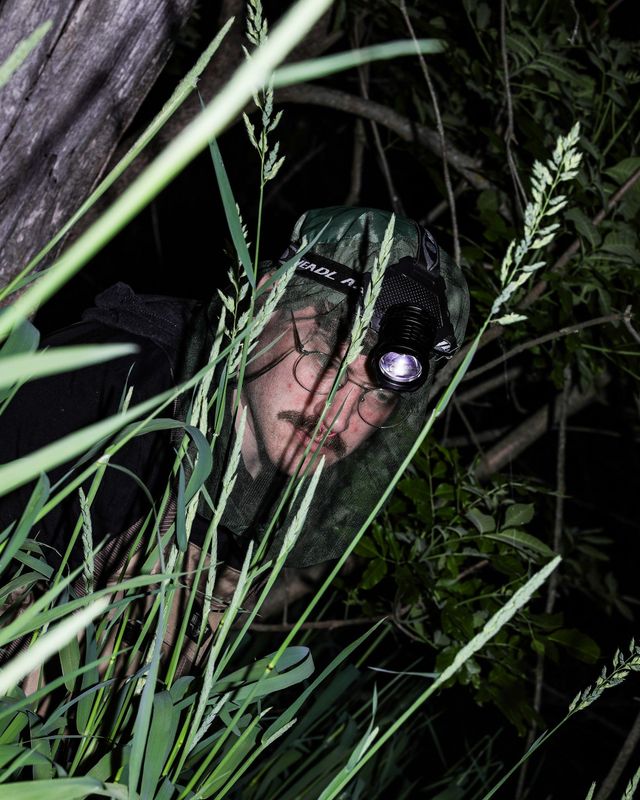
In their home, five Purdue University biologists are sloshing among them, unable to embody the grace with which the wetland creatures move.
With their chest waders keeping them dry, the biologists take one step at a time, hesitant to fall in the larvae-covered water. They are geared with head lamps and rain jackets and smell distinctly of bug spray, their attempt to keep away the insects drawn to their lights.
Their slow speed is not just to prevent an accident; their eyes must remain focused on any movement resembling a frog in the marshy habitat.
Specifically, the gray tree frog.
With buckets and nets in their hands, the graduate students, including Andrew Todd, are trying to observe “amplexed” pairs, or two frogs in the act of breeding.
The bigger female is below the male, exhausted from her attempts to evade the male’s advances. The male is holding down the female as he begins the reproductive process.
Once the biologists see these amplexed pairs, they easily capture them. The male is strapped to the female, and she is too tired to fight against the biologist’s net.
Once in the net, the pair is transferred to a bucket holding about 2 inches of water from the wetland.
Then the process continues.
On Saturday, the researchers caught four pairs. Sunday yielded five. The team needs only one more, but they finished with 15 plastic bins full of about 200 eggs each.
“We’re going to grab any pair that we see. … It’s better to grab more because we can always let them go if we come back and find that we have way too many,” said Todd, who was a rookie when it came to catching this specific type of frog. His research has normally revolved around other frog species.
This collection of amplexed pairs is a part of a bigger experiment. Purdue’s Wildlife Ecology Research Facility is using the gray tree frog eggs to see the effect that different polyfluoroalkyl substances, small chemicals that are extremely harmful to humans and wildlife, have on the natural environment.
“What Andrew’s project is basically doing is stepping back and focusing more on PFAS and trying to understand how additional stressors in the environment might respond to PFAS to influence behavior,” said Jason Hoverman, Purdue professor of vertebrate ecology and the head of the Hoverman Aquatic Community Ecology Lab, the site of Todd’s research.
Tadpoles are larval amphibians, or animals that are larvae when adolescents, which are often more vulnerable to environmental contaminants such as PFAS.
Once the collected fertilized eggs develop into tadpoles, their water is injected with five different amounts of PFAS, each growing higher but none that are lethal.
The experiment is set for researchers to observe the behavioral changes that could influence future ecological interactions, or how all animals in the food chain interact with one another daily.
“There’s a lot of information on how they respond to predators in the larval environment,” said Hoverman, who has been researching gray tree frogs since 1999 and is aware of what behaviors the tadpole should be following.
In past research in Hoverman’s lab, he observed that the main behavioral change that these PFAS had on the tadpoles was that they were more likely to seek refuge, or to run away once a predator approaches.
Previously, the lab used crayfish as their experimental predator. This year, they are using dragonfly larvae, which are killers of many types of aqueous creatures, or an animal that lives mostly in water.
“We are going to switch over to dragonfly larvae, because they are voracious predators,” Todd said as he explained the switch.
Once separated, the tadpoles are placed in small black troughs filled with the water injected with different PFAS levels. They are observed and fed food such as Purina Rabbit Complete pellets, which break down easily and help grow the algae the frogs eat.
Hoverman said he expects this research to continue until fall, when the tadpoles will be fully grown gray tree frogs and their behavioral differences can be easily tracked.
Hoverman and his lab still have a long journey of observation ahead. But they know the findings will be necessary.
“That’s one of the things we are trying to figure out. If you have these chemicals in the environment, in addition to all these biotic stressors,” Hoverman said, “how are they influencing the species that we have out in the environment?”
This article originally appeared on Lafayette Journal & Courier: Purdue scientists capture mating tree frogs to track effects of PFAS
Reporting by Ava Westendorf, Lafayette Journal & Courier / Lafayette Journal & Courier
USA TODAY Network via Reuters Connect